Summary

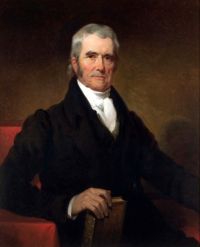
Portrait of John Marshall John Marshall Gibbons v. Ogden (22 U.S. 1) — Opinion of the Court (1824)

If commerce does not include navigation, the government of the Union has no direct power over that subject, and can make no law prescribing what shall constitute American vessels or requiring that they shall be navigated by American seamen. Yet this power has been exercised from the commencement of the government, has been exercised with the consent of all, and has been understood by all to be a commercial regulation. All America understands, and has uniformly understood, the word "commerce" to comprehend navigation.
Source: Wikisource

Portrait of John Marshall John Marshall Gibbons v. Ogden (22 U.S. 1) — Opinion of the Court (1824)

So, if a State, in passing laws on subjects acknowledged to be within its control, and with a view to those subjects, shall adopt a measure of the same character with one which Congress may adopt, it does not derive its authority from the particular power which has been granted, but from some other, which remains with the State and may be executed by the same means. All experience shows that the same measures, or measures scarcely distinguishable from each other, may flow from distinct powers, but this does not prove that the powers themselves are identical.
Source: Wikisource

Portrait of John Marshall John Marshall Gibbons v. Ogden (22 U.S. 1) — Opinion of the Court (1824)

It is a rule of construction acknowledged by all that the exceptions from a power mark its extent, for it would be absurd, as well as useless, to except from a granted power that which was not granted -- that which the words of the grant could not comprehend. If, then, there are in the Constitution plain exceptions from the power over navigation, plain inhibitions to the exercise of that power in a particular way, it is a proof that those who made these exceptions, and prescribed these inhibitions, understood the power to which they applied as being granted.
Source: Wikisource

Get perspective with Kwize: daily news enlightened by great literature