Summary

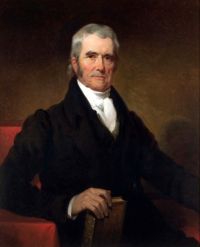
Portrait of John Marshall John Marshall McCulloch v. Maryland — Opinion of the Court

If any one proposition could command the universal assent of mankind, we might expect it would be this — that the Government of the Union, though limited in its powers, is supreme within its sphere of action. This would seem to result necessarily from its nature. It is the Government of all; its powers are delegated by all; it represents all, and acts for all. Though any one State may be willing to control its operations, no State is willing to allow others to control them. The nation, on those subjects on which it can act, must necessarily bind its component parts.
Source: Wikisource

Portrait of John Marshall John Marshall McCulloch v. Maryland — Opinion of the Court

We are not driven to the perplexing inquiry, so unfit for the judicial department, what degree of taxation is the legitimate use and what degree may amount to the abuse of the power. The attempt to use it on the means employed by the Government of the Union, in pursuance of the Constitution, is itself an abuse because it is the usurpation of a power which the people of a single State cannot give.
Source: Wikisource

Portrait of John Marshall John Marshall McCulloch v. Maryland — Opinion of the Court

The power of creating a corporation, though appertaining to sovereignty, is not, like the power of making war or levying taxes or of regulating commerce, a great substantive and independent power which cannot be implied as incidental to other powers or used as a means of executing them. It is never the end for which other powers are exercised, but a means by which other objects are accomplished. No contributions are made to charity for the sake of an incorporation, but a corporation is created to administer the charity
Source: Wikisource

Get perspective with Kwize: daily news enlightened by great literature