Philip Pendleton Barbour

Philip Pendleton Barbour

Summary

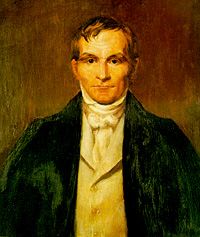
Portrait of Philip Pendleton Barbour Philip Pendleton Barbour New York v. Miln (36 U.S. 102)…

No subtlety of reasoning, no refinement of construction, or ingenuity of supposition, can make commerce embrace police or pauperism, which would not, by parity of reasoning, include the whole code of state legislation. Quarantine, health and inspection laws come much nearer to regulations of commerce, than those which relate to paupers only; if the latter are prohibited by the constitution, the former are certainly so, for they operate directly on the subjects of commerce-the ship, the cargo, crew and passengers; whereas, poor laws operate only on passengers who come within their purview.
Source: Wikisource

Portrait of Philip Pendleton Barbour Philip Pendleton Barbour New York v. Miln (36 U.S. 102)…

If every officer, and every seaman belonging to the Emily, had participated in the crime, they would all have been liable to arrest and punishment; although, thereby, the vessel would have been left without either commander or crew. Now, why is this? For no other reason than this, simply, that being within the territory and jurisdiction of New York, they were liable to the laws of that state, and amongst others, to its criminal laws; and this too, not only for treason, murder and other crimes of that degree of atrocity, but for the most petty offence which can be imagined.
Source: Wikisource

Portrait of Philip Pendleton Barbour Philip Pendleton Barbour New York v. Miln (36 U.S. 102)…

Now, when a law which imposes no tax on imports, exports or tonnage, is brought within a prohibition, by construction, it cannot be validated by the consent of congress; and if they can take jurisdiction of the subject, they cannot be confined to mere revision or control, the power must be co-extensive with their opinion of the necessity of using it, as the means of effecting the object. This seems to me utterly inconsistent with the constitution, which has imposed only a qualified prohibition on the power of states to tax the direct subjects of foreign commerce, imports and exports.
Source: Wikisource

Get perspective with Kwize: daily news enlightened by great literature