Summary

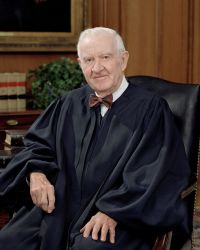
Portrait of John Paul Stevens John Paul Stevens California v. Acevedo — Dissenting Opinion

For, surely it is anomalous to prohibit a search of a briefcase while the owner is carrying it exposed on a public street yet to permit a search once the owner has placed the briefcase in the locked trunk of his car. One's privacy interest in one's luggage can certainly not be diminished by one's removing it from a public thoroughfare and placing it-out of sight-in a privately owned vehicle. Nor is the danger that evidence will escape increased if the luggage is in a car rather than on the street.
Source: Wikisource

Portrait of John Paul Stevens John Paul Stevens California v. Acevedo — Dissenting Opinion

Even if the warrant requirement does inconvenience the police to some extent, that fact does not distinguish this constitutional requirement from any other procedural protection secured by the Bill of Rights. It is merely a part of the price that our society must pay in order to preserve its freedom. Thus, in a unanimous opinion that relied on both Johnson and Chadwick, Justice Stewart wrote:
"Moreover, the mere fact that law enforcement may be made more efficient can never by itself justify disregard of the Fourth Amendment.
Source: Wikisource

Portrait of John Paul Stevens John Paul Stevens California v. Acevedo — Dissenting Opinion

Any line demarking an exception to the warrant requirement will appear blurred at the edges, but the Court has certainly erred if it believes that, by erasing one line and drawing another, it has drawn a clearer boundary.
The Court's statement that Chadwick and Sanders provide only "minimal protection to privacy," ante, at 576, is also unpersuasive. Every citizen clearly has an interest in the privacy of the contents of his or her luggage, briefcase, handbag or any other container that conceals private papers and effects from public scrutiny.
Source: Wikisource

Get perspective with Kwize: daily news enlightened by great literature