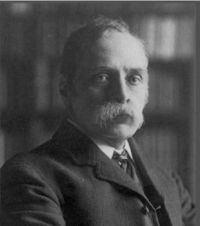
John Percival Postgate

John Percival Postgate

Summary

Portrait of John Percival Postgate John Percival Postgate,  The New Latin Primer — Part 2 (1888)

“ In order to see what is the proper tense to use in Latin, the English Defective Verbs may, might, etc., should be replaced by other Verbs which have all their tense: părērē dēbŭstī you were bound to obey; hōc dīxissĕ pŏtest it is possible that he said this.
§ 381. The Perfect Infinitive is sometimes used where Eng. has a Pres., especially after Verbs of wishing with a Negative, and in the Pass., often without essĕ. The action is usually regarded as complete, quis tē nōlit pĕrīsse? who would not wish you to die ? (to be dead) , mŏnĭtōs eōs vŏlŏ I wish to warn them.
”
Source: Wikisource

Portrait of John Percival Postgate John Percival Postgate,  The New Latin Primer — Part 2 (1888)

“ Rhetorical Questions, which are only asked for the sake of effect, and to which no answer is expected, are generally put in the Infinitive of all persons.
But Rhetorical questions which cannot be answered satisfactorily are always put in the Subjunctive' if of the Second Person, and often if of the Third.
Also a Verb of thinking or believing in the Second Person (as pŭtās do you suppose?) is put in the Subjunctive.
§ 426. II.—Tenses of the Infinitive.—For the Tenses of the Infinitive when it represents an Indicative of the O. R. see the table in § 430 below.
”
Source: Wikisource

Portrait of John Percival Postgate John Percival Postgate,  The New Latin Primer — Part 2 (1888)

“ Defective Nouns.—These are far too numerous for a complete list to be given here. Many Nouns are restricted by their sense to the Sing. [8] : and Latin has many more Nouns than English which are used only in the Plur.
Many others are deficient in certain Cases; such as:
Indeclinables: fās n. right, nĕfās n. wrong, īnstar n. likeness, used only in N. Acc. sĕecus (Ace.) n. sex: the names of letters of the alphabet. So the Adj. nēquam wicked, frūgī honest, and the Numerals from quattŭŏr to centum, and millĕ in Sing.
”
Source: Wikisource

Get perspective with Kwize: daily news enlightened by great literature