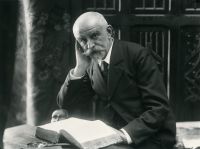
Joris-Karl Huysmans

Joris-Karl Huysmans

Summary

Portrait of Joris-Karl Huysmans Joris-Karl Huysmans,  Against the Grain — Chapter XII (1926)

“ Matters were at this point when the silvery sound of a bell tinkling a tiny angelus informed Des Esseintes that breakfast was ready. He left his books, wiped his forehead and made for the dining-room, telling himself that among all the volumes he had been arranging on his shelves, the works of Barbey d'Aurévilly were still the only ones whose matter and style offered those gamey flavours, those stains of disease and decay, that cankered surface, that taste of rotten-ripeness which he so loved to savour among the decadent writers, Latin and Monastic, of the early ages. ”
Source: Wikisource

Portrait of Joris-Karl Huysmans Joris-Karl Huysmans,  Against the Grain — Chapter XII (1926)

“ Then, again, the letters he used to write to young men often contained the loving words of a father exorting his sons,—smiling reprimands, indulgent expressions of forgiveness. Some were charming where he would avow all his greed for affection, others almost impressively serious when he was sustaining his correspondents' courage or dissipating their doubts by the statement of the irrefragable certainties of his own Faith. In a word, this feeling of fatherhood, which under his pen assumed a dainty, feminine touch, impressed on his prose an accent unique amid all the mass of clerical literature. ”
Source: Wikisource

Portrait of Joris-Karl Huysmans Joris-Karl Huysmans,  Against the Grain — Chapter XII (1926)

“ The belief that man is a Buridan's ass, a being dragged this way and that by two forces of equal strength, which fight, turn and turn about victorious and vanquished, for his soul, the conviction that human life is no better than a doubtful struggle between hell and heaven, the faith in two opposed entities, Satan and the Christ, were bound fatally and inevitably to engender those inward discords where the soul, stimulated by an incessant combat, excited in a sort by promises and threats, ends by giving up the effort to resist and prostitutes itself to whichever of the two factions had been most obstinate in its pursuit.
In the Prêtre marié, the praises of the Christ, whose temptations had been successful, were sung by Barbey d'Aurévilly;
”
Source: Wikisource

Get perspective with Kwize: daily news enlightened by great literature