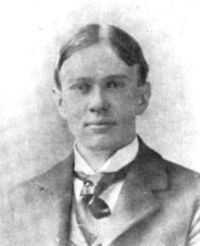
“ The Mississippi is so irregular that one tends unconsciously to personify it by calling it tricky. To find the causes of its sudden changes one must go back hundreds of miles to the mountains east and west. Seeming to delight in destruction, it tears down or eats away the checks that are put upon it. Only a mind never discouraged, a mind capable of discovering and comprehending the laws that after all underlie the apparently blind and brutal jests of this untiring giant, can, by the use of those very laws, tame it. And such a mind Eads had. ”
Quotes from James B. Eads (Louis How)
“ Education, after all, is nothing but a summary method of teaching the lessons of life; therefore, while less insistent, it is often swifter than practical experience. And there is no doubt that a man like Eads would be the first to deplore a young man's failing to appreciate its value. When he himself was young, he never supposed that he was a genius; but if he had thought this, he would have striven to be the best-read and the best-equipped of geniuses; believing that though he might be mistaken about his talent he could make sure of his culture. ”
“ The grim war had roused him; his years of rest were over; he was the well-known boat-builder,—engineer, perhaps some persons already called him,—and his mind was teeming with schemes of helpfulness. Yet his ambition was not for fame, but to do in the perfect way the work that only he could do. ”
“ In bridge-building it marks an era, not only because of its strength and beauty and the daring of its design, but also because of its many labor-saving devices, the inventions of a thoroughly practical mind. A distinguished engineer calls it "a great pioneer in the art of sinking deep foundations and building spans over wide stretches of space, that astonished in its construction the entire civilized world." ”
“ So much is often said of the precocity of youthful geniuses, that it is good to know that young Eads was after all a real flesh-and-blood boy, a boy so mischievous that, as he was the only son, his father hired a neighbor boy to come and play with him. Certainly he was very clever; but that he had even better qualities than cleverness is shown by his first actions on his arrival at Saint Louis. ”
“ If ever Nature played a prominent part in the life of a man, the Mississippi did in that of Eads; for it became the opportunity for three of his chief works, and from it he learned perhaps more of the laws of science than from all the books he ever read. To understand his life, one must have some idea of the huge river, which seems to flow sluggishly or rapidly through his whole career. The Mississippi River, with its branches, drains the larger part of the whole United States,—that is, from the Alleghanies on the east to the Rockies on the west. ”
“ The celebrations of that day were the first public outburst of approval given to Eads's work. And to-day the strong and graceful bridge stands as his most beautiful and lasting monument. And as even the great tornado of 1896 was unable to do the piers any serious damage, they are likely to last indefinitely, and thus make the bridge "endure," as its builder said, "as long as it is useful to man." ”
“ Besides this, the current is constantly washing away and building up not only hidden bars on the river bottom, but even islands above its surface. In the fall and in the spring it rises with such terrifying rapidity that some years it quickly overflows its banks in certain reaches till it is sixty miles wide. Houses and trees torn from their places, and wrecks of boats, float or protrude from the bottom of this brown lake. And when the flood subsides, the current often chooses a new and changed channel. ”
“ And yet, because it drains almost every corner of a valley which comprises over one third of the whole United States, it affords means of transportation to an immense area; and since it cannot be controlled by any one company or group of companies, its freight rates can hardly be arbitrarily fixed. Still, so long as there are impediments to its free navigation in the shape of floods and bars, it cannot be depended on for shipping, and the magnificent opportunities it should offer to commerce are lessened. The vastest river system in the world, it shows in its various parts great contrasts. ”
“ Every one interested in trade or shipping realized what a very serious hindrance to the usefulness of the Mississippi these choked-up mouths were, but no one realized it better than Eads. Understanding that the great valley is capable of supporting 400,000,000 people, and intent on doing all in his power for good, even before he had completed the bridge he was studying the problem of opening the river. Its improvement and the welfare of its millions of people were cherished objects of his life. ”
“ The scheme was always to force the river itself to do all the real work; and though there was, to be sure, a good deal of planning and building, the main idea, as already explained, is exceedingly simple. Eads never pretended to have originated this idea. He had studied many jetties in Europe. He had had the eye to see that they could be adapted to the Mississippi, and the skill to adapt them. For simple as the bald theory is, there was need of the nicest appreciation of laws and forces in applying it, and the result has been called the greatest engineering feat ever accomplished. ”
“ Bates charged him to take care of himself; "the country can't spare you," he said "and I can't spare you." Unless Bates was a prophet, we may well think the first of these statements unduly strong. To be sure, when in a crucial moment the gunboats were needed, and needed quickly, Eads's unparalleled haste in building them certainly did an inestimable service to the country. But so far in his career,—and he was over forty,—while he had shown a marked inventive talent, he had not as yet made clear his signal genius for engineering. ”
“ For he had fallen in love with a Miss Martha Dillon, a young lady of about his own age, daughter of a rich man in Saint Louis. The father disapproved of the match, not only because he thought the suitor too young, too poor, too unknown, but because he wished to keep his daughter with him, and for other less reasonable causes. The letters between the engaged couple show Eads at twenty-five as a keen, experienced, and yet an unsophisticated young man; generous, proud, brave, and courteous; a lover of Nature, of poetry, of people, and of good books; an inveterate early riser ”
“ It was never Eads's way to attack other people in a malicious spirit, for he was never jealous; nor did he often deign to answer purely personal attacks. But in defense of his undertakings, to protect them and the people who had put money into them, he was ready to fight. His defense commonly took the form of criticism of his critics, and in such writing his pen was decidedly trenchant. Probably no man ever incurred more foolish criticism, and probably none ever pointed out more plainly how foolish it was. ”
“ The theory on which he based his jetties was really extremely simple. He said that, other things being equal, the amount of sediment which a river can carry is in direct proportion to its velocity. When, for any reason, the current becomes slower at any special place, it drops part of its burden of sediment at that place, and when it becomes faster again it picks up more. Now, one thing that makes a river slower is an increase of its width, because then there is more frictional surface; and contrariwise, one of the things that make it faster is a narrowing of its width. ”
“ For some men one great undertaking at a time is enough, but Eads's energies were such that his works overlapped one another. It is hard to see how one man can have time, even if he has brains, to do all he did. But apparently he never lived an idle day. The bridge, with its many extraordinary solutions of new problems, made its builder's permanent reputation. ”
“ Besides this parrying of attack, he was continually writing and talking to show the simplicity and feasibility of his method; and one man phrased what it is likely many exemplified, that a few minutes' conversation with Eads had done more to convert him to the Jetties than any amount of writing and of talking with other people could have done. Always modest and unassuming, he was so thoroughly in earnest that he convinced others by his own conviction. Never was a man less afraid to work. ”
“ Never at a loss to solve any problem, again, as when he planned the bridge, he undertook to do what was commonly held to be impossible. Of course, all the backers of the canal scheme opposed him bitterly. New Orleans was of that faction. Saint Louis, on the other hand, upheld him because of his personal popularity and his signal success with the bridge. The army engineers were against him as a civil engineer. Thus the controversy was sectional, personal, and professional. Up to this time the government had invariably intrusted all works of river and harbor improvement to the military engineers ”
“ To the non-mechanical mind the control of such a multitude of abstruse, minute, and exact details as combine in the making of a bridge seems perhaps more marvelous than the mere bending of nature's forces to serve the ends of man. In Eads the power to do both existed. On piles in the marsh houses were built for the engineers and the workmen, and the Jetties were begun. Eads was not able to be there in person all the time, but as usual his choice of competent and faithful lieutenants was noteworthy. ”
“ As the air-pump continued to work all the while, Eads, though wondering what was amiss, sat patiently in his place, till finally he saw a hand appear under the rim of the hogshead. Seizing this, he ducked under and got out. Although the rough diving-bell worked thus awkwardly at first, it served well enough, and finally all of the lost freight was saved. A young man so fearless, so energetic, and so able to invent mechanical devices at sudden need, was bound to succeed in a business like this. And young Eads did succeed. "Fortune," he believed, "favors the brave;" ”
“ In a word, the sole legitimate objection that can be made to them is that they do not furnish a great enough depth. Of course they furnish the required depth, and as great a depth undoubtedly as can possibly be had in the little South Pass. Ships, however, now draw more water than they did twenty-five years ago, and a still deeper channel is needed. The best proof of the success of the present one is that the government is preparing to apply the same plan to the big South West Pass, which Eads begged to open and was not allowed to. ”
“ The problem of making the quantity of water needed run up into the smallest pass "through a narrow, artificially contracted channel, located immediately between two great natural outlets,"—this problem being complicated by many "occult conditions,"—has been called, by no mean engineer, perhaps the most difficult problem ever dealt with successfully. "There is no instance, indeed, in the world where such a vast volume of water is placed under such absolute and permanent control of the engineer, through methods so economic and simple." ”
“ Eads at once returned to Keokuk, and, buying a forty-gallon whiskey hogshead, took it out to the wreck; and having knocked out one head, he slung pigs of lead round his improvised diving-bell, made a seat inside it, rigged it to his derrick and air-pumps, and then asked the diver to go down in it. The diver having very naturally refused, Eads on the spot set himself a precedent which, during his after life, he never broke,—saying that he would not ask an employee to go where he would not trust himself, he got inside his hogshead and was lowered into the river. ”
“ Still there was always something to do, and Eads, the only one of the partners who understood the trade, was forced to work extraordinarily hard. With his usual persistence he stuck to it pluckily, often staying up late into the night and rising the next day before dawn to oversee operations. He was also indispensable for his faculty of managing men; and a letter to his wife written on his twenty-seventh birthday (1847) shows how strong the man already was in that power of getting the most from a workman, which was afterwards to count for so much in his best work. ”
“ And so short was the time that two or three factories alone, no matter how well equipped they might be, were not to be depended upon. Yet Eads had undertaken to start up the factories, to gather the materials, and to build his boats in two months. Never were the self-reliance and the energy of the man better exhibited; but his keen business sense might have hesitated, had not his patriotism shown him that the Union needed the boats quickly. Most of the machine-shops and foundries of Saint Louis were at once set to work night and day ”
“ In his large house in the suburbs of Saint Louis he received not only the young friends of his five daughters and his own friends, but also officers of the river fleet and of the army, officers sent west on inspection duty, and foreign officers following the course of the war and of the improvements in gunboat building. His mind was as active as his heart was generous, and the course of his life mirrored that activity. Now he was at home, now in Washington, now at Cairo visiting the gunboats to see how they worked under fire. In Washington he was busy with plans and projects. ”
“ Evidently the caissons must be filled with compressed air to equalize the external pressure, which is constantly increasing as ever deeper water is reached; they must also have an opening connecting with the surface; and to admit of passing from the ordinary atmosphere to the denser one, there must be an air-lock. Before this bridge was built, the air-lock had always been placed at the top of the entrance shaft, where, as the caisson sank and the shaft was lengthened, it had to be constantly moved up. Eads placed it in the air-chamber of the caisson itself, where it never had to be moved ”
“ The stone, granite, and steel were both hunted up and tested by experts, and by machines specially devised in the bridge works, though not by Eads himself. For his assistants he chose men who were of real ability and well trained, and to them he invariably gave great credit for their part in the work. The plans, after being figured out in detail by them, were gone over by the mathematician Chauvenet, then chancellor of Washington University, who found not one single error in them. Most of the big work, such as the masonry and steel, was given out on contract ”
“ Despite all care that could be used, steamboats were every week sunk and wrecked, and with their valuable engines, boilers, and cargoes were often left where they lay in the ceaseless brown current. After he had been for three years on the river, Eads gave up his clerkship to go into the business of raising these boats, their machinery, and their freight. In 1842, at the age of twenty-two, he formed a partnership with Case & Nelson, boat-builders. His first appearance in the new business was an experience that well shows his quick inventive genius, his persistency, and his courage. ”
“ During those trying war times all of Eads's tremendous energy had by no means been exhausted by the gunboats. In more ways than one he had been showing himself a good citizen and a kind-hearted man. Much as his fortune had been drained by the boats, he still found money to give to the sufferers in the war. ”
“ The insurance companies were willing to give the wreckers a large interest, sometimes as much as a half, of the rescued cargoes; and there was a law by which a vessel or freight that had been wrecked for five years belonged to whoever could get it up. Eads and his partners worked up and down the river for hundreds of miles. The first diving-bell boat was followed by a larger one, provided with machinery for pumping out sand, and for raising whole hulls. While in this hazardous business Eads invented many new appliances for use in its various branches. ”
Common terms
Similar works
Life on the Mississippi, Part 2…The Railway Conquest of the World…Pennsylvania v. Wheeling and Belmont Bridge Company…Popular Science Monthly (John Hawkshaw…The Ohio River Trade, 1788-1830…U.S.S. Cairo: The Story of a Civil War Gunboat…Life on the Mississippi, Part 6…Autobiography of Sir John Rennie…India and Indian Engineering (J. G. Medley…Captain Mary Miller (Harriet H. Robinson…
