Summary

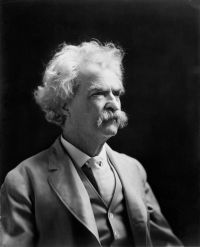
Portrait of Mark Twain Mark Twain The Innocents Abroad

It is as large as a church; its pavement is rich enough for the pavement of a King’s palace; its great dome is gorgeous with frescoes; its walls are made of--what? Marble?--plaster?--wood?--paper? No. Red porphyry--verde antique--jasper--oriental agate--alabaster--mother-of-pearl--chalcedony--red coral--lapis lazuli! All the vast walls are made wholly of these precious stones, worked in, and in and in together in elaborate pattern s and figures, and polished till they glow like great mirrors with the pictured splendors reflected from the dome overhead.
Source: Gutenberg

Portrait of Mark Twain Mark Twain The Innocents Abroad (1869)

Capernaum is a shapeless ruin; Magdala is the home of beggared Arabs; Bethsaida and Chorazin have vanished from the earth, and the “desert places” round about them where thousands of men once listened to the Saviour’s voice and ate the miraculous bread, sleep in the hush of a solitude that is inhabited only by birds of prey and skulking foxes.
Palestine is desolate and unlovely. And why should it be otherwise? Can the curse of the Deity beautify a land?
Palestine is no more of this work-day world. It is sacred to poetry and tradition—it is dream-land.
Source: Gutenberg

Portrait of Mark Twain Mark Twain The Innocents Abroad (1869)

His torch was out; his fires were smoldering; a tall column of smoke that rose up and lost itself in the growing moonlight was all the sign he gave that he was a living Autocrat of the Sea and not the spectre of a dead one.
At two in the morning we swept through the Straits of Messina, and so bright was the moonlight that Italy on the one hand and Sicily on the other seemed almost as distinctly visible as though we looked at them from the middle of a street we were traversing. The city of Messina, milk-white, and starred and spangled all over with gaslights, was a fairy spectacle.
Source: Gutenberg

Get perspective with Kwize: daily news enlightened by great literature