Summary

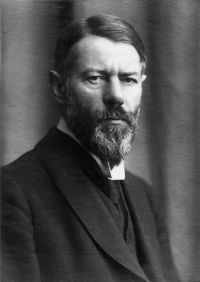
Portrait of Max Weber Max Weber The Protestant Ethic and the Spirit of Capitalism (1930)

"Remember, that time is money. He that can earn ten shillings a day by his labour, and goes abroad, or sits idle, one half of that day, though he spends but sixpence during his diversion or idleness, ought not to reckon that the only expense; he has really spent, or rather thrown away, five shillings besides.
"Remember, that credit is money. If a man lets his money lie in my hands after it is due, he gives me the interest, or so much as I can make of it during that time. This amounts to a considerable sum where a man has good and large credit, and makes good use of it.
"Remember, that money is of the prolific, generating nature.
Source: Wikisource

Portrait of Max Weber Max Weber The Protestant Ethic and the Spirit of Capitalism (1930)

Labour must, on the contrary, be performed as if it were an absolute end in itself, a calling. But such an attitude is by no means a product of nature. It cannot be evoked by low wages or high ones alone, but can only be the product of a long and arduous process of education. To-day, capitalism, once in the saddle, can recruit its labouring force in all industrial countries with comparative ease.
Source: Wikisource

Portrait of Max Weber Max Weber The Protestant Ethic and the Spirit of Capitalism (1930)

It should be taught in the kindergarten of cultural history that this naïve idea of capitalism must be given up once and for all. Unlimited greed for gain is not in the least identical with capitalism, and is still less its spirit. Capitalism may even be identical with the restraint, or at least a rational tempering, of this irrational impulse. But capitalism is identical with the pursuit of profit, and forever renewed profit, by means of continuous, rational, capitalistic enterprise.
Source: Wikisource

Get perspective with Kwize: daily news enlightened by great literature