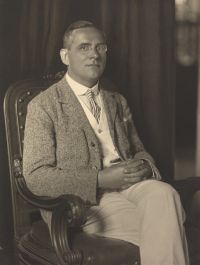
Moritz Schlick

Moritz Schlick

Summary

Portrait of Moritz Schlick Moritz Schlick,  Meaning and verification. (1938)

“ There has never been any other way, and it would be a grave error to suppose that we believe we have discovered a new conception of meaning which is contrary to common opinion and which we want to introduce into philosophy. On the contrary, our conception is not only entirely in agreement with, but even derived from, common sense and scientific procedure. Although our criterion of meaning has always been employed in practice, it has very rarely been formulated in the past, and this is perhaps the only excuse for the attempts of so many philosophers to deny its feasibility. ”
Source: Wikisource

Portrait of Moritz Schlick Moritz Schlick,  Meaning and verification. (1938)

“ I propose to call ‘empirically possible’ anything that does not contradict the laws of nature. This is, I think, the largest sense in which we may speak of empirical possibility; we do not restrict the term to happenings which are not only in accordance with the laws of nature but also with the actual state of the universe (where ‘actual’ might refer to the present moment of our own lives, or to the condition of human beings on this planet, and so forth) . ”
Source: Wikisource

Portrait of Moritz Schlick Moritz Schlick,  Meaning and verification. (1938)

“ No rule of expression presupposes any law or regularity in the world (which is the condition of ‘experience’ as Hume and Kant use the word) , but it does presuppose data and situations, to which names can be attached. The rules of language are rules of the application of language; so there must be something to which it can be applied. Expressibility and verifiability are one and the same thing. There is no antagonism between logic and experience. Not only can the logician be an empiricist at the same time; he must be one if he wants to understand what he himself is doing. ”
Source: Wikisource

Get perspective with Kwize: daily news enlightened by great literature