Summary

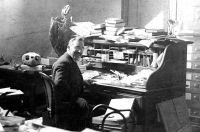
Portrait of Oliver Perry Hay Oliver Perry Hay The Pleistocene of North America

We can not doubt that each glacial and each interglacial stage swept away a few of the less hardy genera and species. Nevertheless, several remarkable animals passed through the vicissitudes of all the glacial and interglacial times and left their bones in the deposits overlying the last, or Wisconsin, drift. Such are two species of elephants, the American mastodon, the giant beaver, and one or more species of peccaries.
Source: Gutenberg

Portrait of Oliver Perry Hay Oliver Perry Hay The Pleistocene of North America

The Pleistocene is regarded as being equivalent to what is known as the Glacial period. It began with the deployment of the ice-sheets which, proceeding from their centers of accumulation in British America, laid down in the East the Jerseyan drift and in the West the Nebraskan. The more the Glacial period is studied the more one becomes impressed with the significance of its physical effects on the northern hemisphere and with its influence on the vertebrate life. Doubtless its effects on the world in general are only beginning to be comprehended.
Source: Gutenberg

Portrait of Oliver Perry Hay Oliver Perry Hay The Pleistocene of North America

It is easily possible that the bones and teeth of early Pleistocene animals may have been buried in such valley fillings and such terrace deposits. Again, remains of such vertebrates may have been buried beneath the glacial “fringe” that has been mentioned. In such cases it may be impossible for one who is not a glaciologist, perhaps not even for him, to determine the real age of the fossils. It is, therefore, of the utmost importance that a record be kept of the exact spot where the fossil was found, so that at some future time the geology of the locality may be studied by a competent person.
Source: Gutenberg

Get perspective with Kwize: daily news enlightened by great literature