Summary

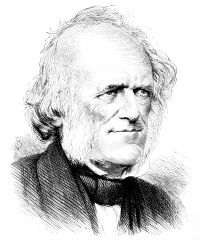
Portrait of Charles Lyell Charles Lyell Geological Evidences of the Antiquity of Man (1863)

It has naturally been asked, if man coexisted with the extinct species of the caves, why were his remains and the works of his hands never embedded outside the caves in ancient river-gravel containing the same fossil fauna? Why should it be necessary for the geologist to resort for evidence of the antiquity of our race to the dark recesses of underground vaults and tunnels, which may have served as places of refuge or sepulture to a succession of human beings and wild animals, and where floods may have confounded together in one breccia the memorials of the fauna of more than one epoch?
Source: Wikisource

Portrait of Charles Lyell Charles Lyell Geological Evidences of the Antiquity of Man (1863)

No conclusion can be more incontestable than that these angular blocks of granite, gneiss, and other crystalline formations, came from the Alps, and that they have been brought for a distance of fifty miles and upwards across one of the widest and deepest valleys of the world; so that they are now lodged on the hills and valleys of a chain composed of limestone and other formations, altogether distinct from those of the Alps. Their great size and angularity, after a journey of so many leagues, has justly excited wonder, for hundreds of them are as large as cottages
Source: Wikisource

Portrait of Charles Lyell Charles Lyell Geological Evidences of the Antiquity of Man (1863)

From this vomitory, the old glacier poured into the plains of the Po that wonderful accumulation of mud, gravel, boulders, and large erratics, which extend for fifteen miles from above Ivrea to below Caluso, and which, when seen in profile from Turin, have the aspect of a chain of hills. In many countries, indeed, they might rank as an important range of hills, for where they join the mountains they are more than 1,500 feet high, and retain more than half that height for a great part of their course, rising very abruptly from the plain, often with a slope of from 20° to 30°.
Source: Wikisource

Get perspective with Kwize: daily news enlightened by great literature