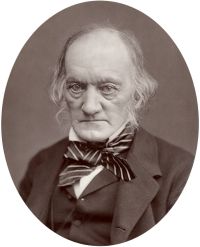
Richard Owen

Richard Owen

Summary

Portrait of Richard Owen Richard Owen 1911 Encyclopædia Britannica (1911)

The range of Oken’s lectures at Jena was a wide one, and they were highly esteemed. They embraced the subjects of natural philosophy, general natural history, zoology, comparative anatomy, the physiology of man, of animals and of plants. The spirit with which he grappled with the vast scope of science is characteristically illustrated in his essay Ueber das Universum als Fortsetzung des Sinnensystems, 1808. In this work he lays it down that “organism is none other than a combination of all the universe’s activities within a single individual body.”
Source: Wikisource

Portrait of Richard Owen Richard Owen 1911 Encyclopædia Britannica (1911)

The idea of the analogy between the skull, or parts of the skull, and the vertebral column had been previously propounded and ventilated in their lectures by J. H. F. Autenreith and K. F. Kielmeyer, and in the writings of J. P. Frank. By Oken it was applied chiefly in illustration of the mystical system of Schelling—the “all-in-all” and “all-in-every-part.” From the earliest to the latest of Oken’s writings on the subject, “the head is a repetition of the whole trunk with all its systems: the brain is the spinal cord; the cranium is the vertebral column; the mouth is intestine and abdomen
Source: Wikisource

Portrait of Richard Owen Richard Owen 1911 Encyclopædia Britannica (1911)

This doctrine led him to the conviction that “world and organism are one in kind, and do not stand merely in harmony with each other.” In the same year he published his Erste Ideen zur Theorie des Lichts, &c., in which he advanced the proposition that “light could be nothing but a polar tension of the ether, evoked by a central body in antagonism with the planets, and heat was none other than a motion of this ether”—a sort of vague anticipation of the doctrine of the “correlation of physical forces.”
Source: Wikisource

Get perspective with Kwize: daily news enlightened by great literature