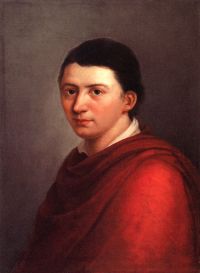
Friedrich Wilhelm Joseph von Schelling

Definition and stakes

Johann Ludwig Wilhelm Thudichum Popular Science Monthly (1876)

The animal decomposes the iron, the plant decomposes the water. The female and the male sex of the plant is the carbon and the nitrogen of the water." These are two examples of the philosophy of Schelling, which was believed at that time to be the science by which Germany could be regenerated, by which the generation which had then only just recovered its independence would be put on a firm mental basis.
Source: Wikisource

Portrait of Georg Wilhelm Friedrich Hegel Georg Wilhelm Friedrich Hegel Hegel's Lectures on the History of Philosophy…

The ego posits itself in opposition to itself, since it posits itself as conditioned by the non-ego; that is the infinite repulsion, for this conditionment is the ego itself. Schelling, on the one hand, says: “The ego is unlimited as the ego only in so far as it is limited,” as it relates to the non-ego. Only thus does consciousness exist, self-consciousness is a barren determination; through its intuition of self the ego becomes finite to itself. “This contradiction only allows itself to be dissolved by the ego becoming in this finitude infinite to itself, i.e.
Source: Gutenberg

Portrait of Georg Wilhelm Friedrich Hegel Georg Wilhelm Friedrich Hegel Hegel's Lectures on the History of Philosophy…

In respect of the ego, as principle of the transcendental philosophy, Schelling sets to work in the same way as did Fichte, inasmuch as he begins from the fact of knowledge “in which the content is conditioned through the form, and the form through the content”; this is formal A = A. But does A exist? The ego is “the point where subject and object are one in their unmediated condition”; the ego is just Ego = Ego, subject-object; and that is the act of self-consciousness wherein I am for myself object to myself.
Source: Gutenberg

Get perspective with Kwize: daily news enlightened by great literature