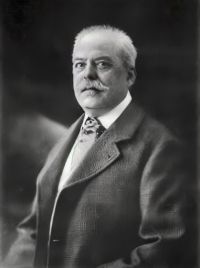
Rodolfo Amedeo Lanciani

Rodolfo Amedeo Lanciani

Summary

Portrait of Rodolfo Amedeo Lanciani Rodolfo Amedeo Lanciani Pagan and Christian Rome

Towards the end of 1881 another remarkable discovery took place in these catacombs: that of a cubiculum which in style of decoration is unique. It looks more like the room of a Pompeian house than a Christian crypt. Its architectural paintings with groups of frail columns supporting fantastic friezes, and enclosing pastoral landscapes, might be compared to the frescoes of the Golden House of Nero, or those of the house of Germanicus on the Palatine; but they find no parallel in "subterranean Rome."
Source: Gutenberg

Portrait of Rodolfo Amedeo Lanciani Rodolfo Amedeo Lanciani Pagan and Christian Rome

For a radius of a thousand feet around the gate, we meet with the typical remains of a Roman villa of the first century,—porticoes, water tanks, and substructions, from the platform of which there is a lovely view over the wooded plains of the Tiber and the Anio, the city, and the hills of the Vatican, and of the Janiculum, which frame the panorama. The site is pleasant, secluded, and quiet, so that it well fulfilled the wish for a secretior latetra expressed by Nero in his hopeless condition.
Source: Gutenberg

Portrait of Rodolfo Amedeo Lanciani Rodolfo Amedeo Lanciani Pagan and Christian Rome

How many times have I studied the so-called Temple of the Sibyl at Tivoli without detecting the faint traces of the figures of the Saviour and the four saints, which now appear to me distinctly visible in the niche of the cella. And again, how many times have I looked at the Temple of Neptune in the Piazza di Pietra, [91] without noticing a tiny figure of Christ on the cross in one of the flutings of the fourth column on the left. It seems to me that, at one period, there must have been more churches than habitations in Rome.
Source: Gutenberg

Get perspective with Kwize: daily news enlightened by great literature