Summary

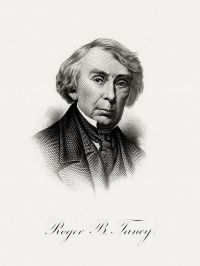
Portrait of Roger B. Taney Roger B. Taney Dred Scott v. Sandford (60 U.S. 393…

And if slavery be limited to the range of the territorial laws, how can the slave be coerced to serve in a State or Territory, not only without the authority of law, but against its express provisions? What gives the master the right to control the will of his slave? The local law, which exists in some form. But where there is no such law, can the master control the will of the slave by force? Where no slavery exists, the presumption, without regard to color, is in favor of freedom. Under such a jurisdiction, may the colored man be levied on as the property of his master by a creditor?
Source: Wikisource

Portrait of Roger B. Taney Roger B. Taney Dred Scott v. Sandford (60 U.S. 393…

The States of Missouri and Illinois are bounded by a common line. The one prohibits slavery, the other admits it. This has been done by the exercise of that sovereign power which appertains to each. We are bound to respect the institutions of each, as emanating from the voluntary action of the people. Have the people of either any right to disturb the relations of the other? Each State rests upon the basis of its own sovereignty, protected by the Constitution. Our Union has been the foundation of our prosperity and national glory.
Source: Wikisource

Portrait of Roger B. Taney Roger B. Taney Dred Scott v. Sandford (60 U.S. 393…

And if, in the language of the Supreme Court of Missouri, the master, by taking his slave to Illinois, and employing him there as a slave, emancipates him as effectually as by a deed of emancipation, is it possible that such an act is not matter for adjudication in any slave State where the master may take him? Does not the master assent to the law, when he places himself under it in a free State?
Source: Wikisource

Get perspective with Kwize: daily news enlightened by great literature