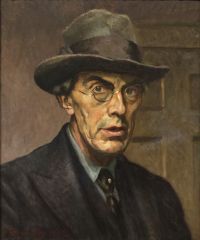
Roger Fry

Roger Fry

The Dial (1923)

Summary

Portrait of Roger Fry Roger Fry,  The Dial (1923)

“ What natural and economic forces made this particular spot, where the barren, treeless plain slopes down to the bed of the Tormes, the centre of learning for Spain, the intermediary for all Europe of Arabic science and Western thought and a great, and in some ways sumptuous city? What products of the earth, got by what toil of man, where the earth seems completely barren and man completely idle, provided the money to build so extensively and so elaborately? For Salamanca is a city where Plateresque and Baroque fancy have impressed their wildest dreams on the rich surface of the stone. ”
Source: Wikisource

Portrait of Roger Fry Roger Fry,  The Dial (1923)

“ Their church is the only one in Salamanca that ever is open at any convenient hours and is always nearly full, but the Hijas don't go into it. They sit up somewhere behind a grille and drone out in their childish treble interminable bad hymn tunes—it must be a sort of perpetual Sunday afternoon of the old-fashioned kind in there.—Sunday indeed is the one day when they do appear in the streets walking with guttering candles behind a procession of the Host and listening to music as bad as their own, but played by a military band. ”
Source: Wikisource

Portrait of Roger Fry Roger Fry,  The Dial (1923)

“ The Plaza Mayor is, to quote Baedeker, "the finest city square in Spain." It is a Spanish version of the Place Stanislas at Nancy, but instead of the pale grey French stone cut into refined and calculated elegance, it is all of the warm golden colour of Salamanca stone, and its proportions are not so nicely adjusted and, though the same elevation is maintained all round the square, the Spanish architects could not achieve symmetry, and façades are broken where its streets happen to enter. ”
Source: Wikisource

Get perspective with Kwize: daily news enlightened by great literature