Summary

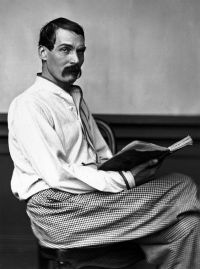
Portrait of Sir Richard Francis Burton Sir Richard Francis Burton The City of the Saints, and Across the Rocky Mountains to California

We then fell into a saline resembling freshly-fallen snow. The whiteness changes to a slaty blue, like a frozen pond when the water still underlies it; and, to make the delusion perfect, the black rutted path looked as if lately cut out after a snow-storm. Weird forms appeared in the moonlight. A line of sand-heaps became a row of railroad cars; a raised bench was mistaken for a paling; and the bushes were any thing between a cow and an Indian. This part of the road must be terrible in winter; even in the fine season men are often compelled to unpack half a dozen times.
Source: Gutenberg

Portrait of Sir Richard Francis Burton Sir Richard Francis Burton The City of the Saints, and Across the Rocky Mountains to California

From the road nothing is to be seen but a deep cunette full of percolated water.
Beyond the Warm Springs lay a hopeless-looking land, a vast slope, barren and desolate as Nature could well make it. The loose sands and the granite masses of the valley had disappeared; the surface was a thin coat of hard gravelly soil. Some mosses, a scanty yellow grass, and the dark gray artemisia, now stunted and shrunk, were sparsely scattered about. It had already begun to give way before an even hardier creation, the rabbit-bush and the greasewood.
Source: Gutenberg

Portrait of Sir Richard Francis Burton Sir Richard Francis Burton The City of the Saints, and Across the Rocky Mountains to California

Averaging two miles in width, which shrinks to one quarter as you ascend, the valley is hedged on both sides by low rolling bluffs or terraces, the boundaries of its ancient bed and modern debordements. As the hills break off near the river, they show a diluvial formation; in places they are washed into a variety of forms, and being white, they stand out in bold relief. In other parts they are sand mixed with soil enough to support a last-year’s growth of wheat-like grass, weed-stubble, and dead trees, that look like old corn-fields in new clearings.
Source: Gutenberg

Get perspective with Kwize: daily news enlightened by great literature