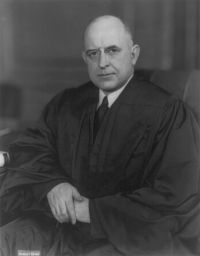
Stanley Forman Reed

Stanley Forman Reed

Summary

Portrait of Stanley Forman Reed Stanley Forman Reed Quinn v. United States (349 U.S. 155… (1955)

In view of the ease with which a claim can be made by any layman, the availability of personal lawyers for these witnesses and the careful avoidance of any such statement as, 'I decline to answer on the ground of possible self-incrimination,' I cannot hold that these witnesses evidenced by their testimony an intention to claim privilege. The fact that a claim of privilege would subject the witnesses to criticism in some quarters, of course, has no bearing upon the necessity to assert one's rights.
Source: Wikisource

Portrait of Stanley Forman Reed Stanley Forman Reed Quinn v. United States (349 U.S. 155… (1955)

I concur with the Court in its assertions of the value of the self-incrimination clause-that it may be used as a shield by guilty and innocent alike-and that it should be construed liberally as it has been to cover more than the literal reading of the phrase 'No person * * * shall be compelled in any criminal case to be a witness against himself' would suggest.
Source: Wikisource

Portrait of Stanley Forman Reed Stanley Forman Reed Quinn v. United States (349 U.S. 155… (1955)

The Court must admit, as it does, Quinn Opinion, 75 S.Ct. 673, that no particular form of words is required. On the other hand, I must admit that a witness must be clearly apprised that his claim of the freedom from an obligation to answer is not accepted by the interrogator. [12] I agree that the offense punishable under the statute is a deliberate, intentional refusal not an inadvertence, accident or misunderstanding. [13] Good faith in refusing to answer, however, is no defense so long as the refusal is intentional, deliberate.
Source: Wikisource

Get perspective with Kwize: daily news enlightened by great literature