Summary

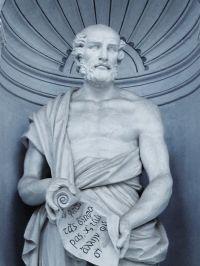
Portrait of Theophrastus Theophrastus Enquiry Into Plants and Minor Works On Odours and Weather Signs (1916)

In the case of trees we may thus distinguish the annual parts, while it is plain that in annual plants all the parts are annual: for the end of their being is attained when the fruit is produced. And with those plants which bear fruit annually, those which take two years (such as celery and certain others [23] ) and those which have fruit on them for a longer time—with all these the stem will correspond to the plant's length of life: for plants develop a stem at whatever time they are about to bear seed, seeing that the stem exists for the sake of the seed.
Source: Wikisource

Portrait of Theophrastus Theophrastus Enquiry Into Plants and Minor Works On Odours and Weather Signs (1916)

Indeed it might be suggested that we should classify in some cases simply by size, and in some eases by comparative robustness or length of life. For of under-shrubs and those of the pot-herb class some have only one stem and come as it were to have the character of a tree, such as cabbage [1] and rue: wherefore some call these 'tree-herbs'; and in fact all or most of the pot-herb class, when they have been long in the ground, acquire a sort of branches, and the whole plant comes to have a tree-like shape, though it is shorter lived than a tree.
Source: Wikisource

Portrait of Theophrastus Theophrastus Enquiry Into Plants and Minor Works On Odours and Weather Signs (1916)

Yet it is not strange that there should be some mountains which do not thus bear all things, but have a more special kind of vegetation to a great extent if not entirely; for instance the range of Ida in Crete [10] ; for there the cypress grows; or the hills of Cilicia and Syria, on which the Syrian cedar grows, or certain parts of Syria, where the terebinth grows. For it is the differences of soil which give a special character to the vegetation.
Source: Wikisource

Get perspective with Kwize: daily news enlightened by great literature