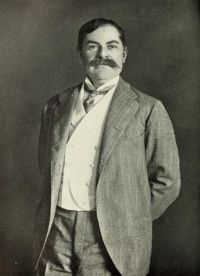
Thomas Nelson Page

Thomas Nelson Page

Summary

Portrait of Thomas Nelson Page Thomas Nelson Page The negro: the southerner's problem (1904)

It aroused and crystallized feeling against the South throughout the world. For the first time, the world had the imaginable horrors of slavery presented in a manner that appealed alike to old and young, the learned and the ignorant, the high-born and the lowly. It blackened the fame of the Southern people in the eyes of the North and fixed in the mind of the North a concept not only of the institution of slavery, but of the Southern people, which lasted for more than a generation, and has only begun of late, in the light of a fuller knowledge, to be dislodged.
Source: Gutenberg

Portrait of Thomas Nelson Page Thomas Nelson Page The negro: the southerner's problem (1904)

Let us apply ourselves to the securing some more reasonable and better basis for the suffrage. Let us establish such a proper qualification as a condition precedent to the possession of the elective franchise as shall leave the ballot only to those who have intelligence enough to use it as an instrument to secure good government rather than to destroy it. In taking this step we have to plant ourselves on a broader principle than that of a race qualification. It is not merely the Negro, it is ignorance and venality which we should disfranchise.
Source: Gutenberg

Portrait of Thomas Nelson Page Thomas Nelson Page The negro: the southerner's problem (1904)

In this way alone can the race or any part of the race look for ultimate salvation.
It has appeared to some that the South has not done its full duty by the Negro. Perfection is, without doubt, a standard above humanity; but, at least, we of the South can say that we have done much for him; if we have not admitted him to social equality, it has been under an instinct stronger than reason, and in obedience to a law higher than is on the statute-books: the law of self-preservation. Slavery, whatever its demerits, was not in its time the unmitigated evil it is fancied to have been.
Source: Gutenberg

Get perspective with Kwize: daily news enlightened by great literature