“ What are the racial endowments of these risen negroes whom we are urged by lofty example to invite into our drawing-rooms upon terms of broadest equality—for upon other terms would be a mockery—as eligible associates, companions, suitors, husbands for our sisters and daughters?—for a sensible father or brother does not admit white men to his home on any other basis. Of what essential racial elements and sources is the negro, risen and unrisen alike? ”
Negroes
Definition and stakes
The concept of "Negroes" has historically been a central theme in literature, reflecting complex social, racial, and cultural dynamics. Authors such as W. E. B. Du Bois explored the psychological and ethical challenges faced by Black Americans, advocating for self-determination in the face of systemic inequality, while George Washington Williams highlighted the resilience and contributions of Black individuals during the Civil War.
Thomas Nelson Page, on the other hand, stressed the importance of Black communities in setting moral and social benchmarks. These differing viewpoints, ranging from critical analyses to appeals for dignity, illustrate how the theme connects with broader conversations on identity, heritage, and justice, revealing both the struggles and aspirations tied to the term.
Quotes about “Negroes”
Ulrich Bonnell Phillips, American Negro Slavery
“ The bulk of the real negroes on the other hand, with an occasional mulatto among them, went their own way, the women frankly indulging a native predilection for gaudy colors, carrying their burdens on their heads, arms akimbo, and laying as great store in their kerchief turbans as their paler cousins did in their beflowered bonnets. ”
George Washington Williams, History of the Negro Race in America from 1619 to 1880…
“ But that during all those years of painful anxiety, of hope and fear, of fiery trial and severe privation, those faithful Negroes toiled, not only to support the wives and children of the men who were fighting to make slavery national and perpetual, but fed the entire rebel army, and never laid the weight of a finger upon the head of any of the women or children entrusted to their care! ”
 W. E. B. Du Bois,
The Souls of Black Folk
W. E. B. Du Bois,
The Souls of Black Folk
“ And as the black third of the land grows in thrift and skill, unless skilfully guided in its larger philosophy, it must more and more brood over the red past and the creeping, crooked present, until it grasps a gospel of revolt and revenge and throws its new-found energies athwart the current of advance. Even to-day the masses of the Negroes see all too clearly the anomalies of their position and the moral crookedness of yours. ”
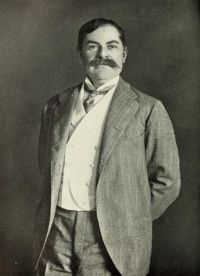 Thomas Nelson Page,
The negro: the southerner's problem
(1904)
Thomas Nelson Page,
The negro: the southerner's problem
(1904)
“ It has long appeared to the writer that the [Pg 159] prime necessity of the Negroes is to learn to distinguish between Negroes and Negroes; between the law-abiding and self-respecting Negro and the lawbreaker and blackguard; between the honest man and the thief; the decent man and the dive-frequenter; the good citizen and the “tough”—in other words, to create for themselves some standard of virtue and right living for both men and women according to which they shall be classified. ”
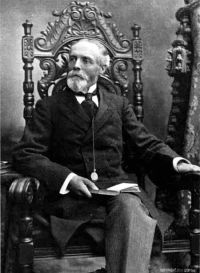 Whitelaw Reid,
After the War: A Southern Tour…
Whitelaw Reid,
After the War: A Southern Tour…
“ After all, there is a good deal of human nature in negroes!Some rickety, tumble-down buildings on an out-of-the-way corner had been secured for another school, which we next visited. A motherly old negress here had her brood of little ones gathered about her, learning in concert the alphabet from the chart which she held in her lap. ”
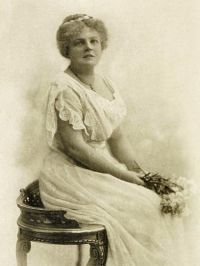 Mary Gaunt,
Where the Twain Meet
Mary Gaunt,
Where the Twain Meet
“ Even at this day there are people who will tell you what tradition has told them that the negroes would come on in a body, fling themselves like an avalanche on the Great House and cut down ruthlessly all before them. Or if they found the white people fled, they satisfied their desires by broaching the rum casks and breaking open the stores. ”
George Washington Williams, History of the Negro Race in America from 1619 to 1880…
“ But in our examination of African tribes we shall not confine ourselves to that class of people known as Negroes, but call attention to other tribes as well. And while, in this country, all persons with a visible admixture of Negro blood in them are considered Negroes, it is technically incorrect. For the real Negro was not the sole subject sold into slavery: very many of the noblest types of mankind in Africa have, through the uncertainties of war, found their way to the horrors of the middle passage, and finally to the rice and cotton fields of the Carolinas and Virginias. ”
“ And yet all these strange-blooded people are classed roughly together as Negroes. I remember sitting once on the platform at a great meeting at the People’s Tabernacle in Atlanta. An audience of some 1,200 coloured people was present. A prominent white man gave a brief address in which he urged the Negroes present to accept with humility the limitations imposed upon them by their heredity, that they were Negroes and that therefore they should accept with grace the place of inferiority. ”
Gilbert Thomas Stephenson, Race Distinctions in American Law
“ Let the Negroes, instead of bemourning their lot and fretting because they are Negroes and trying to escape themselves, rise up and wipe away the stain from this word by glorious and resplendent achievements. ”
George Washington Williams, History of the Negro Race in America from 1619 to 1880…
“ So far from being equal to us, the polished inhabitants of Europe, as some ignorant people suppose, they are immeasurably below the Africans themselves,"The typical Negro is the true savage of Africa; and I must paint the deformed anatomy of his mind, as I have already done that of his body."The typical Negroes dwell in petty tribes, where all are equal except the women, who are slaves; where property is common, and where, consequently, there is no property at all; where one may recognize the Utopia of philosophers, and observe the saddest and basest spectacles which humanity can afford. ”
Thomas Nelson Page,
The negro: the southerner's problem
(1904)
“ There is much truth in the saying that unless the whites lift the Negroes up, the Negroes will drag them down, though it is not true in the full sense in which it was intended. It is not true to the extent that the white must lift the Negro up to his own level ”
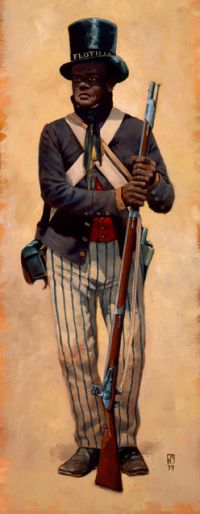 Charles Ball,
Fifty Years in Chains; or, the Life of an American Slave
(1860)
Charles Ball,
Fifty Years in Chains; or, the Life of an American Slave
(1860)
“ It is the custom throughout all the slave-holding States, amongst people of fashion, never to speak of their negroes as slaves, but always as servants; but I had never before met with the keeper of a public house, in the country, who had arrived at this degree of refinement. I had been accustomed to hear this order of men, and indeed the greater number of white people speak of the people of color as niggers. ”
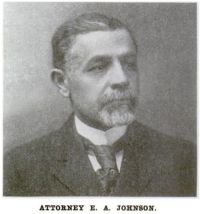 Edward A. Johnson,
Light Ahead for the Negro
Edward A. Johnson,
Light Ahead for the Negro
“ No Negro gained any national reputation without first having been recognized by the white race, instead of his own. The Negroes recognized their leaders after the whites picked them out—not before.“The Negro nature at this time was still a pliable one, after many years of drill training, but it was much more plastic in the days of slavery, and for the first forty years after reconstruction. The master labored to subordinate the will of the slave to his own, to make him like clay in the hands of the potter. ”
 Thomas Hughes,
Vacation Rambles
Thomas Hughes,
Vacation Rambles
“ In all that book there is no single instance of the drawing of a mean, corrupt, or depraved negro; but the negroes are represented as full of patience, trustfulness, shrewdness, and power of many kinds. ”
Gilbert Thomas Stephenson, Race Distinctions in American Law
“ It has been my custom to write and speak of the members of my race as Negroes, and when using the term ‘Negro’ as a race designation to employ the capital ‘N.’ To the majority of the people among whom we live I believe this is customary and what is termed in the rhetorics ‘good usage.’... Rightly or wrongly, all classes have called us Negroes. ”
Edward A. Johnson,
Light Ahead for the Negro
“ They realize as a mass that there has grown up within the last thirty years an idle, vicious class of Negroes whose acts and habits are of such a nature as to make them objectionable to their own race, as well as to the whites. ”
 Madison Grant,
The Conquest of a Continent; or…
Madison Grant,
The Conquest of a Continent; or…
“ Negro—with firmness and with kindness—and the Negroes are liked below the Mason and Dixon line so so long as they keep to their proper relation to the Whites, but in the North the blocks of Negroes in the large cities, migrating from the South, have introduced new complications, which are certain to produce trouble in the future, especially if Communist propaganda makes headway among them. ”
Edward A. Johnson,
Light Ahead for the Negro
“ What to do with this class is a problem that perplexes the better element of Negroes, more, possibly, than it does the whites; since their shortcomings are generally credited to the whole Negro race, which is wrong as a fact and unjust in theory.“This vicious element in the race is a constant subject of discussion in Negro churches and in private conversation. It is a mistake to say that crime is not condemned by the better class of Negroes. ”
George Washington Williams, History of the Negro Race in America from 1619 to 1880…
“ It is evident, from the wording of the last advertisement quoted, that the Negroes were sniffing the air of freedom that occasionally blew from the victorious battle-fields, where many of their race had distinguished themselves by the most intrepid valor. ”
Sterling A. Brown, The Negro in American fiction (1938)
“ Slaves seem to be kept busiest tending their own garden patches, of which they sell the produce. “I never meet a Negro man—unless he is quite old—that he is not whistling; and the women sing from morning to night.” Negroes are shown as ludicrous:And when to these are added a few, reverend, wrinkled decrepit old men, with faces shortened as if with drawing strings, noses that seemed to have run all to nostril, and with feet of the configuration of a mattock, my readers will have a tolerably correct idea of the negro-quarter. ”
Sutton E. Griggs, The Hindered Hand; or, The Reign of the Repressionist
“ Negro men sit in carriages by the side of the fairest daughters of the Southland and take them in safety from place to place. The Negroes do the cooking for the whites, nurse their babies, and our mothers hover about the bedside of their dying. This they do while their hearts are yearning for a better day for themselves and their kind. But the racial honor is above being212 tainted. Let the Anglo-Saxon crush us if he will and if there is no God! But I say to you, the Negro can never be provoked to stoop to the perfidy and infamy which you suggest. ”
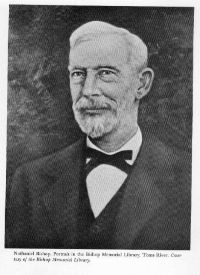 Nathaniel H. Bishop,
Voyage of the Paper Canoe
Nathaniel H. Bishop,
Voyage of the Paper Canoe
“ A few men of negro extraction, with white blood in their veins, not any more negro than white man, consequently not negroes in the true sense of the word, are sent from the negro colleges of the south to lecture northern congregations upon the needs of their race; and these one-quarter, or perhaps three-quarters, white men are, with their intelligence, and sometimes brilliant oratory, held up as true types of the negro race by northerners ”
Thomas Nelson Page,
The negro: the southerner's problem
(1904)
“ Happily for the Negroes, the major portion of them have retired from the struggle for political power, and, except when excited by agitators, live harmoniously enough with the whites; and the industrious element are saving, and are building themselves homes. ”
Robert Strange, Church work among the Negroes in the South
“ Let us turn aside for a moment to consider the general conditions of the negroes and their relation to the white people. We have to-day about the same relative proportion of blacks to whites in the whole country as we had in 1860—about 12 per cent.—; and we have nearly the same in the South, about 40 per cent. What is to become of the negro for the next fifty years? No man would dare suggest an answer looking farther ahead than that: God only knows. Some say he will amalgamate with the whites. ”
Robert Strange, Church work among the Negroes in the South
“ This answer, again, comes from those who are looking more closely at the few, better, advancing negroes, thinking of them as men, with manly hopes and powers and aspirations, believing that races must be lifted by their own race leaders, that they can only truly understand and follow their own heroes. ”
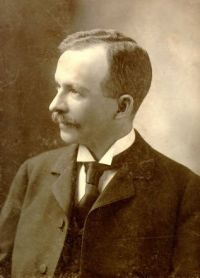 Charles W. Chesnutt,
The Wife of his Youth and Other Stories of the Color Line…
Charles W. Chesnutt,
The Wife of his Youth and Other Stories of the Color Line…
“ To start with, the Negroes are already considerably mixed—many of them in large proportion, and most of them in some degree—and the white people, as I shall endeavor to show later on, are many of them slightly mixed with the Negro. ”
Thomas Nelson Page,
The negro: the southerner's problem
(1904)
“ The fidelity of the Negroes throughout the war was fully appreciated and called forth a warmer affection on the part of the masters and mistresses, and the care and self-denial of the whites were equally recognized by the Negroes. ”
 Gilbert Parker,
No Defense, Volume 1
Gilbert Parker,
No Defense, Volume 1
“ I look out of the window and see hundreds of acres of cotton-fields, with hundreds upon hundreds of negroes at work. I hear the songs they sing, faint echoes of them, even as I write. Yes, my black folk do sing, because they are well treated. ”
W. E. B. Du Bois,
The Souls of Black Folk
(1903)
“ For some time men doubted as to whether the Negro could develop such leaders; but to-day no one seriously disputes the capability of individual Negroes to assimilate the culture and common sense of modern civilization, and to pass it on, to some extent at least, to their fellows. ”
Thurgood Marshall, Regents of University of California v…
“ The experience of Negroes in America has been different in kind, not just in degree, from that of other ethnic groups. It is not merely the history of slavery alone, but also that a whole people were marked as inferior by the law. And that mark has endured. ”
“ Many mulattoes have a mixed ancestry reaching back to the beginning of civilisation in North America; for the Negro slave appeared practically as soon as the white colonist. Many Negroes mixed (and are still mixing in Oklahoma) with the Indians, and one is to-day often astonished to see distinct Indian types among them. I shall never forget a woman I saw in Georgia—as perfect of line as any Greek statue—erect, lithe, strong, with sleek straight hair, the high cheekbones of the Indian, but the lips of the Negro. She was plainly an Indian type—but had no memory of anything but Negro ancestry. ”
Whitelaw Reid,
After the War: A Southern Tour…
“ Meantime, the negroes are worked as hard as ever—in some cases a little harder—and they have no more protection from the cruelty of the whites than ever. [9] 52“I tell you, sah” said a very intelligent negro, who had been reciting the present troubles of his people, “we ain’t noways safe, ‘long as dem people makes de laws we’s got to be governed by. ”
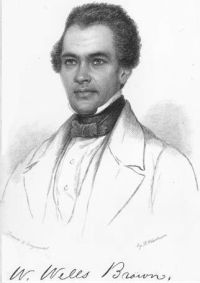 William Wells Brown,
Narrative of William W. Brown, a Fugitive Slave
(1848)
William Wells Brown,
Narrative of William W. Brown, a Fugitive Slave
(1848)
“ How improved will be our condition when we have such white negroes as perform the servile labors of Europe, of old England, and he would add now of New England, when our body servants and our cart drivers, and our street sweepers, are white negroes instead of black. ”
John James Geer, Beyond the Lines; Or, A Yankee Prisoner Loose in Dixie
“ If ever negroes, bursting their chains, should come (which Heaven forbid!) on the European coast, to drag whites of both sexes from their families, to chain them, and conduct them to Africa, and mark them with a hot iron ”
Various, The American Missionary — Volume 37…
“ Now, what we ask for the negro is that he be judged by his best and not by his worst. Of course, the best is always in the minority, but that is the way we are judged. If these same men were to go into the South and go into the negroes’ homes, they would find there very often excellent comfort. Some one has asked whether the negro has any of this race prejudice in him. ”
Edward A. Johnson,
Light Ahead for the Negro
“ Second—The natural disposition of the colored people to patronize white merchants and professional men in preference to their own was a factor to be reckoned with in looking for the causas rerum—a kind of one-sided arrangement whereby the whites got the Negroes’ money but the Negroes could not get theirs—in the professions. In many of the small lines of business, however, the Negro was patronized by the whites. ”
Holland Thompson, The New South: A Chronicle of Social and Industrial Evolution
“ These individuals all spell negro with a capital and declare that they are proud of their race. They parade its achievements—and these are not small when enumerated all at once—but they avoid intimate association with the great mass of negroes. ”
Mrs. Henry Rowe Schoolcraft, Letters on the Condition of the African race in the United States (1852)
“ My heart burns with indignant feeling when I see that the poor foolish negro is seduced from his master, and brought to our Northern cities, or smuggled into Canada, where he is alike despised and deserted, and left to famish, or exist in a place so small and filthy that our cows could not survive a winter in them. I have obtained a statistical pamphlet, printed by highly respectable gentlemen in Philadelphia, that reveals the hopeless desolation, and the agonizing sufferings, of the miserable, degraded classes of negroes in that city. ”
Thomas Nelson Page,
The negro: the southerner's problem
(1904)
“ The Negro race has already doubled three times in the United States since the beginning of the last century, and, unless conditions change, it is possible that before the end of the century there may be between sixty and eighty millions of Negroes in this country; a situation which will tax all, and more than all, of the wisdom and constancy of the white race. ”
Sterling A. Brown, The Negro in American fiction (1938)
“ Thousands of Negroes cross the line and I assure you that few, if any, feel that fictional urge to rejoin their own kind.... Negroes who can and do pass are so glad to get away they probably join the K.K.K. to uphold white supremacy. ”
Related terms
Authors who wrote about “Negroes”
George Washington WilliamsW. E. B. Du BoisEdward A. JohnsonThomas Nelson Page Carter Godwin WoodsonGilbert Thomas StephensonSterling A. Brown
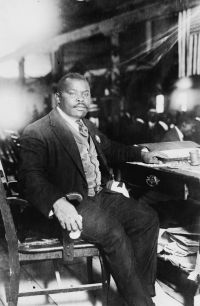 Marcus GarveyHubert H. Harrison
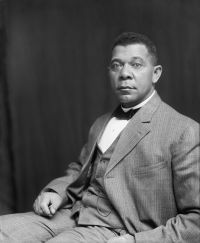 Booker T. WashingtonSutton E. GriggsJames Weldon JohnsonMadison Grant
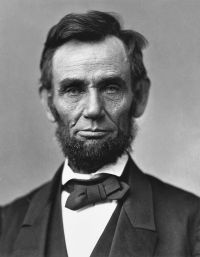 Abraham LincolnUlrich Bonnell PhillipsWhitelaw Reid
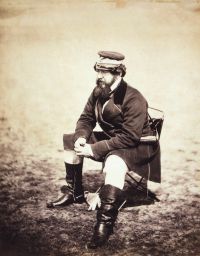 Sir William Howard RussellNathaniel H. BishopRobert StrangeGilbert Parker
W. E. B. Du BoisEdward A. JohnsonThomas Nelson PageCarter Godwin WoodsonGilbert Thomas StephensonSterling A. BrownMarcus GarveyHubert H. HarrisonBooker T. WashingtonSutton E. GriggsJames Weldon JohnsonMadison GrantAbraham LincolnUlrich Bonnell PhillipsWhitelaw ReidSir William Howard RussellNathaniel H. BishopRobert StrangeGilbert Parker