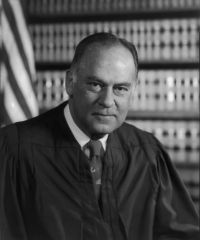
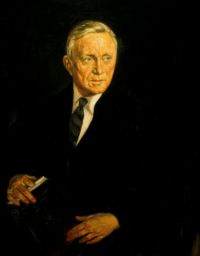
Thurgood Marshall

Biographical details

Thurgood Marshall Milliken v. Bradley — Dissenting Opinion

No more is necessary, but we can tolerate no less. To read this principle as barring a district court from imposing the only effective remedy for past segregation and remitting the court to a patently ineffective alternative is, in my view, to turn a simple common sense rule into a cruel and meaningless paradox. Ironically, by ruling out an inter-district remedy, the only relief which promises to cure segregation in the Detroit public schools, the majority flouts the very principle on which it purports to rely.
Source: Wikisource

Thurgood Marshall Stanley v. Georgia — Opinion of the Court

Whatever may be the justifications for other statutes regulating obscenity, we do not think they reach into the privacy of one's own home. If the First Amendmen means anything, it means that a State has no business telling a man, sitting alone in his own house, what books he may read or what films he may watch. Our whole constitutional heritage rebels at the thought of giving government the power to control men's minds.
And yet, in the face of these traditional notions of individual liberty, Georgia asserts the right to protect the individual's mind from the effects of obscenity.
Source: Wikisource

Thurgood Marshall Regents of University of California v…

It is unnecessary in 20th-century America to have individual Negroes demonstrate that they have been victims of racial discrimination; the racism of our society has been so pervasive that none, regardless of wealth or position, has managed to escape its impact. The experience of Negroes in America has been different in kind, not just in degree, from that of other ethnic groups. It is not merely the history of slavery alone, but also that a whole people were marked as inferior by the law.
Source: Wikisource

Get perspective with Kwize: daily news enlightened by great literature