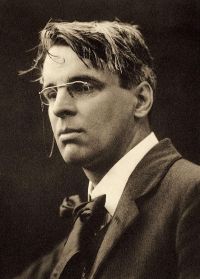
Summary

Portrait of W. B. Yeats W. B. Yeats Reveries over Childhood and Youth

The same passion for all moral and physical splendour that drew him to O’Leary would make him beg leave to wear, for some few days, a friend’s ring or pin, and gave him a heart that every pretty woman set on fire. I doubt if he was happy in his loves; for those his powerful intellect had fascinated were, I believe, repelled by his coarse red hair, his gaunt ungainly body, his stiff movements as of a Dutch doll, his badly rolled, shabby umbrella. And yet with women, as with O’Leary, he was gentle, deferential, almost diffident.
Source: Gutenberg

Portrait of W. B. Yeats W. B. Yeats Reveries over Childhood and Youth

When I was ten or twelve my father took me to see Irving play Hamlet, and did not understand why I preferred Irving to Ellen Terry, who was, I can now see, the idol of himself and his friends. I could not think of her, as I could of Irving’s Hamlet, as but myself, and I was not old enough to care for feminine charm and beauty. For many years Hamlet was an image of heroic self-possession for the poses of youth and childhood to copy, a combatant of the battle within myself.
Source: Gutenberg

Portrait of W. B. Yeats W. B. Yeats Reveries over Childhood and Youth

I could not compose anything but a portrait and even to-day I constantly see people as a portrait painter, posing them in the mind’s eye before such and such a background. Meanwhile I was still very much of a child, sometimes drawing with an elaborate frenzy, simulating what I believed of inspiration and sometimes walking with an artificial stride in memory of Hamlet and stopping at shop windows to look at my tie gathered into a loose sailor-knot and to regret that it could not be always blown out by the wind like Byron’s tie in the picture.
Source: Gutenberg

Get perspective with Kwize: daily news enlightened by great literature