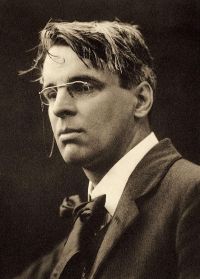
“ I have described what image—always opposite to the natural self or the natural world—Wilde, Henley, Morris copied or tried to copy, but I have not said if I found an image for myself. I know very little about myself and much less of that anti-self: probably the woman who cooks my dinner or the woman who sweeps out my study knows more than I. It is perhaps because nature made me a gregarious man, going hither and thither looking for conversation, and ready to deny from fear or favour his dearest conviction, that I love proud and lonely images. ”
Summary
Quotes from Four Years (W. B. Yeats)
“ I had been put into a rage by the followers of Huxley, Tyndall, Carolus Duran and Bastien-Lepage, who not only asserted the unimportance of subject, whether in art or literature, but the independence of the arts from one another. Upon the other hand I delighted in every age where poet and artist confined themselves gladly to some inherited subject matter known to the whole people, for I thought that in man and race alike there is something called 'unity of being,' using that term as Dante used it when he compared beauty in the Convito to a perfectly proportioned human body. ”
“ Its grave wide-open eyes, like the eyes of some dreaming beast, remind me of the open eyes of Titian's' Ariosto,' while the broad vigorous body suggests a mind that has no need of the intellect to remain sane, though it give itself to every phantasy, the dreamer of the middle ages. It is 'the fool of fairy ... wide and wild as a hill,' the resolute European image that yet half remembers Buddha's motionless meditation, and has no trait in common with the wavering, lean image of hungry speculation, that cannot but fill the mind's eye because of certain famous Hamlets of our stage. ”
“ The dream world of Morris was as much the antithesis of daily life as with other men of genius, but he was never conscious of the antithesis and so knew nothing of intellectual suffering. His intellect, unexhausted by speculation or casuistry, was wholly at the service of hand and eye, and whatever he pleased he did with an unheard of ease and simplicity, and if style and vocabulary were at times monotonous, he could not have made them otherwise without ceasing to be himself. ”
“ I was convinced, from some obscure meditation, that Stevenson's conversational method had joined him to my elders and to the indifferent world, as though it were right for old men, and unambitious men and all women, to be content with charm and humour. It was the prerogative of youth to take sides and when Wilde said: 'Mr. Bernard Shaw has no enemies but is intensely disliked by all his friends,' I knew it to be a phrase I should never forget, and felt revenged upon a notorious hater of romance, whose generosity and courage I could not fathom. ”
“ Have not all races had their first unity from a polytheism that marries them to rock and hill? We had in Ireland imaginative stories, which the uneducated classes knew and even sang, and might we not make those stories current among the educated classes, re-discovering for the work's sake what I have called 'the applied arts of literature,' the association of literature, that is, with music, speech and dance; and at last, it might be, so deepen the political passion of the nation that all, artist and poet, craftsman and day labourer would accept a common design? ”
“ Certain old women's faces filled me with horror, faces that are no longer there, or if they are, pass before me unnoticed: the fat blotched faces, rising above double chins, of women who have drunk too much beer and eaten too much meat. In Dublin I had often seen old women walking with erect heads and gaunt bodies, talking to themselves in loud voices, mad with drink and poverty, but they were different, they belonged to romance: Da Vinci has drawn women who looked so and so carried their bodies. ”
“ I hated his big lion pictures, where he attempted an art too much concerned with the sense of touch, with the softness or roughness, the minutely observed irregularity of surfaces, for his genius; and I think he knew it. 'Rossetti used to call my pictures 'pot-boilers,' he said, 'but they are all—all,' and he waved his arms to the canvases, 'symbols.' When I wanted him to design gods and angels and lost spirits once more, he always came back to the point, 'Nobody would be pleased.' 'Everybody should have a raison d'etre' was one of his phrases. ”
“ I thought that it was my business in life to bean artist and a poet, and that there could be no business comparable to that. I refused to read books, and even to meet people who excited me to generalization, but all to no purpose. I said my prayers much as in childhood, though without the old regularity of hour and place, and I began to pray that my imagination might somehow be rescued from abstraction, and become as pre-occupied with life as had been the imagination of Chaucer. ”
“ I can remember meeting of a Sunday night Charles Whibley, Kenneth Grahame, author of 'The Golden Age,' Barry Pain, now a well known novelist, R. A. M. Stevenson, art critic and a famous talker, George Wyndham, later on a cabinet minister and Irish chief secretary, and Oscar Wilde, who was some eight years or ten older than the rest. But faces and names are vague to me and, while faces that I met but once may rise clearly before me, a face met on many a Sunday has perhaps vanished. ”
“ My first meeting with Oscar Wilde was an astonishment. I never before heard a man talking with perfect sentences, as if he had written them all over night with labour and yet all spontaneous. There was present that night at Henley's, by right of propinquity or of accident, a man full of the secret spite of dullness, who interrupted from time to time and always to check or disorder thought ”
“ To-day I add to that first conviction, to that first desire for unity, this other conviction, long a mere opinion vaguely or intermittently apprehended: Nations, races and individual men are unified by an image, or bundle of related images, symbolical or evocative of the state of mind, which is of all states of mind not impossible, the most difficult to that man, race or nation; because only the greatest obstacle that can be contemplated without despair rouses the will to full intensity. ”
“ I brought him an admiration settled in early boyhood, for my father had always said, 'George Wilson was our born painter but Nettleship our genius,' and even had he shown me nothing I could care for, I had admired him still because my admiration was in my bones. He showed me his early designs and they, though often badly drawn, fulfilled my hopes. Something of Blake they certainly did show, but had in place of Blake's joyous intellectual energy a Saturnian passion and melancholy. ”
“ If Stevenson's talk became monologue we did not know it, because our one object was to show by our attention that he need never leave off. If thought failed him we would not combat what he had said, or start some new theme, but would encourage him with a question; and one felt that it had been always so from childhood up. His mind was full of phantasy for phantasy's sake and he gave as good entertainment in monologue as his cousin Robert Louis in poem or story. ”
“ My very remorse helped to spoil my early poetry, giving it an element of sentimentality through my refusal to permit it any share of an intellect which I considered impure. Even in practical life I only very gradually began to use generalizations, that have since become the foundation of all I have done, or shall do, in Ireland. For all I know, all men may have been as timid; for I am persuaded that our intellects at twenty contain all the truths we shall ever find, but as yet we do not know truths that belong to us from opinions caught up in casual irritation or momentary phantasy. ”
“ At the end of the eighties my father and mother, my brother and sisters and myself, all newly arrived from Dublin, were settled in Bedford Park in a red-brick house with several wood mantlepieces copied from marble mantlepieces by the brothers Adam, a balcony, and a little garden shadowed by a great horse-chestnut tree. Years before we had lived there, when the crooked, ostentatiously picturesque streets, with great trees casting great shadows, had been anew enthusiasm: the Pre-Raphaelite movement at last affecting life. ”
“ I am very religious, and deprived by Huxley and Tyndall, whom I detested, of the simple-minded religion of my childhood, I had made a new religion, almost an infallible church, out of poetic tradition: a fardel of stories, and of personages, and of emotions, a bundle of images and of masks passed on from generation to generation by poets & painters with some help from philosophers and theologians. ”
“ We in Ireland thought as do the plays and ballads, not understanding that, from the first moment wherein nature foresaw the birth of Bastien-Lepage, she has only granted great creative power to men whose faces are contorted with extravagance or curiosity or dulled with some protecting stupidity. I had now met all those who were to make the nineties of the last century tragic in the history of literature, but as yet we were all seemingly equal, whether in talent or in luck, and scarce even personalities to one another. ”
“ Even in those days I would often defend him by saying that his very admiration for his predecessors in poetry, for Browning, for Swinburne and Rossetti, in their first vogue while he was a very young man, made any success seem impossible that could satisfy his immense ambition: never but once before had the artist seemed so great, never had the work of art seemed so difficult. ”
“ I never travel anywhere without it; but it is the very flower of decadence. The last trumpet should have sounded the moment it was written.' 'But,' said the dull man, 'would you not have given us time to read it?' 'Oh no,' was the retort, 'there would have been plenty of time afterwards—in either world.' I think he seemed to us, baffled as we were by youth, or by infirmity, a triumphant figure, and to some of us a figure from another age, an audacious Italian fifteenth century figure. ”
“ Some quarter of an hour's walk from Bedford Park, out on the high road to Richmond, lived W. E. Henley, and I, like many others, began under him my education. His portrait, a lithograph by Rothenstein, hangs over my mantlepiece among portraits of other friends. He is drawn standing, but, because doubtless of his crippled legs, he leans forward, resting his elbows upon some slightly suggested object—a table or a window-sill. ”
“ I thought myself alone in hating these young men, now indeed getting towards middle life, their contempt for the past, their monopoly of the future, but in a few months I was to discover others of my own age, who thought as I did, for it is not true that youth looks before it with the mechanical gaze of a well-drilled soldier. ”
“ There was Todhunter, a well-off man who had bought my father's pictures while my father was still Pre-Raphaelite. Once a Dublin doctor he was a poet and a writer of poetical plays: a tall, sallow, lank, melancholy man, a good scholar and a good intellect; and with him my father carried on a warm exasperated friendship, fed I think by old memories and wasted by quarrels over matters of opinion. Of all the survivors he was the most dejected, and the least estranged, and I remember encouraging him, with a sense of worship shared, to buy a very expensive carpet designed by Morris. ”
“ Have not all peoples, while bound together in a single mind and taste, believed that such men existed and paid them that honour, or paid it to their mere shadow, which they have refused to philanthropists and to men of learning? ”
“ I thought that all art should be a Centaur finding in the popular lore its back and its strong legs. I got great pleasure too from remembering that Homer was sung, and from that tale of Dante hearing a common man sing some stanza from 'The Divine Comedy,' and from Don Quixote's meeting with some common man that sang Ariosto. Morris had never seemed to care for any poet later than Chaucer; and though I preferred Shakespeare to Chaucer I begrudged my own preference. ”
“ At the British Museum reading-room I often saw a man of thirty-six or thirty-seven, in a brown velveteen coat, with a gaunt resolute face, and an athletic body, who seemed before I heard his name, or knew the nature of his studies, a figure of romance. ”
“ If the London merchants of our day competed together in writing lyrics they would not, like the Tudor merchants, dance in the open street before the house of the victor; nor do the great ladies of London finish their balls on the pavement before their doors as did the great Venetian ladies even in the eighteenth century, conscious of an all enfolding sympathy. ”
“ Sometimes I told myself very adventurous love stories with myself for hero, and at other times I planned out a life of lonely austerity, and at other times mixed the ideals and planned a life of lonely austerity mitigated by periodical lapses. I had still the ambition, formed in Sligo in my teens, of living in imitation of Thoreau on Innisfree, a little island in Lough Gill, and when walking through Fleet Street very homesick I heard a little tinkle of water and saw a fountain in a shop window which balanced a little ball upon its jet and began to remember lake water. ”
“ We have been told that all spiritual influx into the society will come to an end in 1897 for exactly one hundred years. Before that date our fundamental ideas must be spread through the world.' I knew the doctrine and it had made me wonder why that old woman, or rather 'the trance personalities' who directed her and were her genius, insisted upon it, for influx of some kind there must always be. Did they dread heresy after the death of Madame Blavatsky, or had they no purpose but the greatest possible immediate effort? ”
“ He cared nothing for philosophy, nothing for economics, nothing for the policy of nations, for history, as he saw it, was a memory of men who were amusing or exciting to think about. He impressed all who met him & seemed to some a man of genius, but he had not enough ambition to shape his thought, or conviction to give rhythm to his style, and remained always a poor writer. ”
“ When the Fenian poet says that his heart has grown cold and callous, 'For thy hapless fate, dear Ireland, and sorrows of my own,' he but follows tradition, and if he does not move us deeply, it is because he has no sensuous musical vocabulary that comes at need, without compelling him to sedentary toil and so driving him out from his fellows. ”
“ In London I saw nothing good, and constantly remembered that Ruskin had said to some friend of my father's—'As I go to my work at the British Museum I see the faces of the people become daily more corrupt.' I convinced myself for a time, that on the same journey I saw but what he saw. ”
“ How could one resent his prejudice when, that he himself might play a worthy part, he must find beyond the common rout, whom he derided and flouted daily, opponents he could imagine moulded like himself? Once he said to me in the height of his imperial propaganda, 'Tell those young men in Ireland that this great thing must go on. They say Ireland is not fit for self-government but that is nonsense. It is as fit as any other European country but we cannot grant it.' And then he spoke of his desire to found and edit a Dublin newspaper. ”
Common terms
Similar works
The Trembling of the Veil (W. B. Yeats…The Collected Works in Verse and Prose of William Butler Yeats…Ideas of Good and Evil (W. B. Yeats…Early memories; some chapters of autobiography…The Cutting of an Agate (W. B. Yeats…Ideas of Good and Evil (William Butler Yeats…William Blake, painter and poet…Essays Irish and American (John Butler Yeats…Thomas Moore (Stephen Lucius Gwynn…The Revival of Irish Literature…
