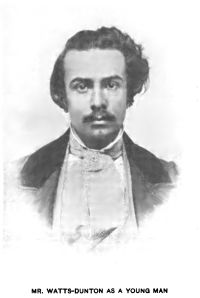
Walter Theodore Watts-Dunton

Walter Theodore Watts-Dunton

Summary

Portrait of Walter Theodore Watts-Dunton Walter Theodore Watts-Dunton 1911 Encyclopædia Britannica (1911)

When Menander declared that, having selected his plot, he looked upon his comedy as three parts finished, he touched upon a subject which all workers in drama—all workers in imaginative literature of every kind—would do well to consider. In all literatures—ancient and modern—an infinite wealth of material has been wasted upon subjects that are unworthy, or else incapable, of artistic realization; and yet Wycherley's case is, in our literature at least, without a parallel.
Source: Wikisource

Portrait of Walter Theodore Watts-Dunton Walter Theodore Watts-Dunton 1911 Encyclopædia Britannica (1911)

He had not seen enough of life to learn that in the long run nothing is politic but “straightforwardness.” Whether because his countenance wore a pensive and subdued expression, suggestive of a poet who had married a dowager countess and awakened to the situation, or whether because treacherous confidants divulged his secret, does not appear, but the news of his marriage oozed out—it reached the royal ears, and deeply wounded the father anxious about the education of his son. Wycherley lost the appointment that was so nearly within his grasp—lost indeed the royal favour for ever.
Source: Wikisource

Portrait of Walter Theodore Watts-Dunton Walter Theodore Watts-Dunton 1911 Encyclopædia Britannica (1911)

If civilization has any meaning at all for the soul of man, the Englishmen of Chaucer's time, the Anglo-Saxons of the Heptarchy, nay, those half-naked heroes, who in the dawn of English history clustered along the southern coast to defend it from the invasion of Caesar, were far more civilized than that “race gangrenée”—the treacherous rakes, mercenary slaves and brazen strumpets of the court of Charles II., who did their best to substitute for the human passion of love (a passion which was known perhaps even to palaeolithic man) the promiscuous intercourse of the beasts of the field.
Source: Wikisource

Get perspective with Kwize: daily news enlightened by great literature