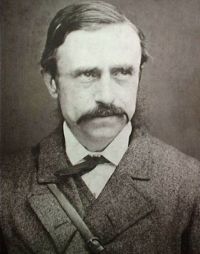
William Boyd Dawkins

William Boyd Dawkins

../../ (1872)

Summary

Portrait of William Boyd Dawkins William Boyd Dawkins,  ../../ (1872)

“ The fauna of Italy and Spain is remarkable for the absence of the Arctic forms which were so abundant in Central France and Germany; and there is no doubt that the difference between the fauna of the region north of the Alps and Pyrenees and that of the south is due to a difference of latitude and to the fact that the climatal change so marked in the north was hardly felt in the south. In other words, the physical condition of Britain during the early stage of the Pleistocene, and which did not recur again, was maintained throughout the Pleistocene period in the districts above mentioned. ”
Source: Wikisource

Portrait of William Boyd Dawkins William Boyd Dawkins,  ../../ (1872)

“ The temperate climate gradually became colder in France, Germany and Britain; and as the cold became more intense in the northern portions, the animals fitted for a cold climate passed southwards and westwards. In this great migration the animals adapted for a temperate or moderately severe climate would be the first to arrive. Were the climate of the extreme north to become so intense as to prevent the sojourn of the Reindeer and Musk-sheep on the shores of the Arctic Ocean, and to affect the whole of the Continent, there would be a steady drift of mammal life from north to south ”
Source: Wikisource

Portrait of William Boyd Dawkins William Boyd Dawkins,  ../../ (1872)

“ In the vast plains of Siberia also, extending from the Altai Mountains to the Arctic Sea, we find a near approach to the Pleistocene climate of North-western and Central Europe. Covered by impenetrable forests, for the most part of birch, poplar, larch, and pine, and, in the north, of low creeping dwarf cedars, they present every gradation in climate, from the temperate to that in which the cold is too severe to admit of the growth of trees, which decrease in size as the traveller advances northwards, and are finally replaced by the grey mosses and lichens that cover the low marshy tundras. ”
Source: Wikisource

Get perspective with Kwize: daily news enlightened by great literature