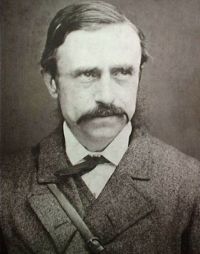
William Boyd Dawkins

William Boyd Dawkins

Summary

Portrait of William Boyd Dawkins William Boyd Dawkins 1911 Encyclopædia Britannica, Volume 5… (1911)

Caves have excited the awe and wonder of mankind in all ages, and have been the centres round which have clustered many legends and superstitions. They were the abode of the sibyls and the nymphs in Roman mythology, and in Greece they were the temples of Zeus, Pan, Dionysus, Pluto and the Moon, as well as the places where the oracles were delivered at Delphi, Corinth and Mount Cithaeron.
Source: Wikisource

Portrait of William Boyd Dawkins William Boyd Dawkins 1911 Encyclopædia Britannica, Volume 5… (1911)

It may, therefore, be concluded that in the Neolithic Age an Iberian population occupied the whole of the area mentioned above, inhabiting caves and burying their dead in caves and chambered tombs, and possessed of the same habits of life. The remains of the same small, oval-featured, long-headed race have been found in Belgium in the cave of Chauvaux, and they have been described by Sergi in southern Europe under the name of the Mediterranean race.
There is no evidence that any other race except the Iberic buried their dead in the caves of Britain in the Neolithic Age.
Source: Wikisource

Portrait of William Boyd Dawkins William Boyd Dawkins 1911 Encyclopædia Britannica, Volume 5… (1911)

The cave-men ranged over middle Europe as far south as the Pyrenees and the Alps, and inhabited the caverns of Belgium and Germany, Hungary and Switzerland. Their remains have not as yet been met with in southern Europe. They lived by hunting and fishing, they were fire users, and lit up the darkness of their caves with stone lamps filled with fat (Altamira) . They were clad in skins sewn together with sinews of reindeer or strips of intestines. They used huts as well as caves for habitation. They had a marvellous facility for drawing animal figures.
Source: Wikisource

Get perspective with Kwize: daily news enlightened by great literature