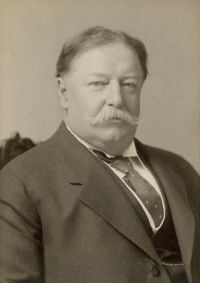
William Howard Taft

William Howard Taft

Summary

Portrait of William Howard Taft William Howard Taft Truax v. Corrigan/Dissent Pitney… (1921)

There is here no denial of equal protection. Legislation almost of necessity proceeds subject by subject, with classification as an essential part of the process. In adjusting their laws to the needs of the people, the states have a wide range of discretion about classification; the equal protection clause does not require that all state laws shall be perfect and complete, nor that the entire field of proper legislation shall be covered by a single act
Source: Wikisource

Portrait of William Howard Taft William Howard Taft Truax v. Corrigan/Dissent Pitney… (1921)

The use of the process of injunction to prevent disturbance of a going business by such a campaign as defendants here have conducted, is in the essential sense a measure of police regulation. And just as the states have a broad discretion about establishing police regulations, so they have a discretion, equally broad, about modifying and relaxing them. They may adopt the common law, or some other system, as their own judgment of the interests of their people may determine.
Source: Wikisource

Portrait of William Howard Taft William Howard Taft Truax v. Corrigan/Dissent Pitney… (1921)

I find no authority for the proposition that the guaranty was intended to secure equality of protection 'not only for all but against all similarly situated,' except as between persons who properly belong in the same class. The familiar expression, in Barbier v. Connolly, 113 U.S. 27, 32, 5 Sup. Ct. 357, 360 (28 L. Ed. 923) , 'Class legislation, discriminating against some and favoring others,' refers to a discrimination which at the same time favors others similarly situated.
Source: Wikisource

Get perspective with Kwize: daily news enlightened by great literature