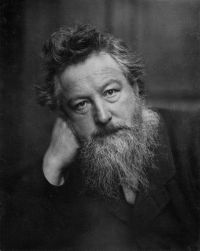
William Morris

William Morris

Summary

Portrait of William Morris William Morris,  Pygmalion and the Image

“ The craftsman o'er his work some morn of spring
May chide his useless labor never done,
For all his murmurs, with no other thing
He soothes his heart, and dulls thought's poisonous sting,
And thus in thought's despite the world goes on;
And so it was with this Pygmalion.
Unto the chisel must he set his hand,
And slowly, still in troubled thought must pace
About a work begun, that there doth stand,
And still returning to the self-same place,
Unto the image now must set his face,
And with a sigh his wonted toil begin,
Half loathed, half loved, a little rest to win.
”
Source: Gutenberg

Portrait of William Morris William Morris,  Pygmalion and the Image

“ In the second, 'The Hand Refrains,' the days of long labor are ended, and the artist's ideal, the cold, pure figure of the yet soulless image stands finished on the still rough pedestal, surrounded by flakes and chips of marble and implements of the sculptor's craft, while Pygmalion, chisel and mallet in hand, stays gazing in awe at the marvel his hand has achieved, his eyes content, but his soul still hungering. ”
Source: Gutenberg

Portrait of William Morris William Morris,  Pygmalion and the Image

“ It is this love of craftsmanship for its own sake, joined to a remarkable feeling for decorative beauty which both possessed, that binds the pictures of Burne-Jones and this poem by Morris so closely together that they form one perfect whole. Even the ideal and wholly imaginary world in which their figures move is the same—a land where emotion rather than passion bears sway, where the fates of man and of woman are determined by a whim of the gods rather than dominated by the chivalrous or devout hardihood of the individual. ”
Source: Gutenberg

Get perspective with Kwize: daily news enlightened by great literature