Alexander VI of the Holy Roman Empire

Definition and stakes

Recent Developments in European Thought

Down even to yesterday it seemed to many minds a necessary condition that one man, gathering in his hands the resources of one great State, should from that centre dominate the world. And in the dawn of human history it was no doubt often true, the only way in which the world could then advance. This was true for Alexander, the prototype of all the Roman conquerors, and true, conspicuously, for the Roman empire at its best. But, after the break-up of the empire, unity of this type became a delusive mirage, misleading all who, like the Holy Roman emperors, sought to enjoy it again.
Source: Gutenberg

Various Encyclopaedia Britannica, 11th Edition…

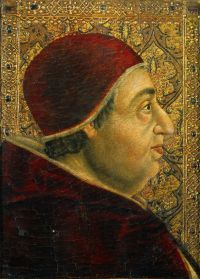
Each petty potentate strove for his own private advantage in the confusion; and at this epoch the chief gains accrued to the papacy. Aided by his terrible son, Cesare Borgia, Alexander VI. chastised the Roman nobles, subdued Romagna and the March, threatened Tuscany, and seemed to be upon the point of creating a Central Italian state in favour of his progeny, when he died suddenly in 1503. His conquests reverted to the Holy See. Julius II., his bitterest enemy and powerful successor, continued Alexander’s policy, but no longer in the interest of his own relatives.
Source: Gutenberg

The historians' history of the world in twenty-five volumes…

Alexander went to Asia with the intention of seizing upon the empire of the Persian king. This he accomplished, not in a wild orgy of victory but with the tenacious perseverance which took three years for the conquest and organisation of the Eastern provinces, but did not overleap itself by extravagant ambitions. It is only legend that makes him the conqueror of the world. He was a Macedonian, the hereditary king of a feudal state which the energy of his father had transformed into a military monarchy.
Source: Gutenberg

Get perspective with Kwize: daily news enlightened by great literature