Austro-Prussian War

Definition and stakes

Percy Cross Standing,  The Campaign in Russian Poland

“ He realises more fully than before that every blow struck at the Central European Powers on their eastern frontier is, in the long run, as telling as any reverse inflicted upon them in the western theatre of war. But he ought to realise it more fully yet. The position is that the long series of Russian successes, culminating in the Austrian overthrow at Lemberg and Halicz, has cast the whole Austro-German war-plan into confusion, which may at this moment be affecting the German operations in France in the most serious degree. ”
Source: Gutenberg

baron de Jean-Baptiste-Antoine-Marcelin Marbot,  The Memoirs of General Baron de Marbot

“ It is hard to believe the incompetence displayed, for seven years, by our enemies' governments. We saw, in 1805, the Austrians attack us on the Danube, and be defeated in isolation at Ulm, instead of waiting for Russia to join them and for Prussia to declare war on Napoleon. Now, in 1806, those same Prussians who, a year before, could have prevented the defeat of the Austro-Russians by joining them, not only declared war on us when we were at peace with Vienna, but repeated the mistake of attacking us without waiting for the Russians! ”
Source: Gutenberg

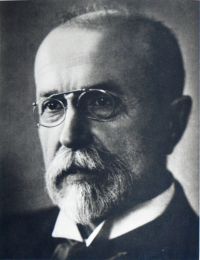
Portrait of Tomáš Garrigue Masaryk Tomáš Garrigue Masaryk,  The New Europe (1917)

“ Let us see things clearly, and let us speak as politicians. What would the Allies say if Italy made a separate peace with our common enemy? Why are those people, who desire a separate peace with Austria, so nervous if the possibility of Russia making a separate peace is suggested? If Austria made a separate peace, that would mean an Austrian betrayal of Germany; Austria provoked the war; Germany used the occasion for her political aims, and, incidentally, saved Austria by forcing the Russians to retreat. ”
Source: Wikisource

Get perspective with Kwize: daily news enlightened by great literature