Berwick-upon-Tweed

Definition and stakes

William Winter,  Gray Days and Gold in England and Scotland

“ All the country-side in this region is rich. At Long Houghton a grand church uprears its vast square tower, lonely and solemn in its place of graves. Royal Berwick comes next, stately and serene upon its ocean crag, with the white-crested waves curling on its beach and the glad waters of the Tweed kissing the fringes of its sovereign mantle, as they rush into the sea. The sun is sinking now, and over the many-coloured meadows, red and brown and golden and green, the long, thin shadows of the trees slope eastward and softly hint the death of day. ”
Source: Gutenberg

1911 Encyclopædia Britannica (1910)

“ A fair is held annually at the end of May. There are iron-works and boat-building yards.
The custom of specially mentioning Berwick-upon-Tweed after Wales, though abandoned in acts of parliament, is retained in certain proclamations. The title of “county in itself” also helps to recall its ancient history. The liberties of the borough, commonly called Berwick Bounds, include the towns of Spittal, at the mouth, and Tweedmouth immediately above it, on the south bank of the river.
”
Source: Wikisource

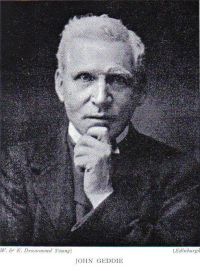
Portrait of John Geddie John Geddie,  The Scott Country

“ Kelso gave bent and direction to his genius.
Like Smailholm, Kelso was “meet nurse for a poetic child”, for here join two “superb rivers”—Tweed and Teviot—each bringing down, from a hundred sources, its treasure of ancient story. As we have said, the beauty and romance of Tweedside do not begin in this neighbourhood. They are the endowment of the main stream from its tap-root to 12 the sea. Berwick-upon-Tweed, for centuries a cause of contention between the Kingdoms, was at one time regarded as separate and apart from each—“England, Scotland, and the town of Berwick-upon-Tweed”.
”
Source: Gutenberg

Get perspective with Kwize: daily news enlightened by great literature