The Three Bears (1888)
“ But big Bruin was angry, and shouted out, "No! You had no right to come hither, and now you shan't go. What we mean to do with you, ere long you shall find; You can lie there and cry till I make up my mind." ”
The literary concept of "Bruin," often depicted as a bear, delves into themes of wildness, human-animal relationships, and moral contemplation. Authors such as Clarence Hawkes illustrate Bruin’s shift from a tamed companion to an emblem of unbridled nature, while Alfred Elwes employs the bear to challenge human vices such as selfishness and bias.
Charles Egbert Craddock presents Bruin as a playful yet powerful figure in frontier narratives, and Peter Christen Asbjørnsen imbues the character with a folkloric allure. These diverse interpretations highlight Bruin as a multifaceted symbol representing both the natural world and human societal evaluations, connecting the realms of wilderness and civilization.
The Three Bears (1888)
“ But big Bruin was angry, and shouted out, "No! You had no right to come hither, and now you shan't go. What we mean to do with you, ere long you shall find; You can lie there and cry till I make up my mind." ”
 Charles Egbert Craddock,
The Story of Old Fort Loudon
Charles Egbert Craddock,
The Story of Old Fort Loudon
“ A finer looking Bruin than he was when enveloped in a great bearskin never came out of the woods, and certainly none more active as he chased the youthful pioneers, who were screaming shrilly, from one side of the hall to the other. ”
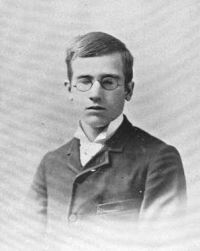 Clarence Hawkes,
Black Bruin: The Biography of a Bear
Clarence Hawkes,
Black Bruin: The Biography of a Bear
“ Children and their caresses had been his one pleasure during the strenuous year with Pedro. Now, suddenly all this relationship toward man was changed. Black Bruin had gone from the pale of civilization into that of savagery. He was now a wild beast, feared by men, although without much cause. Little by little this new relationship between himself and the man beast was borne in upon Black Bruin. At first, he shunned men and their way, fearing that some man might capture him and again claim him for the road. The wild, free life made him glad. ”
Clarence Hawkes,
Black Bruin: The Biography of a Bear
“ The old world and the old life were left far behind, and when the last blue hilltop faded, the heart went out of Black Bruin. He no longer exulted in his strength and his cunning, for man had again undone him. ”
Clarence Hawkes,
Black Bruin: The Biography of a Bear
“ Then Black Bruin crept forward to within three or four feet of where Pedro lay heavily sleeping, and stood there, watching his master. He felt sure that with one blow of his paw he could cripple him, but he could not bring himself to strike that blow. The man might have some new and terrible hidden power that he knew not of. ”
Alfred Elwes, The Adventures of a Bear, and a Great Bear Too
“ Alas, how much does Bruin's condition remind us of little scenes among ourselves! We give way to our bad tempers and our selfishness; we make ourselves disagreeable, and our friends unhappy; we quarrel, if we do not actually fight; and when we meet the reward of our waywardness, and find ourselves abandoned by those who would have loved us had we acted differently, we then moan [Pg 11] over our fate, and bitterly regret what we might have avoided. Alas, poor human nature! alas, poor bear!I am truly sorry to observe that no act of repentance followed Bruin's sense of desolation. ”
“ Bruin was hit hard, but for a time at least he was as strong as ever, while his rage was the more intensified.He reached out both ponderous paws to seize Jack, who, had he been caught, would have received a hug sufficient to crush all the bones in his body to a pulp; but with a dexterity and coolness wonderful in one of his years, he dropped down, so that the paws clasped vacancy over his head, and, darting to one side, he made a dash to the nearest sapling.When the animal turned to see what had become of his victim, he observed him dashing off in a full run. ”
Alfred Elwes, The Adventures of a Bear, and a Great Bear Too
“ And here we may observe, that they are such characters as Bruin who bring disrepute on a whole tribe; for we are too apt to form our opinions of a nation by the few individuals we may happen to fall in with, although, probably, no conclusions can be falser. Let us, therefore, be careful ere we form our judgments, and let us not believe that all Bruin's kindred and compatriots were sulky and ill-tempered because he himself was such a disagreeable lump of a bear. ”
Alfred Elwes, The Adventures of a Bear, and a Great Bear Too
“ Bruin was thunderstruck! Never before had they ever presumed to dip their paws into his dish, and now they were actually before his face, converting the most delicate morsels to their own use, and, as it were, taking the food out of his very mouth! After an internal struggle of a few seconds, during which it seemed doubtful whether his emotions or his greediness in filling his jaws so full would choke him, he uttered a savage growl, and, with one stroke of his huge paw, felled his younger brother to the ground. ”
Alfred Elwes, The Adventures of a Bear, and a Great Bear Too
“ Ah, Master Bruin! Master Bruin! you are not the first to make the discovery that knowledge is superior to brute force. Angry or not, he wished to know the meaning of the note; and summoning to his presence one who had managed to procure the chief place in his household, cunning Fox as he was, he commanded that worthy to read its contents aloud. ”
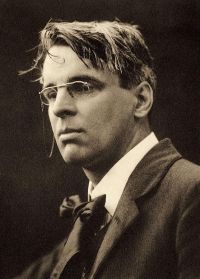 William Butler Yeats,
The Land of Heart's Desire
(1894)
William Butler Yeats,
The Land of Heart's Desire
(1894)
“ Bridget Bruin. You are the fool of every pretty face, And I must pinch and pare that my son's wife May have all kinds of ribbons for her head. Maurteen Bruin. Do not be cross; she is a right good girl! ”
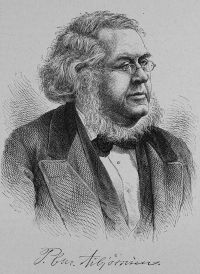 Peter Christen Asbjørnsen,
Tales from the Fjeld — Bruin Goodfellow
(1908)
Peter Christen Asbjørnsen,
Tales from the Fjeld — Bruin Goodfellow
(1908)
“ Bruin, they say, is a brave fellow, but even he was not quite pleased with his drive this time. So there he sat, holding fast as well as he could, and he glared and grinned on all sides, and he thought of throwing himself off, but he was not used to sledge travelling, and so he made up his mind to sit still where he was. So when he had driven a good bit he met a pedlar. "Whither, in heaven's name, is the sheriff bound to-day? He has surely little time and a long way, he drives so fast." ”
Alfred Elwes, The Adventures of a Bear, and a Great Bear Too
“ These various sights proved to Bruin that there must be a different agency at work to that which existed in his native forest. He was wise enough to perceive that mere animal force was not likely to succeed here, or hold the same position as it did in the land where he was born and had spent his earlier years. The appearances of wealth on one hand, the evidences of a soldier-like discipline and order on the other, convinced him that this was no place to vent his ill-humour by an exhibition of brute strength, for that it was sure to meet more than its match ”
 William Henry Giles Kingston,
Dick Onslow Among the Redskins
William Henry Giles Kingston,
Dick Onslow Among the Redskins
“ I very naturally could not help turning my head over my shoulder, to see what Bruin was about, and, as I did so, a growl louder than the previous one reached my ear, and I saw him moving on at a swinging trot after me. This I knew meant mischief. Flight was totally out of the question. I must fight the battle like a man. It must be literally victory or death.Strange as it may seem, my heart felt more buoyant when I had made up my mind for the struggle, independent of certain anticipations of the pleasure I should derive from the bear steaks I had in contemplation, should I be successful. ”
Frederick Whishaw, The Romance of the Woods
“ Then at length the spirit of the assembled population returned to them, and, as though with one accord, the entire crowd gave vent to a shriek of relief and rage; men began to finger their scythes and women their rakes, and the whole assembly moved a step or two towards the intruder. Then Bruin began to think that discretion was, perhaps, after all, the better part of valour, and, with a few savage snarls and grunts, he retired into the forest, stepping upon a sleeping baby as he withdrew, and causing the child to wake and scream with pain or fright. ”
Alfred Elwes, The Adventures of a Bear, and a Great Bear Too
“ Bruin reflected a moment, where reflection was ruin. Had he at once and scornfully rejected the horrible temptation, there would still have been hope for him; but, besides the prospect of liberty, though he did not yet know how that was to be effected, there was the chance of enriching himself once again; and, above all, there was a prospect of revenge against the dog who had once sought his life, because he had been selected as an object of preference by his daughter. His meditations, therefore, were at once brought to an end, by his resolution to accept the proposal ”
Peter Christen Asbjørnsen,
Tales from the Fjeld: A Second Series of Popular Tales
“ The first is Father Bruin in the Corner, and it shows too what tongues old wives have, and how there's no stopping them even in a pitfall. Many's the time I've trapped Bruin, and Graylegs, and Reynard, in a pit; but I never yet trapped an old woman, and I hope I never shall. It would be like shearing a pig, 'all cry and no wool.' But here is the story."FATHER BRUIN IN THE CORNER."Once on a time there was a man who lived far, far away in the wood. He had many, many goats and sheep, but never a one could he keep for fear of Graylegs, the wolf. ”
“ The poor King, having no means of defending his kingdom, was forced to disguise himself with a false beard, and carrying his only son, the little Prince Featherhead, in his arms, and accompanied only by the Queen, to make the best of his way into the wild country. They were lucky enough to escape the soldiers of King Bruin, and at last, after unheard-of fatigues and adventures, they found themselves in a charming green valley, through which flowed a stream clear as crystal and overshadowed by beautiful trees. ”
A Selection from the Norse Tales for the Use of Children
“ Well! the others had nothing against that. It would be good fun, they said, and the Bear began; for you may fancy he was king of the company.“The king of England,” said Bruin, “has such bad eyesight, that he can scarce see a yard before him; but if he only came to this lime-tree in the morning, while the dew is still on the leaves, and took and rubbed his eyes with the dew, he would get back his sight as good as ever.”“Very true!” said Greylegs. “The king of England has a deaf and dumb daughter too; but if he only knew what I know, he would soon cure her. ”
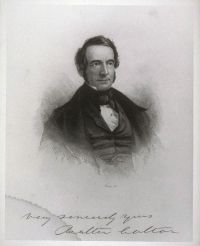 Walter Colton,
The land of gold; or, Three years in California
(1860)
Walter Colton,
The land of gold; or, Three years in California
(1860)
“ Down came old bruin with one bound into the midst, full of wrath and revenge. The horses instinctively wheeled into a circle, and as bruin sprung for a death-grapple, the lasso of our baccaros, thrown with unerring aim, brought him up all standing. He now turned upon the horse of his new assailant; but that sagacious animal evaded each plunge, and seemed to play in transport about his antagonist. The pistols were out again, and a fresh volley fell thick as hail 206around the bear. ”
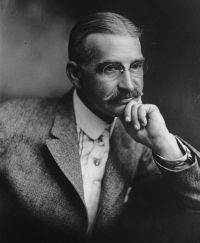 L. Frank Baum,
John Dough and the Cherub
L. Frank Baum,
John Dough and the Cherub
“ He was always good-natured and cheerful, quite winning the hearts of the Hilanders by poking fun at the Lolanders, and afterward delighting the Lolanders by jeering at the Hilanders.So Para Bruin's life was a happy one, and for countless years he remained the close friend and [Pg 315] companion of King Dough the First, the popular and worthy ruler of Hiland and Loland. ”
W. C. Bartlett, The Overland Monthly (1868)
“ When stage horses start on a tearing run over a mountain road at midnight, look for bear tracks in the morning. It is but fair to say that bruin does not generally meddle with people who are not of a meddlesome turn of mind. When put upon his mettle, he goes in for a square fight; and as far as my scanty data may be relied upon, he whips in a majority of instances. A Henry rifle, two shot-guns, a small mili tary tent, some heavy blankets, and a good supply of fishing-tackle, with two or three cooking utensils and some small stores, made up the equipment. ”
Various, The Wide World Magazine, Vol. 22…
“ During the latter part of these proceedings "Texas" had been trying to tear a hole in the roof, and, standing on his bunk—one of the top ones—had been successful in ripping off a shingle or two.Directly Bruin got clear of the shack George let drive. He must have hit him in the leg, I think, for the brute seemed to limp afterwards. I was up a tree at the time, and when the next cartridge jammed I fully expected to see George have a lively time. According to precedent the bear should have got savage on being hit and made things interesting ”
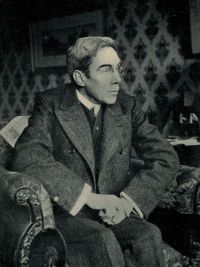 Henry Harland,
Mademoiselle Miss, and Other Stories
Henry Harland,
Mademoiselle Miss, and Other Stories
“ A young woman going to Bruants (than which there is scarcely a shadier resort in all the shady by-ways of Bohemia) —going to Bruant’s for the first time in her life, boldly gets up, and takes part in the performance! How were we to penetrate beneath the surface of her conduct, and perceive the world of innocence, the supreme unconsciousness of evil, that lay hidden there, and accounted for it? Bruant himself, to our shame be it owned,—rough, ribald, rowdy Aristide,—saw what we were blind to. ”
Ellen Velvin, Rataplan, a Rogue Elephant; and Other Stories
“ Then the "tappen" comes forward, blocks up a passage in the stomach, so that no food can pass through the system, and stays there until the bear wakes up in the spring. Then, as soon as he begins to take food, everything goes on as before.Brunie knew perfectly well, as she sat there sucking her feet—for she changed the thick, hard skin which covered the soles of her feet every winter, and the sucking helped the new growth—that it was quite time she also looked out for and prepared her winter home. ”
Ernest Gilliat-Smith, The Story of Bruges
“ In the foremost rank were the burghers of Bruges, each man ranged under the banner of the guild to which he belonged and gorgeous in its rich livery—purple, blue, gold, or white embroidered with crimson crosses. Their leaders were Breidel and De Coninck and the redoubtable Provost of Maestricht. Hard-by, under Eustace Sporkin, one of the last of the old Saxon chiefs, stood the yeomen of the Liberty of Bruges; half naked, bare headed, sinewy of limb, carrying no weapon but the rude scharmsax of their ancestors, but for all that a force not to be contemned. ”
 Carl Schurz,
The Reminiscences of Carl Schurz
(1908)
Carl Schurz,
The Reminiscences of Carl Schurz
(1908)
“ When I talked to him of Kinkel and of my desire to alleviate his misery at least a little by conveying to him additional fare, Brune's face expressed none of the pitiable embarrassment of the man who is vacillating between his sense of duty and a ten-thaler note. Brune stood firmly upright like a man who is not ashamed of what he is willing to do. ”
Ernest Gilliat-Smith, The Story of Bruges
“ The Erembalds had been châtelains of Bruges for well-nigh a hundred years, and no man heretofore had ever ventured even to hint at the possibility of a flaw in their escutcheon. Walter had aimed his shaft well, it had flown far and pierced deep. By it was threatened not only the honour and the liberty and the purse of every man in whose veins flowed the blood of an Erembald, but alike the honour and the liberty and the purse of each one of the score or more of proud barons allied by marriage to the dishonoured race. ”
Carl Schurz,
The Reminiscences of Carl Schurz
(1908)
“ IN the autumn of 1851 the refugees in London, especially the Germans, found a common meeting-place in the drawing-room of a born aristocrat, the Baroness von Brüning, née Princess Lieven, from one of the German provinces of Russia. She was then a little more than thirty years old; not exactly beautiful, but of an open, agreeable, winning expression of face, fine manners and a stimulating gift of conversation. ”
 Charles Dudley Warner,
Saunterings
Charles Dudley Warner,
Saunterings
“ The women-nearly every one we saw-wear long cloaks of black cloth with a silk hood thrown back. Bruges is famous of old for its beautiful women, who are enticingly described as always walking the streets with covered faces, and peeping out from their mantles. They are not so handsome now they show their faces, I can testify. Indeed, if there is in Bruges another besides the beautiful girl who showed us the old council-chamber in the Palace of justice, she must have had her hood pulled over her face. ”
 Lewis Carroll,
Sylvie and Bruno Concluded (Illustrated…
Lewis Carroll,
Sylvie and Bruno Concluded (Illustrated…
“ BRUNO’S LESSONS.During the next month or two my solitary town-life seemed, by contrast, unusually dull and tedious. I missed the pleasant friends I had left behind at Elveston—the genial interchange of thought—the sympathy which gave to one’s ideas a new and vivid reality: but, perhaps more than all, I missed the companionship of the two Fairies—or Dream-Children, for I had not yet solved the problem as to who or what they were—whose sweet playfulness had shed a magic radiance over my life. ”
Ernest Gilliat-Smith, The Story of Bruges
“ Your true Fleming is rarely lacking in filial piety—it is one of the most pleasing characteristics of the race—and thus these old people are able to rub along, not perhaps in affluence, but for all that with a good roof over their heads, without enduring the pangs of hunger, and, no small boon, in the enjoyment of their liberty.Thus was Bruges transformed in the seventeenth century, thus did she become what she still is—a vast conglomeration of religious houses and charitable institutions, a city of nuns and friars. ”
Ernest Gilliat-Smith, The Story of Bruges
“ As he fell some men-at-arms caught him on the points of their spears, and a cruel shout of approbation welled from the throats of the Bruges men—‘Behold a just judge, a man cut out for captain of Flanders!’ and they swore that henceforth the burghers of Bruges would live in brotherly love with the burghers of Ghent. ”
