“ The outside world was beginning to regard the Clarion as an important paper. Wharton knew all the time that its advertisements were falling off, and its circulation declining. Why? Who can say? If it is true that books have their fates, it is still more true of newspapers. Was it that a collectivist paper—the rival organ mentioned by Wilkins—recently started by a group of young and outrageously clever Venturists and more closely in touch than the Clarion with two or three of the great unions, had filched the Clarion's ground? ”
Clarion
Definition and stakes
The theme of “Clarion” has been addressed by authors such as Samuel Hopkins Adams, Mrs. Humphry Ward, Bret Harte and Various. It is often associated with terms like clarinet, John, Clare, Clarence and musical.
Quotes about “Clarion”
 Bret Harte,
The Boom in the Calaveras Clarion
(1899)
Bret Harte,
The Boom in the Calaveras Clarion
(1899)
“ The real editor of the Clarion woke one morning, in San Francisco, to find his paper famous. Its advertising columns were eagerly sought for—he at once advanced the rates. People bought successive issues, to gaze upon this monumental record of extravagance. A singular idea, which, however, brought further fortune to the paper, was advanced by an astute critic at the Eureka Saloon. "My opinion, gentlemen, is that the whole blamed thing is a bluff! There ain't no Mr. Dimmidge; there ain't no Mrs. Dimmidge; there ain't no desertion! ”
 Samuel Hopkins Adams,
The Clarion
Samuel Hopkins Adams,
The Clarion
“ And"—his eyes sought the door through which Hal Surtaine had passed—"I've got this much out of it, anyway: I've helped a boy make himself a Man." Ten thousand extra copies sped from the new and wonder-working press of the "Clarion" that night, to be absorbed, swallowed, engulfed by a mazed populace. In all the city there was perhaps not a man, woman, or child who, by the following evening, had not read or heard of the "Clarion's" exposure of the epidemic—except one. ”
Samuel Hopkins Adams,
The Clarion
“ Harrington Surtaine to the staff of the Worthington "Clarion." Newspapers are reticent about their own affairs. In this case it is rather a pity, for the effort is said to have been an eminently successful one. Estimated by its effect, it certainly was, for it materialized with quite spiritistic suddenness, from out the murk of uncertainty and suspicion, the form and substance of a new esprit de corps, among the "Clarion" men, and established the system of Talk-it-Over Breakfasts which made a close-knit, jealously guarded corporation and club out of the staff. ”
Samuel Hopkins Adams,
The Clarion
“ Moreover the public, not yet ready to credit any journal with honest intentions, was inclined to regard the "Clarion" as "a chronic kicker." The "Banner's" gibing suggestion of a reversal of the editorial motto between the triumphant birds to read "With malice toward all," stuck. But there were compensations. The blatant cocks had occasional opportunity for crowing. With no small justification did they shrill their triumph over the Midland & Big Muddy Railroad. ”
Samuel Hopkins Adams,
The Clarion
“ He consulted his watch. "Eleven forty-five," he said. "Better give out the story to-night." "Why not wait till to-morrow?" asked Dr. Surtaine. "The longer you wait, the more it will look like suppressing it." "But we want to suppress it." "Certainly," agreed Ellis. "I'm telling you the best way. Fix the story up for the 'Clarion' and the other papers will follow our lead." "If we can arrange a story that they'll believe—" began Hal. "Oh, they won't believe it! Not the kind of story we want to print. They aren't fools. But that won't make any difference." ”
Various, Encyclopaedia Britannica, 11th Edition…
“ The word “clarionet” is similarly derived from “clarion,” the English equivalent of clarino. It is suggested that the name clarinet or clarinetto was bestowed on account of the resemblance in timbre between the high registers of the clarino and clarinet. By adding the speaker-hole to the old chalumeau, J.C. Denner gave it an additional compass based on the overblowing of the harmonic twelfth, and consisting of an octave and a half of harmonics, which received the name of clarino, while the lower register retained the name of chalumeau. ”
 Honoré de Balzac,
Facino Cane
(1837)
Honoré de Balzac,
Facino Cane
(1837)
“ I thought of nothing else; the wedding party and the music ceased to exist, my curiosity was roused to the highest pitch, for my soul passed into the body of the clarionet player.The fiddle and the flageolet were neither of them interesting; their faces were of the ordinary type among the blind—earnest, attentive, and grave. Not so the clarionet player; any artist or philosopher must have come to a stop at the sight of him. ”
Samuel Hopkins Adams,
The Clarion
“ Ellis checked his familiar growl, looked with growing suspicion from Esmé's flushed loveliness to Hal's self conscious confusion, leaped to his feet, gathered the pair into a sudden, violent, impartial embrace, and roared out:— "Go ahead! Be young! You can only be it once in a lifetime." XXXVIII THE CONVERT Old Home Week passed in a burst of glory and profit. True to its troublous type, the "Clarion" had interfered with the profit, in two brief, lively, and effective campaigns. ”
 Ambrose Bierce,
The Devil's Dictionary — C
Ambrose Bierce,
The Devil's Dictionary — C
“ CLARIONET, n. An instrument of torture operated by a person with cotton in his ears. There are two instruments that are worse than a clarionet -- two clarionets. ”
Kathleen Schlesinger, 1911 Encyclopædia Britannica, Volume 6… (1911)
“ The clarina is a metal instrument with the conical bore and fingering of the oboe and the clarinet single-reed mouthpiece. The compass of the instrument is as shown, and it stands in the key of B♭. Like the clarinet, the clarina is a transposing instrument, for which the music must be written in a key a tone higher than that of the composition. The timbre resulting from the combination of conical bore and single-reed mouthpiece has in the lowest register affinities with the cor anglais, in the middle with the saxophone, and in the highest with the clarinet. ”
Esther Singleton, The orchestra and its instruments (1917)
“ It possesses no less than four registers, perfectly defined; the chalumeau, which contains the deepest notes and recalls the old rustic instrument of that name; the medium, warm and expressive; the high, brilliant and energetic; and the very high, biting and strident. All these registers, thanks to the progress of manufacture, are able to melt into one another in the happiest manner possible and furnish a perfectly homogeneous scale. Almost as agile as the flute, as tender as, and more passionate than, the oboe, the clarinet is infinitely more energetic and richer in color. ”
Various, Encyclopaedia Britannica, 11th Edition…
“ There is something to be said also in favour of another suggested derivation from the Italian chiarina, the name for reed instruments and the equivalent for tibia and aulos. At the beginning of the 18th century in Italy clarinetto, the diminutive of clarino, would be masculine, whereas chiarinetta or clarinetta would be feminine,1 as in Doppelmayr’s account of the invention written in 1730. The word “clarinet” is sometimes used in a generic sense to denote the whole family, which consists of the clarinet, or discant corresponding to the violin, oboe, &c; the alto clarinet in E ”
“ The clarinet man looked as if he wanted to cry, and he had to twitter his eyelids all the time to keep the sweat from blinding him, and every once in a while, his soggy reed would let go of a squawk that sounded like a scared chicken. But the organ groaned on unrelentingly, and the tune didn't matter so much as the rhythm which was kept up as regular as a clock, whack! ”
Kathleen Schlesinger, 1911 Encyclopædia Britannica, Volume 6… (1911)
“ In a wind instrument with lateral holes the fundamental note corresponding to any particular hole is produced when all the holes below that hole are open and it itself and all above it are closed, the effective length of the resonating tube being shortened as each of the closed holes is successively uncovered. In order to obtain a complete chromatic scale on the clarinet at least eighteen holes are required. ”
“ There, indeed, lay Clarimonde, even as I had seen her at the church on the day of my ordination. She was not less charming than then. With her, death seemed but a last coquetry. The pallor of her cheeks, the less brilliant carnation of her lips, her long eyelashes lowered and relieving their dark fringe against that white skin, lent her an unspeakably seductive aspect of melancholy chastity and mental suffering; her long loose hair, still intertwined with some little blue flowers, made a shining pillow for her head, and veiled the nudity of her shoulders with its thick ringlets ”
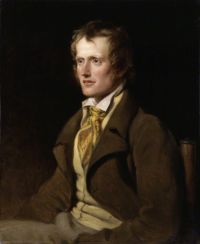
“ Clare always felt himself cheated and empty of ideas when shut up within four walls. The Muse would not follow him to his fireside, but she would frolic with him the live-long day in the open air, filling him with buoyancy, kissing his lips, and smoothing out his wrinkles. Seated inside an old oak, whose heart had gradually passed into the atmosphere, Clare was wont to pour his soul in song, and so fruitful were the hints of his unseen companion that he soon had a great collection of new verses. ”
 Charles Felton Pidgin,
The Corsican Lovers
(1906)
Charles Felton Pidgin,
The Corsican Lovers
(1906)
“ I will!! Oh, father! father!! Clarine! Clarine!! Where are you? Where is Manassa? He is lost—lost! Come listen, Clarine—come! Five days, Clarine, five long days and nights! Dear God, one long night—one hundred and twenty hours of darkness; no food, no drink, and naught but the cold stones to lie upon.“I see him now, with his eyes turned towards that merciless door; watching, praying for the ray of light that never comes; waiting for the sound of the voice that promised to save him; listening for the step he can never hear.“Oh, I shall go mad! Mad!! Vandemar! Vandemar!! It is I, Vivienne. ”
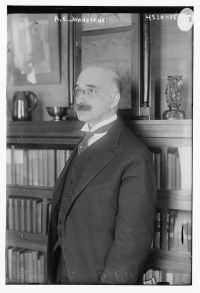 Arthur Edward Johnstone,
Instruments of the Modern Symphony Orchestra…
(1917)
Arthur Edward Johnstone,
Instruments of the Modern Symphony Orchestra…
(1917)
“ The clarinet comprises four registers, which can be blended without perceptible break by the skillful performer. The first or lowest is dark and ominous. The second consists of four or five dull, weak, notes of inferior quality. The third or medium register is of singular beauty, combining nobility, tenderness, and that limpid quality for which the clarinet is distinguished. ”
Kathleen Schlesinger, 1911 Encyclopædia Britannica, Volume 6… (1911)
“ Telephanes was a great virtuoso who scorned the use of a speaker-hole, being able to obtain his harmonics on the aulos by the mere control of lips and teeth. The modern clarinet has from thirteen to nineteen keys, some being normally open and others closed. In order to understand why, when once the idea of adding keys to the chalumeau had been conceived, the number rose so slowly, keys being added one or two at a time by makers of various nationalities at long intervals, it is necessary to consider the effect of boring holes in the side of a cylindrical tube. ”
Karl Wilson Gehrkens, Music Notation and Terminology
“ The clarinet and bass clarinet are made of wood and are used in both bands and orchestras, but the saxophone is usually made of metal, and, the tone being more [Pg 122] strident and penetrating, the instrument is ordinarily used only in combination with other wind instruments, i.e., in bands.Since the fingering of the clarinet is excessively difficult the performer can play in only certain keys on the same instrument, hence to play in different keys clarinets in several keys must be provided, there being usually three in all. ”
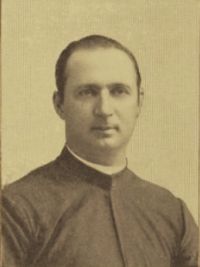 Francis J. Finn,
Cupid of Campion
Francis J. Finn,
Cupid of Campion
“ Clarence was profoundly impressed by what he saw in the chapel. The boys—full, in ordinary, of mischief and life—were going about their devotions in earnest.Clarence was seated next to John Rieler. That youth, when he was not singing lustily with the others, had his face buried in his prayer-book. Religion, Clarence perceived, entered intimately into the lives of nearly all these boys.He was escorted by Rieler to breakfast, where he inspired much respect among the boys of the particular table at which he sat by his workmanlike way of getting through with the dishes served him. ”
 Ben Hecht,
A Thousand and One Afternoons in Chicago
Ben Hecht,
A Thousand and One Afternoons in Chicago
“ The clarinet screeches, wails, moans and whistles. The clarinet flings an obbligato high over the heads of the dancers on the cabaret floor. It makes shrill sounds. It raves like a fireless Ophelia. It plays the clown, the tragedian, the acrobat.A whimsical insanity lurks in the music of the clarinet. It stutters ecstasies. ”
author:Metta Victoria Fuller Victor, Poems of Sentiment and Imagination (1851)
“ I scorn thee from my waking sight— Away! away Obedient to that gesture of command. From her proud, glorious presence, with no word, No sigh, and no farewell, young Clarence turned. The souls once blent in seeming perfectness Were riven apart forever—evermore! Earth—earth! thy mystery—thy agony! ”

“ The curtains again parted, and I beheld Clarimonde, not as on the former occasion, pale in her pale winding-sheet, with the violets of death upon her cheeks, but gay, sprightly, jaunty, in a superb travelling-dress of green velvet, trimmed with gold lace, and looped up on either side to allow a glimpse of satin petticoat. Her blond hair escaped in thick ringlets from beneath a broad black felt hat, decorated with white feathers whimsically twisted into various shapes. ”
 Sheridan Le Fanu,
The House by the Churchyard — Chapter XC
(1863)
Sheridan Le Fanu,
The House by the Churchyard — Chapter XC
(1863)
“ We who have heard those wondrous aërial echoes of Killarney, when the breath has left the bugle and its cadences are silent, take up the broken links of the lost melody with an answer far away, sad and celestial, real, yet unreal, the fleeting yet lingering spirit of music, that is past and over, have something in memory by which we can illustrate the effect of these true voices of the thoughts and affections that have perished, returning for a few charmed moments regretfully and sweetly from the sea of eternal silence. ”
Frederick Martin, The Life of John Clare
“ There now lies, under the shade of a sycamore-tree, with nothing above but the green grass and the eternal vault of heaven, all that earth has to keep of John Clare, one of the sweetest singers of nature ever born within the fair realm of dear old England—of dear old England, so proud of its galaxy of noble poets, and so wasteful of their lives. ”
“ To influences other than those of the countryside, Clare remained unimpressionable. To be in London was to long for Helpstone, the commons and pools of which were more precious to the poet than all the glories of Westminster Abbey, and the expanses of the artificial lakes. While he sojourned in the Metropolis the right spark would not fall from heaven, but as soon as he wandered once more among the scenes so long familiar to him, the Muse was his unfailing companion. ”
Baron Edward Bulwer Lytton Lytton, The Disowned — Complete
“ The first time Clarence had observed the young artist, he had taken a deep interest in his appearance. Pale, thin, undersized, and slightly deformed, the sanctifying mind still shed over the humble frame a spell more powerful than beauty. ”
Francis J. Finn,
Cupid of Campion
“ My firm belief is that Master Clarence’s bright-eyed goddess of adventure hasn’t lost her grip on her young victim yet. She’s got him hoodooed.”“See here, you fellows,” remonstrated Clarence, “talk about something pleasant. What I want is a quiet life.” ”
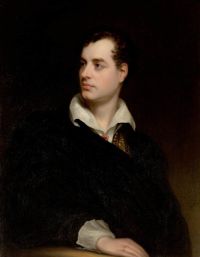 Lord Byron,
Childe Harold's Pilgrimage
(1812)
Lord Byron,
Childe Harold's Pilgrimage
(1812)
“ Clarens! sweet Clarens! birthplace of deep Love! Thine air is the young breath of passionate thought; Thy trees take root in love; the snows above The very glaciers have his colours caught, And sunset into rose-hues sees them wrought By rays which sleep there lovingly: the rocks, The permanent crags, tell here of Love, who sought In them a refuge from the worldly shocks, Which stir and sting the soul with hope that woos, then mocks. C. Clarens! by heavenly feet thy paths are trod,— Undying Love's, who here ascends a throne To which the steps are mountains ”
W. J. Henderson, The orchestra and orchestral music (1899)
“ This is because three kinds of clarinet are employed, clarinets in A, B flat, and C. A clarinet in B flat means one whose pitch is a whole tone below the standard, so that when one plays the scale of C natural on it he gets the sounds of the scale of B flat, just as he would from a piano tuned a whole tone too low. A clarinet in A is a tone and a half below pitch in the scale of C. One in C produces the scale of C when played in C. The reason for using different kinds of clarinets is that it is difficult to play the instrument in remote keys. ”
