Francis Parkman,
The Oregon Trail
(1901)
“ Fort Leavenworth is in fact no fort, being without defensive works, except two block-houses. ”
Fort Leavenworth, established in 1827 in Kansas, is the second oldest active U.S. Army post west of Washington, D.C., renowned as the "Intellectual Center of the Army" for its educational and doctrinal roles. Historically pivotal during westward expansion, it served as a strategic hub for military operations, including the Santa Fe Trail and conflicts with Indigenous tribes.
Authors like Francis Parkman noted its lack of conventional fortifications, while Edwin L. Sabin highlighted its importance as a headquarters for the Department of the Missouri. The fort’s legacy spans military training, correctional facilities, and its association with the Buffalo Soldiers, reflecting its enduring influence on U.S. military history and strategy.
Francis Parkman,
The Oregon Trail
(1901)
“ Fort Leavenworth is in fact no fort, being without defensive works, except two block-houses. ”
Gottlieb F. Oehler, Description of a journey and visit to the Pawnee Indians
“ Oehler was previously acquainted, received us very courteously, and gave us a letter of introduction to the quartermaster at Fort Kearney, in case we should be obliged to go that way on our return home and need any assistance.—Fort Leavenworth is eligibly situated on a high prairie, near the bank of the Missouri, about 35 miles above the mouth of Kansas River. It is a place of considerable business, in the way of furnishing military stores for the more western forts. At the wharf a large storehouse has been built by the Government for the purpose of depositing military stores. ”
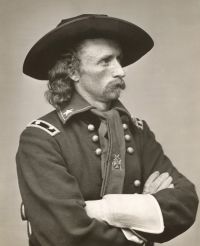
George A. Custer,
My life on the plains
(1874)
“ I had spent the winter of 1867–’68 most agreeably with many of my comrades at Fort Leavenworth, but in the spring was forced to see them set out for their summer rendezvous for operations against the Indians, and myself compelled by superior authority, or rather by “circumstances over which I had no control,” to remain in the rear, a non-combatant in every sense of the word ”
Augustus Meyers, Ten years in the ranks, U.S. Army
“ Johnson was assembling a little army to punish the Mormons. At Leavenworth post I saw Robert E. Lee, who was then the colonel of one of the cavalry regiments and soon to become the Commander-in-Chief of the Confederate Army. A few days after our arrival at the fort some comrades and myself obtained a twenty-four hour pass to go to Leavenworth City, only a few miles down the river. It had grown to a thriving town with many stores, hotels and saloons, on the business streets; churches, dwellings and shacks on others. All were built of wood and very few were more than two stories high. ”
Edwin L. Sabin,
On the Plains with Custer
“ Of many finely constructed buildings, in the midst of a one-thousand-acre military reservation overlooking the Missouri River, near to the bustling city of Leavenworth, with its cavalry and infantry and artillery, Fort Leavenworth, headquarters post of the Department of the Missouri, was a decided change from Wallace and Hays and Harker and even Fort Riley.The fall and winter were quiet, while out on the southwest plains a Government Peace Commission made a new treaty with the tribes. The Cheyennes were still angry because General Hancock had destroyed their village ”
Edwin L. Sabin,
On the Plains with Custer
“ The arrival of the troops from Fort Leavenworth brought a squad of Delaware Indians, as more scouts. They were from their reservation near to Fort Leavenworth. The chief was Fall Leaf, a well-built, fierce-looking old man, war chief of the Delaware tribe, and a great fighter. Of the train he grunted: “Heap good! Went whiz! Beat buffalo and pony.” Of the telegraph he said: “No understand, but heap good. Heap swift! Like arrow or bullet between wide places; but heap better.” His nephew General Jackson was another member of the squad. General Jackson was slender and small, but brave. ”
Charles Morris, Historic Tales: The Romance of Reality…
“ It was an expedition in which the soldiers would have to fight far more with nature than with man, and force their way through [pg 289] desolate regions and over deserts rarely trodden by the human foot.The invading army made its rendezvous at Fort Leavenworth, on the Missouri River, in the month of June, 1846. It consisted of something over sixteen hundred men, all from Missouri, and all mounted except one battalion of infantry. Accompanying it were sixteen pieces of artillery. ”
Charles Lanman,
Farthest North
“ ARMY-LIFE IN KANSAS.During Lieutenant Lockwood’s absence on leave, his regiment was transferred to Fort Leavenworth, and there we find him early in 1877, and for about two years thereafter. Of course, the garrison life of an officer, in times of peace, is somewhat monotonous; but the letters which the lieutenant wrote from this station contain some passages which are interesting and illustrate his character, as will be seen in the following pages. Here it should be stated that, during his sojourn at Fort Leavenworth, he made many pleasant acquaintances, which ripened into friendship ”
Pardee Butler, Personal Recollections of Pardee Butler
“ GOVERNOR SHANNON:—Information has been received direct from Lawrence, which I consider reliable, that the outlaws are well fortified with cannon and Sharpe' rifles, and number at least 1,000 men. It will, therefore, be difficult to dispossess them. The militia in this portion of the State are entirely unorganized, and mostly without arms. I suggest the propriety of calling upon the military of Fort Leavenworth. If you have the power to call out the government troops, I think it would be best to do so at once. It might overawe these outlaws and prevent bloodshed. ”
Joseph T. Wilson,
The Black Phalanx
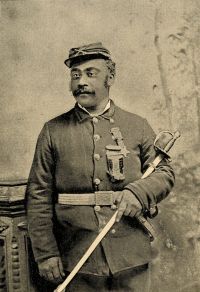
“ Here it remained, doing garrison and escort duty, until October 1st, 1865, when it was mustered out of service and ordered to Fort Leavenworth for final payment and discharge. The regiment received its final payment and was discharged at Fort Leavenworth on the 30th day of October, 1865."The heroism of the negro people of Kansas was not all centered in this one regiment. Elated with the success of their brethren already in the field, there was a general desire to emulate their heroic deeds. In June, 1863, the second regiment was organized at Fort Scott. ”
Buffalo Bill,
An Autobiography of Buffalo Bill…
“ On our return to Fort Leavenworth we found General Sanborn and a number of others of the former Union leaders who had come to the border to make peace with the Indians. The various tribes that roamed the Plains had heard of the great war, and, believing that it had so exhausted the white man that he would fall an easy prey to Indian aggression, had begun to arm themselves and make ready for great conquests. They had obtained great stores of arms and ammunition. During the last two years of the war they had been making repeated raids and inflicting vast damage on the settlers. ”
Buffalo Bill,
The Life of Hon. William F. Cody…
“ Leavenworth at that time was quite an important outfitting post for the West and Southwest, and the fort there was garrisoned by a large number of troops. While in the city one day I met several of the old, as well as the young men, who had been members of the Free State party all through the Kansas troubles, and who had, like our family, lost everything at the hands of the Missourians. ”
Edwin L. Sabin,
Boys' Book of Frontier Fighters
“ Major Henry's party returned with them, to General Ashley at the mouth of the Cheyenne River in South Dakota. From the United States post at the Lewis and Clark's Council Bluffs, western Iowa of to-day, Lieutenant-Colonel Henry Leavenworth (Fort Leavenworth of Kansas is named for him) of the Sixth United States Infantry, hastened up with six companies of regulars, several cannon and three keel-boats. Joshua Pilcher, president of the Missouri Fur Company, joined him; General Ashley and Major Henry met him with other men; four or five hundred Sioux enlisted—the Sioux hated the Arikaras. ”
John B. Wilson, Maneuver and Firepower: The Evolution of Divisions and Separate Brigades (1998)
“ To fit within the new concept, the General Staff, in conjunction with the Army School of the Line at Fort Leavenworth, made the infantry division a more powerful and self-sufficient organization. A field artillery brigade of two regiments with forty-eight guns replaced the provisional regiment. Infantry and cavalry regiments benefited from additional firepower. Based on experiments with machine guns in 1906, a provisional two-gun platoon had been added to each infantry and cavalry regiment, and with the new regulations the authorization was increased to six guns. ”
Charlotte Ouisconsin Clark Van Cleve,
'Three Score Years and Ten'
“ Everything grew rapidly, and a sufficient supply of vegetables was secured to prevent any recurrence of the evil.More permanent and comfortable quarters were built during the spring at the beautiful spring on the fort side of the river, and named by the officers "Camp Coldwater;" but before moving into the new camp Colonel Leavenworth was relieved from the command by Colonel Josiah [Pg 20] Snelling, who, with his well-known energy and promptitude, immediately began preparations for building the fort, the site of which had been selected by Colonel Leavenworth. ”
Emma Dorothy Eliza Nevitte Southworth,
For Woman's Love
“ It is a new fort—an outpost really on the extreme southwestern frontier, as I understand. We shall have to cross what used to be called the Great American Desert to reach it. We go first to Leavenworth, and, of course, the journey to Leavenworth is easy enough. But from Leavenworth the long, tedious traveling by army wagons over the plains and through the wilderness to the southwestern forts will try your endurance, my dear.""Come, come!" said the captain, heartily; "it is not all unmitigated dreadfulness. To be sure we have no railroads through the wilderness, no fine city hotels to stay at ”
Frederic L. Paxson, The Last American Frontier
“ The Indians of the route knew no national lines, and found a convenient refuge against pursuers from either nation in crossing the border. There was no military protection to the frontier at the American end of the trail until in 1827 the war department erected a new post on the Missouri, above the Kansas, calling it Fort Leavenworth. Here a few regular troops were stationed to guard the border and protect the traders. The post was due as much to the new Indian concentration policy as to the Santa Fé trade. ”
Francis Parkman,
The Oregon Trail
(1901)
“ A military road led from this point to Fort Leavenworth, and for many miles the farms and cabins of the Delawares were scattered at short intervals on either hand. ”
Oregon Historical Society, Oregon Historical Quarterly (1902)
“ This regiment, when it left Fort Leavenworth, numbered six hundred men, thirty-one commissioned officers, some women and children, with guides, agents, helpers and teamsters a large number. There were one hundred and sixty-one wagons in the train, one thousand and two hundred mules, and seven hundred horses. For all these men and animals subsistence had to be carried. ”
Grenville Mellen Dodge,
The Battle of Atlanta
“ I saw, after spending a day at Fort Leavenworth, that it was necessary to change the depressed feeling and temper existing among the troops and the citizens throughout the department. I sent for Bela M. Hughes, agent of the overland stages, and Edward Craighten, general manager and superintendent of the overland telegraph, and consulted fully with them. I selected from my old guides some of the most trusted men, and some of the trusted Indians that I had known, and sent by them to each district commander who could be reached, these two short dispatches:1. ”
by John George Nicolay and John Hay, Abraham Lincoln: A History (1890)
“ Governor Geary went at once to the fort, where he spent the day in consultation with General Smith. That same evening he wrote to W.L. Marcy, Secretary of State, a report of the day's impressions which was anything but reassuring--Leavenworth in the hands of armed men committing outrages under the shadow of authority; theft and murder in the streets and on the highways; farms plundered and deserted; agitation, excitement, and utter insecurity everywhere, and the number of troops insufficient to compel peace and order. ”
Doane Robinson,
A Brief History of South Dakota
(1905)
“ When near Yankton on the 3d of July, one of the boats struck a submerged General Henry Leavenworth log and was capsized and broken in two, and Sergeant Samuel Stackpole and six privates were drowned. At Fort Recovery, on American Island at Chamberlain, Joshua Pilcher joined Leavenworth with a company of forty men, and at the Cheyenne, Ashley joined them with eighty additional men, making a total of three hundred and forty white men, soldiers, and volunteers all told. ”
Edwin L. Sabin,
Boys' Book of Frontier Fighters
“ Bent's Fort became famous. Soon all the Indians for leagues around knew of it. The Arapahos and the Southern Cheyennes traded in their buffalo robes here; the mountain Utes, and the Red River Comanches of northern Texas came in. At one time, in the late fall and in the winter, twenty thousand Indians would be camped within sight of it. Trappers from north, west and south made it their market and headquarters. Traders trailed in, from the States and from New Mexico. In 1846 General Stephen Watts Kearny's army from Leavenworth for Santa Fe and California halted here, to refit. ”
by John George Nicolay and John Hay, Abraham Lincoln: A History (1890)
“ Similar belligerent preparations were in progress at all the river towns they touched. At Kansas City the vigilance committee of the blockade boarded and searched the boat for concealed "abolitionists." Finally arrived at Leavenworth, the Governor saw a repetition of the same scenes--parades and military control in the streets, fugitives within the inclosure of the fort, and minor evidences of lawlessness and terror. [Sidenote] Geary to Marcy, Sept. 9, 1856. Senate Ex. Doc., 3d Sess. 34th Cong. Vol. II., p. 88. ”
Frederick Palmer,
Our Greatest Battle (The Meuse-Argonne…
“ To this tendency of ours to seek perfection the Allies might reply: "Perfection is all very well; but we have tested equipment, and a staff system the result of three years' trial, and time is valuable against the German."Just as the West Point system, which takes the "plebes" in hand, was being applied in our training camps, so Leavenworth staff college was reproduced in France in the ancient city of Langres, near Chaumont, which had been a fortress in many wars. Here regulars worked beside reserves, while the regulars had no special privileges except the first choice of horses to ride. ”
Anna Katharine Green,
The Leavenworth Case
(1906)
“ Even before the handkerchief was produced, I had made up my mind to attempt their destruction; but when that was brought up and shown, I became so alarmed I immediately rose and, making my way under some pretence or other to the floors above, snatched the key from the gas-fixture, the lighters from the vase, and hastening with them down the hall to Mary Leavenworth’s room, went in under the expectation of finding a fire there in which to destroy them. ”
Anna Katharine Green,
The Leavenworth Case
(1906)
“ Enough that, supporting upon my arm the half-fainting form of one woman, but with my attention, and interest devoted to another, I descended the stairs of the Leavenworth mansion, and re-entered the dreaded presence of those inquisitors of the law who had been so impatiently awaiting us. As I once more crossed that threshold, and faced the eager countenances of those I had left so short a time before, I felt as if ages had elapsed in the interval; so much can be experienced by the human soul in the short space of a few over-weighted moments. ”
Anna Katharine Green,
The Leavenworth Case
“ Mr. Harwell fell back against the opposite wall. “Clavering, Clavering,” he murmured with quaking lips; then, suddenly bounding forward, clutched the railing before him, and fixing me with his eyes, from which all the stoic calmness had gone down forever in flame and frenzy, gurgled into my ear: “You want to know who the assassin of Mr. Leavenworth is, do you? Look there, then: that is the man, Clavering!” And with a leap, he bounded from my side, and, swaying like a drunken man, disappeared from my gaze in the hall above. ”
Frederick Palmer,
Our Greatest Battle (The Meuse-Argonne…
“ The Leavenworth plan was to harmonize regulars, National Guard, and National Army into a force so homogeneous that flesh and blood became machinery, with every soldier, squad, platoon, brigade, and division as much like all the others as peas in a pod; but human elements older than the Leavenworth School, which had given soldiers cheer on the march and fire in battle from the days of the spear to the days of the quick-firer, hampered the practical application of the cold professional idea worked out in conscientious logic in the academic cloister. ”
Frederick Palmer,
Our Greatest Battle (The Meuse-Argonne…
“ Relations would be smoother by having the resentment of the men who bore the brunt of casualties directed into home channels.The Leavenworth men, thinking as army officers and for the army, did not wish to yield power. They wanted to establish a staff system and a tradition for a large American force, in the hope that universal service would be accepted and continued, making the system permanent. Where were they to get the host of additional staff officers required for the armies, the corps, and the divisions in battle? A few student observers could be sent to the British and French staffs ”