McCulloch v. Maryland

Definition and stakes

The Constitution of the United States of America…

“ Maryland was not merely followed but greatly extended as a restraint on State interference with federal instrumentalities. Conversely, the Court's recent return to Marshall's conception of the powers of Congress has [Pg 736] coincided with a retreat from the more extreme positions taken in reliance upon McCulloch v. Maryland. Today the application of the supremacy clause is becoming, to an ever increasing degree, a matter of statutory interpretation—a determination of whether State regulations can be reconciled with the language and policy of federal enactments. ”
Source: Gutenberg

Legal Tender Cases (79 U.S. 457…

“ The opinion of the then minority affirmed the power on the ground that it was a necessary and proper means, within the definition of the court, in the case of McCulloch v. Maryland, to carry on war, and that it was not probited by the spirit or letter of the Constitution, though it was admitted to be a law impairing the obligation of contracts, and notwithstanding the objection that it deprived many persons of their property without compensation and without due process of law. ”
Source: Wikisource

Presidential Commission on the Supreme Court of the United States,  Presidential Commission on the Supreme Court of the United States Final Report (2021)

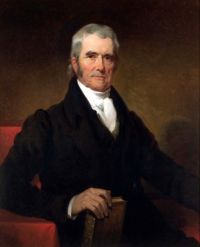
“ First, the Supreme Court continued to be viewed by contemporaries as an institution that was necessarily involved in politics. Prior to Chief Justice Marshall’s death in 1835, the Court took stances in a few high-profile cases that appeared to be carefully calculated acts of resistance to Jeffersonian-Republican policies. In McCulloch v. Maryland (1819) and Osborn v. Bank of the United States (1824) , the Court upheld the constitutionality of the Second Bank of the United States against attacks on it by several states and by then-candidate Jackson. ”
Source: Wikisource

Get perspective with Kwize: daily news enlightened by great literature