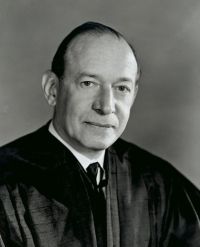
Clarence Thomas

Biographical details

Clarence Thomas,  Apprendi v. New Jersey, 530 U.S. 466…

“ What matters is the way by which a fact enters into the sentence. If a fact is by law the basis for imposing or increasing punishment—for establishing or increasing the prosecution's entitlement—it is an element. (To put the point differently, I am aware of no historical basis for treating as a nonelement a fact that by law sets or increases punishment.) When one considers the question from this perspective, it is evident why the fact of a prior conviction is an element under a recidivism statute. ”

Source: Wikisource

Clarence Thomas,  Parents Involved in Community Schools v… (2007)

“ The dissent does not face the complicated questions attending its proposed standard. For example, where does the dissent's principle stop? Can the government force racial mixing against the will of those being mixed? Can the government force black families to relocate to white neighborhoods in the name of bringing the races together? What about historically black colleges, which have "established traditions and programs that might disproportionately appeal to one race or another"? ”
Source: Wikisource

Clarence Thomas,  Stenberg v. Carhart — Dissenting Opinion

“ The broad rule articulated by the majority and by Justice O'Connor are unprecedented expansions of this Court's already expansive pre-Casey jurisprudence.
As if this state of affairs were not bad enough, the majority expands the health exception rule articulated in Casey in one additional and equally pernicious way. Although Roe and Casey mandated a health exception for cases in which abortion is "necessary" for a woman's health, the majority concludes that a procedure is "necessary" if it has any comparative health benefits.
”
Source: Wikisource

Get perspective with Kwize: daily news enlightened by great literature