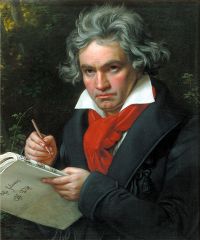
“ I, therefore, ask you, dear Moscheles, to be the organ through which I can express my most heartfelt thanks to the Philharmonic Society for their sympathy and help. Tell these worthy men that if God restores me to health, I shall try practically to show my gratitude by works, and that I leave it to the Society to choose what I shall write for them. A whole sketched Symphony (the 10th) is in my desk, also a new Overture, or even something else. As regards the concert which the Philharmonic Society has resolved on giving for my benefit, I beg the Society not to give up this intention. ”
Philharmonic Society
Definition and stakes
The Philharmonic Society, a cultural organization active within the Habsburg monarchy from 1702 to 1918, functioned as a central center for musical creativity and cooperation. Writers such as Romain Rolland emphasized its role in supporting composers like Beethoven, who expressed appreciation for the Society’s sponsorship, while others, including Ernest Ford, stressed its perseverance in promoting musical art despite difficulties.
Works like A Dictionary of Music and Musicians highlight its contribution to bringing groundbreaking compositions to the public, portraying it as a key element in European musical development. The Society’s impact continues through its organized support for composers and its outstanding orchestral performance, combining artistic vision with institutional goals.
Quotes about “Philharmonic Society”
Various, The Strand Magazine, Vol. 07, Issue 40…
“ If the Philharmonic Society or Richter ask a composer to write them a symphony, they put at his disposal a magnificent orchestra for the interpretation of anything that he may have to say in that line; or if the committee of any great festival invite a composer to write them an oratorio several years before it is wanted, they put at his disposal a splendid chorus and soloists, and all the resources a man can desire. With such opportunities, I should have thought a man had a better chance of being inspired to some purpose than if he were pottering about just when the humour took him. ”
Various, The art of music, Vol. 04 (of 14… (1915)
“ Many clear-headed New York musicians realized the needs of the situation and eventually there arose a healthy agitation in favor of a strong permanent orchestra of professional musicians. The agitation found an energetic leader in Uriah C. Hill, conductor of the Sacred Music Society, and chiefly through his efforts the Philharmonic Society was formed in 1842. In many respects the Philharmonic differed from all the societies which preceded and most of those which have followed it in America. ”