“ To make a long story short, the next night the boy was there again; and if he didn’t delight the poor pooka, holding a fine warm coat before him, it’s no mather! Betune the pooka and the man, his legs was got into the four arms of it, and it was buttoned down the breast and the belly, and he was so pleased he walked up to the glass to see how it looked. “Well,” says he, “it’s a long lane that has no turning. ”
Pooka
Definition and stakes
The theme of “Pooka” has been addressed by authors such as D. R. McAnally, Oscar Wilde, P. W. Joyce, Padraic Colum and Patrick Weston Joyce. It is often associated with terms like people, river, Indian, Puck and William.
Quotes about “Pooka”
Fairy and Folk Tales of the Irish Peasantry
“ On November Eve they are at their gloomiest, for, according to the old Gaelic reckoning, this is the first night of winter. This night they dance with the ghosts, and the pooka is abroad, and witches make their spells, and girls set a table with food in the name of the devil, that the fetch of their future lover may come through the window and eat of the food. After November Eve the blackberries are no longer wholesome, for the pooka has spoiled them.When they are angry they paralyse men and cattle with their fairy darts. ”
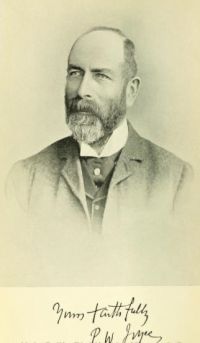
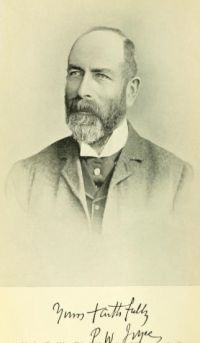 P. W. Joyce,
English As We Speak It in Ireland
P. W. Joyce,
English As We Speak It in Ireland
“ The great ambition of the pooka horse is to get some unfortunate wight on his back; and then he gallops furiously through bogs, marshes, and woods, over rocks, glens, and precipices; till at last when the poor wretch on his back is nearly dead with terror and fatigue, the pooka pitches him into some quagmire or pool or briar-brake, leaving him to extricate himself as best he can. But the goblin does not do worse: he does not kill people. Irish púca. Shakespeare has immortalised him as Puck, the goblin of 'A Midsummer-Night's Dream.'Pookapyle, also called Pookaun ”
“ More betoken, the Pooka's an althered baste every way, fur now he dhrops his hair like a common horse, and it's often found shtickin' to the hedges where he jumped over, an' they do say he doesn't shmell half as shtrong o' sulfur as he used, nor the fire out o' his nose isn't so bright. ”
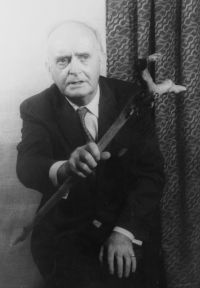 Padraic Colum,
The King of Ireland's Son
Padraic Colum,
The King of Ireland's Son
“ The blackberries that were good to eat the day before are no good on November day, because the Pooka touched them the night before. What else the Pooka does no one really knows. He is a timid fellow as the Little Red Hen said, and he hopes that the sight of his big black horse and the sound of its trampling and panting as he rides by will frighten people out of his way, for he has a great fear of being seen. The next day the Little Red Hen stayed in the courtyard until Crom Duv left with his herd. Flann followed her. ”

“ The fairy lives on their life, and they waste away. Death is no escape from her. She is the Gaelic muse, for she gives inspiration to those she persecutes. The Gaelic poets die young, for she is restless, and will not let them remain long on earth.’ The Pooka is essentially an animal spirit, and some have considered him the forefather of Shakespeare’s ‘Puck.’ He lives on solitary mountains, and among old ruins ‘grown monstrous with much solitude,’ and ‘is of the race of the nightmare.’ ‘He has many shapes—is now a horse, . ”
“ Now, however, as she attends only the old families and does not change to the new, with the disappearance of many noble Irish names during the last half century have gone also their Banshees, until in only a few retired districts of the west coast is the dreaded spirit still found, while in most parts of the island she has become only a superstition, and from the majesty of a death-boding angel, is rapidly sinking to a level with the Fairy, the Leprechawn and the Pooka; the subject for tales to amuse the idle and terrify the young. ”
Roger Pocock, The wolf trail (1923)
“ The spirit of prophecy forsook her; she was all woman as she answered him. "I try," she confessed, "to be a Christian, but I'm a little heathen inside. A Christian wouldn't have told the Absaroka Council, as I did, to burn the Crow's wagons, to steal his horses, and take his scalp if he came back again. 'Twas I who had the Crow turned loose to ruin my own dear Blackfeet people. If I wasn't really and truly a Christian I'd paint my face black, cut off one or two fingers, and howl all night. Then Storm would beat me, and it would do me good." ”
 Grace Greenwood,
Stories and Legends of Travel and History…
Grace Greenwood,
Stories and Legends of Travel and History…
“ The Phooka is said to be a half-wicked, half-mischievous spirit, who takes the form of many strange animals, but oftenest assumes that of a wild horse. His great object then, is to get a rider, and when he has persuaded a poor fellow to mount him, he never lets him off till he has treated him to a ride long and hard enough to last him his lifetime. ”
Roger Pocock, The cheerful blackguard (1915)
“ But she ignored me, pattering in Blackfoot. "Don't," she chattered, "don't think of trading horses to my father. All people try to trade them off for food, but we haven't enough grub for winter, and he gets mad. So then they go away and eat a pony." "My rifle," said I, "won't he take that in trade?" "No buffalo left," said Miss Lane, "and the people can't find any deer. Why, Flat Tail's band are reduced to fish, and you know that the Sun God forbids them to eat fish." "Don't you hear?" asked Rain. "Oh, Got-Wet, we'll sell the rifle." ”
Roger Pocock, The cheerful blackguard (1915)
“ I take your new name, Charging Buffalo." He offered me blood brotherhood, the greatest honor that one Indian can pay to another. But I laughed. "You," said I, "shall be Charging Buffalo, but I'm too poor to be called Many Horses. My name shall be No-horses-but-wants-to-owe-for-a-mule." He shook his head, bewildered, and made the sign, "No good," flicking his fingers at me. How dull must life be for men who never see a joke. "Go," said I, "tell Rain to keep her courage up, and not to fuss." So I made the moon sign and the zigzag fluttering down of a falling leaf. ”
 William Henry Giles Kingston,
Twice Lost
William Henry Giles Kingston,
Twice Lost
“ Popo being quite sure that he came as a friend, left the life-buoy as soon as he drew near, and with a few strokes reached the bow of the canoe, over which he soon scrambled; when the boy at once paddled back to the beach, carrying him safely through the breakers. The savages, who were as brown as those he had before seen, gathered round him and examined his skin with much curiosity, supposing, he observed, that he had got on a black coat. ”
Roger Pocock, The cheerful blackguard (1915)
“ In excruciating raptures, Got-Wet promised a supper after dark. Meanwhile, she stayed for a gossip, advising Rain in the art of pitching camp, with now and again a peep at the sham Indian, followed by great pantomime of fright. As for me, I was too proud to be routed out of camp by a girl's impudence, too hungry to search for my brother, too shy to interview the trader and buy food. How could I, with Rain's last streak of yellow face-paint across my lordly nose, confront a white man? ”
Roger Pocock, The cheerful blackguard (1915)
“ Then the chiefs starved in council until Rain sent them a pony-load of meat, so that their hearts were warm, and they consented to her plea. If the tribe lived at the full moon, in the moon of falling leaves she should be made a priestess, and dedicate a temple to the Sun. "My prayer is heard," she said, in her great joy. "My man is saved from death, the Sun has given us food, and the animals will be kind to us and pity us. In three suns, the wicked agent will be sent away, and there will be food for all our people." ”
Roger Pocock, The wolf trail (1923)
“ The trader sighed. "If it were only true!" he thought. "It gives one quite a glow. The Devil, if there is any such person, must enjoy a bit of philanthropy. It makes one feel so good." The Indian felt the blood race in his arteries, the whirling joy. Clearer vision, a new worldly wisdom, made him see the folly of Rain's mission to the tribes. "She doesn't know what's good for her," he thought. "She needs me to handle her affairs, and make her the Big Chief's wife. ”
Roger Pocock, Captains of adventure (1913)
“ It was not much to pay for a beautiful woman who became a faithful and loving wife.One day news reached the three main camps of the Blackfoot nation that a white buffalo had been sighted in the herds. Midwinter as it was, the hunters turned out, for the man who killed a white buffalo was held to have the especial favor of the Sun, and not only he, but his tribe. The head chief of a nation has been known to use the robe for a seat, but it could never be sold, and at the next building of a temple to the Sun it was offered up as a national sacrifice. ”
Roger Pocock, The cheerful blackguard (1915)
“ I saw Rain flush. "But," she said, "Tail-Feathers went to the buffalo hunting." "There were no buffaloes," said Got-Wet. "So Tail-Feathers came back. You know, he's the greatest rifle-shot that ever— Well, that's how he got a job, with rations and big pay. He's scout-interpreter now to the pony soldiers." With nods and winks, Got-Wet would have us understand that Tail-Feathers also adored her. Not that she would stoop to marry a mere Indian. "Oh, no," she simpered. "Die first. Still, he adores me, and rode off at once when I told him to fetch the soldiers." ”
Great Men and Famous Women. Vol…
“ Pocock was a brave, faithful, and devoted follower of Stanley, who has paid a touching tribute to the manliness, affection, and courage of the young Englishman who lies buried in the savage wilderness of the Congo.Very soon, as they drew nearer to the west coast, in the latter part of the summer of 1877, sickness, distress, and famine pressed hard upon the way-worn travellers. They were destitute of nearly everything that could sustain nature. The natives refused to sell supplies, and starvation stared them in the face. ”
James Athearn Jones, Traditions of the North American Indians…
“ His face was covered with hair of the colour of the feathers of the blue heron, and stood out like the feathers of a duck that plumes itself in the warm sun, on the shores of the lake. His skin was blacker than charred wood, or the black raven. The Narragansetts were dreadfully frightened, and were going to run away, when Pocasset stopped them, saying, "Don't be afraid, it is my master. Don't you know him whom you have served so many years? Why he won't hurt you.""More than you know, Poke," grunted the ugly little creature, putting his moss-coloured hair behind his great yellow ears. ”
Roger Pocock, The Blackguard (1897)
“ So he sat at the edge of the cliff, perched like a fly on a wall, until presently there came another fly stealing up softly behind; a female fly this, full as her little body could hold of wanton mischief, to wit, the Burrows girl, who clapped her dainty hands over both La Mancha's eyes. "You must be Love," laughed the Blackguard, "blinding a chap like that. What nice soft fingers—Um! Get away, you minx, or I'll kiss you." "Ugh!" said the minx, suddenly releasing him. "Now, sit down here, Impudence, and tell me who taught you your manners." ”
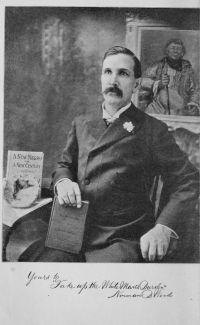 Norman B. Wood,
Lives of Famous Indian Chiefs
Norman B. Wood,
Lives of Famous Indian Chiefs
“ I open it and a voice inquires: "Pokagon, what of your people? What will be their future?" My answer is: "Mortal man has not the power to draw aside the veil of unborn time to tell the future of his race. That gift belongs to the Divine alone. But it is given to him to closely judge the future by the present and the past."' Pokagon died January 28, 1899, at his old home in Allegan County, Michigan, at the age of seventy years; and thus passed away the last and most noted chief of the once powerful Pottawatomie tribe. His remains were buried in Graceland Cemetery, Chicago." ”
Roger Pocock, The cheerful blackguard (1915)
“ Yet in one camp at least the dying fires flickered up at my coming. Old Medicine Robe called his priests and sacred women to the sweet and solemn ritual, with which I was formally adopted as a Blackfoot, as a chief and as his son. The young men roused themselves for a hunting and killed deer, so that the women might dress the skins, and make clothes for Rain and for me. The poles were cut, the cover sewn for my lodge, in which I had to sit in lonely state while Rain attended me with meals, which she brought from her hearth. ”
Roger Pocock, The Blackguard (1897)
“ He looked towards the camp where lay Arrapahoe Bill, tended by the Mexican, recovering from an interview with a grizzly bear; he looked along the trail toward the Mission, whither, to judge by the scraps of cambric, Miss Violet had been carried much against her will; and he looked across the valley to where the tents of the Mounted Police encampment glimmered white in the afternoon sun. It was useless to trouble the cowboys, useless to ride to the Mission unless he had some sort of authority for interference; better to get help from the camp. ”
Roger Pocock, The Blackguard (1897)
“ Going round by way of the Tough Nut Claim, he gained the upper moorland, wrapped in a choking dry mist, out of which rose the Throne cabins, gaunt, spectral, desolate. The doors were locked, the windows barred hastily across with a few rough planks, the stable empty. Down the hills he rode, his black horse lathered with sweat, his face haggard as he followed the trail of three riders. Ramsay had led, Miss Violet followed, Burrows taking the rear, all down the swaying curves of the steep places, and along the sinuous path through heavy timber. They had not stayed to even pack their clothes ”
Roger Pocock, The wolf trail (1923)
“ Powhatan had ordered him to find out the number of English warriors there were for killing. Johnsmith hailed him, making the sign for peace. "'Oh, Great Werowance, Master of all the Seas,'" cried Uttamatomahkin. "'I come with the Lady Pocahontas, and her husband, and her baby son to seek you.'" "So they walked together, the chief notching his stick for every man they met. 'Now show me God,' said he, supposing that the God of the English ought to live in their chief village. ”
Rupert Sargent Holland, Historic Girlhoods, Part One
“ She did not live to go back to Virginia or see her own tribesmen again, but died in England when she was only twenty-two. Ma-ta-oka, or Pocahontas as we call her, was a real heroine, one of the few daughters we know of that brave, romantic race which so quickly vanished from America after the white settlers came. Many among the Indians were cruel and bloodthirsty, many were treacherous and sly, but Pocahontas we know was warm-hearted and true, faithful to the great Captain she had admired before she had even seen him and risking her life to save him from her father. ”
Roger Pocock, The cheerful blackguard (1915)
“ It was into your arms, not mine, she threw herself. Is it not proved? The honor of guarding this lady is yours, not mine." Then Red's eyes fell before mine, and he understood. "Señora," I lifted my hat, and bowed to her for the last time on earth. "When Beauty murdered her sister Chastity, she was turned into a vulture. "You may remember that Joe Chambers died for you, and Sarde lost his career, and I was ruined, as this poor man will be ruined, and others after him. "You are too wondrous fair to be all one man's own, but God aids her who changes, as you will change. ”
Roger Pocock, The cheerful blackguard (1915)
“ My horse? I had no horse. "You poor?" she asked. "I'm all I've got," I told her. "S'pose," said Rain gaily, "I make 'um Indian man?" "What! You'll make me an Indian? Oh, what a lark! Come on!" She led me through an aspen grove, all tremulous green and silver, and in her little teepee, Rich Mixed and I had breakfast. Then she left us to watch a copper pot of herbs which simmered on the fire, and slid away to her father's burial scaffold. There, with some quaint apology to the Sun God, she took back her braids of hair and sacrificed instead the tip of her left little finger. ”
Roger Pocock, The wolf trail (1923)
“ Rain answered, "I was what Storm calls Red Indian. I was Powhatan's daughter then. It was in those days that the English came first into our country—the land they call Virginia—yes, and the English called me Pocahontas. It wasn't my real name though. I wedded my man, and he was Master John Rolfe—a little widower. Twice he was Roman soldier, once he was thrall in Iceland, and then it seems crusader, and again John Rolfe the planter, and now what he calls bargee; but he is always Storm and I am always Rain, and we shall always love." ”