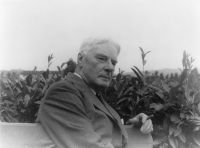
“ He never rails at anything. Had I been subjected to half the annoyances he endured, my curses would have been loud and long. Under such provocation, Ramage contents himself with reproving his tormentors in rounded phrases of oratio obliqua which savour strongly of those Latin classics he knew so well. What he says of the countryfolk is not only polite but true, that their virtues are their own, while their vices have been fostered by the abuses of tyranny. ”
Quotes about “Ramage”
“ Here was a poor old coastguard who had been taken prisoner by the Corsairs thirty years earlier, carried to Algiers, and afterwards ransomed. Having "nothing better to do" (says our author) "I confess I furnished him with somewhat more wine than was exactly consistent with propriety"; with so liberal a quantity, indeed, that the coastguard became quite "obstreperous in his mirth"; whereupon Ramage hops on his mule and leaves him to his fate. Here, then, we have a young fellow deliberately leading an old man astray. And why? Because he has "nothing better to do." ”
“ It was something like what happened at Rojate. Did not the curly-haired Giulio end by "stating" something to the same effect? I cannot make up my mind whether to be pleased with this particular trait in friend Ramage's character. For let it never be forgotten that our traveller was a young man at the time. He says so himself, and there is no reason for doubting his word. Was he acting as beseemed his years? I am not more straight-laced than many people, yet I confess it always gives me a kind of twinge to see a young man yielding to intemperance of any kind. ”
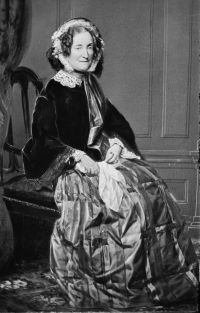
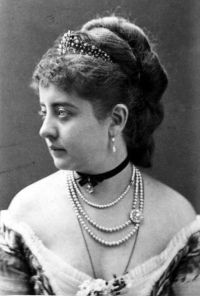 Marie Louise de la Ramée,
In Maremma
(1882)
Marie Louise de la Ramée,
In Maremma
(1882)
“ I saw no other living thing. I forgot that I was a hunted felon; I only remembered you. I felt the wind was from the south-west, and so walking against it I hoped to come to the beach at last. If I had known the country as well as you, I should have had no fear. As it was, I knew I might walk the whole night yet never find the sea. But all at once I felt my feet wet. I stooped and tasted the water; it was salt. The roar of the wind was so loud that I had missed the sound of the sea, but the sea it was. By the lantern light I could see the foam on a breaking wave. ”
Marie Louise de la Ramée,
In Maremma
(1882)
“ The sea was quiet; there was wind enough to fill her little sail, and what there was favoured her. Under the easy motion of the boat, with the play of air and light around, she recovered her natural spirit; she sat and steered and now and then thrust an oar in the water, that was all. She wanted to make all the haste she could; she longed to be at home again, carrying home good food and the red wine that is man's strength. ”
Marie Louise de la Ramée,
In Maremma
(1882)
“ The sea was calm as glass; her boat floated on it with hardly any movement; the great white flood of moonlight fell upon it and her; together they made but a small, dark, motionless thing in the midst of that silvery field of light. How long she slept she never knew; when she awoke with a start the cool of the midnight had come that comes with the descent of the dews. Used to the look of the sky, she knew that it was midnight by the stars. She awoke refreshed, but conscience-stricken. Every moment she delayed was a pang of hunger and of fear more to the hunted man. ”
Marie Louise de la Ramée,
Idalia
(1867)
“ The boat waited in a creek, floating there under so dark a shadow from the drooping boughs of lemon and acacia, that it was atmost in twilight: a few strokes of the oars, and it swept out of the brown ripples, flinging up their surf against the rocks, into the deep blue of the sunlit bay; below, above, around on every side, colour in all its glory, all its variety, all its harmony and contrast, melting into one paradise in the warmth of the summer day. "I love the sea more dearly than any land. It is incarnate freedom!" ”
Marie Louise de la Ramée,
In Maremma
(1882)
“ Great ships passed in the offing, their canvas swelling in the wind; yawls and brigs and the tartane of the coast went to and fro in the fresh weather, dipping and showing their copper under the rolling of the seas; now and then a little felucca with her single sail stood off the shore while her men were fishing, or out from the bay of Follonica a whole lateen fleet came crowding when the news was told of a shoal of ragni or rombi seen at sunrise. He waited patiently, with the sea and its vessels before his eyes, and the big white clouds floating above the head of the bluff. ”
Marie Louise de la Ramée,
Idalia
(1867)
“ If truth abode not with her, and the fealty of honour, she was dead to him. "If her eyes shrink from mine, let the seas cover me!" he prayed in his soul; and the length of the shore seemed endless to him, and the tawny stretch of the beach to be the waste of a desert, and the surf, as it flowed up and broke at his feet, to force his steps backward and backward, and to bind his limbs as with lead. ”
Marie Louise de la Ramée,
In Maremma
(1882)
“ I am not much myself, though women have smiled on me before now; but the ship is a good ship, and will cradle you safely on the waves—and you love the sea—and down on my Sicilian shore I would make you a nest as the lory makes his amongst the orange-trees, and your nest should be all amongst the white orange and lemon flowers, and overhang the waves so that you should be able to see the coral and the fish of the deep water, just leaning from your balcony. ”
Marie Louise de la Ramée,
In Maremma
(1882)
“ Away there, north and south, and east and west, the earth was alive with the mirth and the music and the triumphs and the passions of men. He forgot that there were pain and privation and struggle and sorrow there also; he only remembered the world as an orchard of fruit and of flowers, fair to behold and to taste, full of sunshine eternal, and musical with tireless song. That Winter came there, and sickness, and grief, and death, he had forgotten. The boat was on the edge of the sea, tied by a rope to a pine-tree, and with the oars of it lying on the beach. ”
Marie Louise de la Ramée,
Idalia
(1867)
“ The sea lay there, but between them and liberty it stretched, an inexorable desert, impassable, and giving no freedom except death. "Moments are years; we cannot waste them," he muttered, as he looked across the waters, where no sail broke the space, and upward at the rocks which frowned, sterile and lonely, locking in the breadth of ribbed beach-sand. "A fisher-boat, sea-worthy, might save us still. ”
Marie Louise de la Ramée,
In Maremma
(1882)
“ It is the sea-shore, indeed. But all the health, and vigour, and strong activity, and pungent fresh odours, and buoyant winds, of the sea elsewhere are too often missing here. No one knows how hateful the blessed and beautiful sea can be who has not seen it, oily, and glassy, and motionless, stretching under a grey sky that looks parched with mists of intensest heat, and with the fever fog of the poisonous summer hovering about the glaring sands. It is no sin of the sea's; the sin is man's alone. ”
Marie Louise de la Ramée,
In a Winter City
(1876)
“ They were on a tolerably broad road, with a village above them, on a steep green vine-clad hill; there were the usual olive orchards everywhere, with great almond trees full of blossom and white as driven snow, and farther still all around the countless curves of the many mountain spurs that girdle the valley of Floralia. There was another stone wall in front of them; beyond it the turf looked fresh and pleasant; she put Saïd at it, but someone from a distance called out to her in Italian, "For God's sake stop the horse!" ”
Marie Louise de la Ramée,
In Maremma
(1882)
“ Never. When he sees a house-wall he gets up upon his wings and goes away upon the air.' He saw that he had no effect upon her, took no more hold on her than the water takes upon the glossy laurel leaf, or the plumes of the coot. 'Let her stay!' he thought, angrily; 'she will go away with the Sicilian sailor, no doubt, sooner or later; she will be happier so than amidst culture and repose.' His heart revolted from leaving her here all alone in the twilight of the sepulchres, and upon the wildness and vastness of the moors. ”
Marie Louise de la Ramée,
In Maremma
(1882)
“ There was but one path practicable southward; and she knew that he would not dare to show himself on the main road, the once Consular and Imperial Highway that ran far nearer the moor than did this mule track over the moors and meadows, which was only in use by the charcoal-burners, the herdsmen, the foresters, and the hunters, and which now mounted over tufa or sandstone rocks, now delved down into wooded hollows, and now was interrupted by brawling streams descending from the hills. ”
 Lobsang Rampa,
The Rampa Story
(1960)
Lobsang Rampa,
The Rampa Story
(1960)
“ With him had traveled the wisest in the land, the Telepathic Lamas, the Clairvoyants, and the Sages of Great Memory. Slowly, over many months, they had wended their way higher and higher up the mountain ranges, with the air becoming thinner and thinner with the increasing altitude. Sometimes a mile a day was the most their aged bodies could travel, a mile of scrambling over mighty rocks with the eternal wind of the high passes tearing at their robes, threatening to blow them away. ”
Marie Louise de la Ramée,
In Maremma
(1882)
“ She had lost her buoyant vigour of movement; she had felt unwell the last few weeks and did not know what ailed her; but she summoned her courage and her strength, walked to the coast, and there set sail in her little boat, that had the pine-bough at its prow. The morning was fine and calm; the sea was blue and so were the skies; there was no chance of foul weather. It would have been nearer to have crossed the country on foot to Telamone; but she did not feel as strong as usual, and the linen she had spun and the matting she had made were heavy to carry. ”
Marie Louise de la Ramée,
In Maremma
(1882)
“ He had no one in all the world but herself; what would become of him if the sea killed her? All the while as this one thought kept place in her mind, to the exclusion of all others, she did all that it was possible to do to save the boat and herself. Once she was washed fairly out of the boat, but she clung to it with both hands, and climbed over its wet side, and went on again in the trough of the trembling waves. The flasks of wine and oil and the sack of flour had been washed over also, and were lost. ”
Marie Louise de la Ramée,
In Maremma
(1882)
“ Where the moonlight is so brilliant the shadows are proportionately black. She could keep out of sight in these shadows, and did so, for she heard voices and a sort of stir in the narrow lanes that parted the houses one from another. Some people were awake loitering languidly on the stones, or hanging from the open windows. The passage of the mounted carabineers through the town had roused them, but only roused them slightly. ”
 John McCosh,
Advice to Officers in India — Chapter 5
(1856)
John McCosh,
Advice to Officers in India — Chapter 5
(1856)
“ The Ravee is full to overflowing, and has extended its dimensions up to the city walls and entered some of its gates; every ditch is now become a canal, every hole a pool of water, every hollow a placid lake; islands, isthmuses and peninsulas have started into existence, and given new forms and features to the arid landscape, otherwise so tame and dreary. ”
 Henry William Herbert,
Warwick Woodlands: Things as they Were There Twenty Years Ago
Henry William Herbert,
Warwick Woodlands: Things as they Were There Twenty Years Ago
“ A few miles farther yet, the road wheeled round the base of the Tourne Mountain, a magnificent bold hill, with a bare craggy head, its sides and skirts thick set with cedars and hickory--entering a defile through which the Ramapo, one of the loveliest streams eye ever looked upon, comes rippling with its crystal waters over bright pebbles, on its way to join the two kindred rivulets which form the fair Passaic. Throughout the whole of that defile, nothing can possibly surpass the loveliness of nature ”
Marie Louise de la Ramée,
Idalia
(1867)
“ She stooped to him slightly as the vessel swept away into the breadth and brightness of the bay. "Is not my temple nobler than those that are built by men?" He looked upward at her with a look in his eyes that had never been there before. ”
Louise Lamprey, Days of the Discoverers
“ There seemed to be no towns, no grain-land and no gold-bearing mountains. The persevering explorers crossed half a dozen large rivers and many small ones, wading when they could, building rafts or swimming when the water was deep. After between three and four months of this, half-starved, shaken with swamp fever, weary and bedraggled, they reached the first harbor they had found upon the coast they followed, but no ships were there. Whether the ships had been wrecked, or put in somewhere only to meet with destruction at the hands of the Indians, they never knew. ”
 Richard Le Gallienne,
Vanishing Roads and Other Essays
Richard Le Gallienne,
Vanishing Roads and Other Essays
“ No, nothing except birds and trees, water-lilies and such like happenings, ever happens along the old canal; and our nearest to a human event was our meeting with a lonely, melancholy man, sitting near a moss-grown water-wheel, smoking a corn-cob pipe, and gazing wistfully across at the Ramapo Hills, over which great sunlit clouds were billowing and casting slow-moving shadows. ”
 Lydia Huntley Sigourney,
Scenes in my Native Land
(1845)
Lydia Huntley Sigourney,
Scenes in my Native Land
(1845)
“ The perpetual gliding of sails, and the rapid movement of steamers, brilliant with their evening lights, give to the prospect of the surrounding sea continual variety and interest. The Narrows, that watery pathway, through which the voyager to distant climes passes, his heart broken with the tender farewells of beloved ones, and by which he returns, in joy unutterable, every thought filled to overflowing with the imagery of home and native land, can never be viewed with indifference by those who have felt these emotions. ”
John William Clayton, The Sunny South: An Autumn in Spain and Majorca
“ Nothing can be more agreeable than to lounge in the mellow evening along the broad ramparts, against which the blue waters gently splash, and to gaze upon the high mountain range, seen afar off, with the rocky summits tinged with a pinkish hue by the reflection of the sun's declining rays. This walk is the Rambla, or public promenade, on which, although the dire chignon is, we fear, beginning to exhibit its deformity, one may meet with many a lovely daughter of the South draped in the black lace shawl and the graceful mantilla. ”
Nelson S. Bond, Gods of the jungle
“ But never in the world had he dreamed of seeing that which he actually beheld! Beyond the field sprawled a narrow grove of cane and palm; when they had eased their way through this, they stood on the edge of a wide, sluggish stream, once more looking out across flat terrain. And—Ramey's eyes widened. Speech died at the incredible sight before him. Because the stream was not a stream, but a seven hundred foot moat, circling to left and right as far as the eye could see, spanned by a tremendous paved causeway of sandstone which arched into the central portico of a gigantic structure! ”
 Lilian Whiting,
The Land of Enchantment: From Pike's Peak to the Pacific
Lilian Whiting,
The Land of Enchantment: From Pike's Peak to the Pacific
“ A dam site was discovered sixty-two miles from a railroad, and they proceeded to connect it with civilization by a marvellous road which winds its way for forty miles through deep cañons, along the face of frowning precipices, over foaming cataracts, and across broad areas of treeless desert. It opens up to the transcontinental traveller a new region of compelling interest and of splendid scenery. Better than that, it provides an easy thoroughfare for the transportation of heavy machinery of all kinds and the supplies for the new community which sprang into life almost at a word. ”
 Alfred Lambourne,
The Pioneer Trail
Alfred Lambourne,
The Pioneer Trail
“ The third sketch is a hasty one. The sky and the river—the slow-flowing Platte, are responsive to the light of a golden sunset. The brilliant rays come from behind the huge, square, sedimentary cliffs, and which throw a shadow across the foreground. The main interest in the scene, however, is not that given by nature, but in the presence of man. It shows our long train of wagons—how slightly sketched—coming down from the bluffs, and winding toward the radiance along the dusty road. ”
Nelson S. Bond, Gods of the jungle
“ Studying the salient, Ramey saw with dread despair the insurmountable difficulties his allies had to overcome. From the water, the wharves were invulnerable. Defenseless soldiers creeping into land on slow-moving skiffs would be scythed down mercilessly by the bows of the enemy. Nor was there any safe approach to the walled court wherein huddled the dock's defenders. Two high and sturdy walls stretched from the citadel itself down across the beach to the quais. Behind these ramparts a handful of men could withstand an army forever. ”
