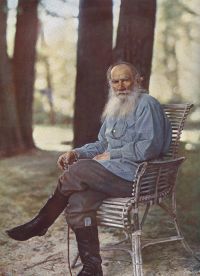
 Leo Tolstoy,
War and Peace
(1869)
Leo Tolstoy,
War and Peace
(1869)
“ On the twelfth of June, 1812, the forces of Western Europe crossed the Russian frontier and war began, that is, an event took place opposed to human reason and to human nature. ”
Leo Tolstoy,
War and Peace
(1869)
“ On the twelfth of June, 1812, the forces of Western Europe crossed the Russian frontier and war began, that is, an event took place opposed to human reason and to human nature. ”
 Peter Kropotkin,
Memoirs of a revolutionist
(1906)
Peter Kropotkin,
Memoirs of a revolutionist
(1906)
“ The last stronghold of the old nobility was now invaded by the new spirit.VIII The next year, early in the spring, I made my first journey to Western Europe. In crossing the Russian frontier I experienced, even more intensely than I was prepared to do, what every Russian feels on leaving his mother country. So long as the train runs on Russian ground, through the thinly populated north-western provinces, one has the feeling of crossing a desert. Hundreds of miles are covered with low growths which hardly deserve the name of forests. ”
University of Oxford. Faculty of Modern History, Why We Are at War (2nd Edition…
“ The reorganization of the Russian army in recent years has resulted, so we are told, in the grouping of enormously increased forces upon the western frontier. The western fortresses also have been equipped on an unparalleled scale. New roads and railways have been constructed to accelerate the mobilization of the war strength; and, above all, strategic railways have been pushed towards the western frontier. Thus, it is argued, Russia has in effect gone behind the Potsdam Agreement of 1910, by which she withdrew her armies to a fixed distance behind the Russo-German frontier. ”
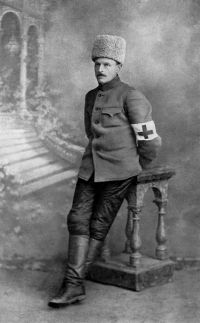 Bernard Pares,
Day by Day with the Russian Army…
Bernard Pares,
Day by Day with the Russian Army…
“ The Russian advance is now much more complete in southern Poland and is better lined up with the forces in Galicia. This advance tends to secure the Russian position on the northern frontier, where any German initiative becomes daily more hazardous. The ordinary fresh yearly Russian contingents mean an increase of half a million men. ”
Russia, as Seen and Described by Famous Writers
“ The southern frontier is still unsettled. In Asia beyond the Caspian, the southern boundary of the empire remains vague; the advance into the Turcoman Steppes and Afghan Turkestan, and on the Pamir plateau is still in progress. Bokhara and Khiva, though represented as vassal khanates, are in reality mere dependencies of Russia. An approximately settled frontier-line begins only farther east, where the Russian and Chinese empires meet on the borders of eastern Turkestan, Mongolia and Manchuria. Russia has no oceanic possessions, and has abandoned those she owned in the last century ”
 John Fiske,
Civil Government in the United States Considered with Some Reference to Its Origins
John Fiske,
Civil Government in the United States Considered with Some Reference to Its Origins
“ One reason for this has doubtless been that in times past the Russian territory was the great frontier battle-ground between civilized Europe and the wild hordes of western Asia, and the people who lived for ages on that turbulent frontier were subjected to altogether too much conquest. ”
 Ellen Churchill Semple,
Influences of Geographic Environment
Ellen Churchill Semple,
Influences of Geographic Environment
“ The Russian of the Asiatic border is proud to call himself a Siberian: he is already differentiated in his own consciousness. The force of Moscow tradition and discipline is faint when it reaches him, it has traveled so far. Even the elaborate observances of the orthodox Greek Church tend to become simplified on the frontier. The question naturally arises whether in the Russian Empire, as in the United States, the political periphery will in time, react upon the center, infuse it with the spirit of progress and youth.390Free border states as political survivals. ”
 Thomas Wallace Knox,
The Boy Travellers in the Russian Empire
(1887)
Thomas Wallace Knox,
The Boy Travellers in the Russian Empire
(1887)
“ The Russians have established a military and naval station at Novi Golfe, on the Caspian, twenty-two versts north-west of Mikhailovsk, and connected it with the latter point by railway. In case of war with England, the Russians are prepared to strike heavy blows in Asia. They have two army corps in the Caucasus, and another in Turkestan ready for service on their south-eastern frontier. ”
“ RUSSIA.—On our Eastern frontier the population of the Russian Empire is increasing on an enormous scale—about 2-1⁄2 to 3 millions yearly. Within a generation a population of 250 millions will be attained. Against this overwhelming pressure of numbers on our eastern flank, undoubtedly the greatest danger to the German and European future, Germany can hold her ground only— (a) if a strong boundary-wall be erected both against the advancing tide of Russification, which encroaches imperceptibly in times of peace, and also against the menace of an aggressive war ”
Sinclair Kennedy, The Pan-Angles
“ Only the fighting edges of Siberia are filled with settlers, most of them ex-soldiers and their families. The interior is scantily populated against the time when the advance of the frontier shall be checked.The significance of this growth has not been ignored in Europe. Statesmen have acted or have feared to act according to their conjectures of Russian desires and powers. For years Russia has been, and indeed still is, the bugbear of the British on the Indian and Persian frontiers. Urged by the British Isles, Japan, fighting for its very existence, checked Russia. ”
The German Classics of the Nineteenth and Twentieth Centuries…
“ Russia is the more quickly at hand, either as an ally or as a foe, the nearer her main army, or at least a large army, is to her western frontier.This policy has directed the Russian allocation of troops for a long while. You will remember that the army assembled in the Polish kingdom during the Crimean War was so large that this war might have ended differently if the army had started on time. If you think farther back, you will see that the events of 1830 found Russia unprepared and not ready to take a hand, because she had an insufficient number of troops in the western part of her empire. ”
comte de Philippe-Paul Ségur, History of the Expedition to Russia
“ The enemy is in deserted Moscow as in a tomb, without means of domination or even of existence. He entered Russia with three hundred thousand men of all countries, without union or any national or religious bond;—he has lost half of them by the sword, famine, and desertion: he has but the wreck of this army in Moscow; he is in the heart of Russia, and not a single Russian is at his feet. ”
Elizabeth Kimball Kendall, A Wayfarer in China
“ There is a community of about five hundred Russians in Urga, mostly traders and officials, and a fifth as many soldiers protecting them. The look of the Russian quarter takes you across the sea, for many of the houses are of logs set in a grass yard, the whole surrounded by a high board fence, almost a stockade in strength. Far East and Far West have met, and the homes of the Russian pioneer and American frontiersman are much alike. ”
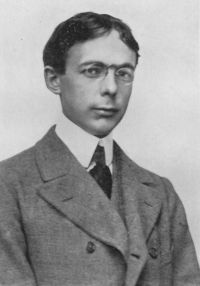 Carl Russell Fish,
The Path of Empire: A Chronicle of the United States as a World Power
Carl Russell Fish,
The Path of Empire: A Chronicle of the United States as a World Power
“ The United States arrived in the Orient at a moment of high excitement. Russia was consolidating the advance of two centuries by the building of the trans-Siberian railroad, and was looking eagerly for a port in the sun, to supplement winter-bound Vladivostok. Great Britain still regarded Russia as the great enemy and, pursuing her policy of placing buffer states between her territories and her enemies, was keenly interested in preventing any encroachment southward which might bring the Russian bear nearer India. ”
Alexander Michie, The Englishman in China During the Victorian Era…
“ Russia alone has a policy independent at once of accidents, autocrats, shifting governing bodies, and of all personalities, weak or strong. With the accumulated force of past achievements, an unbroken tradition, and great military forces massed on a frontier which is no frontier, Russia among the other Powers now masquerading in the Far East is as the iron vessel floating among the earthenware pots. ”
Agnes C. Laut, Vikings of the Pacific
“ Russian forts were seen on Cook's Inlet, Russian settlements on Prince William Sound, Russian flotillas of nine hundred {288} Aleutian hunters steering by instinct like the gulls spreading over the sea as far east as Bering Bay, or where the coast of Alaska dips southward. Everywhere he heard the language of Russia, everywhere saw that Russia regarded his explorations with jealousy as intrusion; everywhere observed that Russian and savage had come to an understanding and now lived as friends, if not brothers. ”
Samuel Irenæus Prime, The Alhambra and the Kremlin: The South and the North of Europe
“ But we are now on the border between the East and the West, between Asia and Europe, between barbarism in its best estate and civilization. Take a map of the world and see where Moscow stands! What vast, uncultured, desolate regions lie at the east of it, and still further on, what empires and peoples that make up the bulk of the human race! Out of the barbarism of that eastern portion of the earth’s plane, Russia is emerging, and Moscow is her frontier town ”
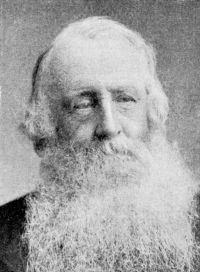 Edward A. Freeman,
The Historical Geography of Europe…
Edward A. Freeman,
The Historical Geography of Europe…
“ The southern advance of Russia on European ground has been during this century an advance less of territory than of influence. The frontier of 1878 is the restored frontier of 1812. It is in the lands out of Europe that Russia has in the meanwhile advanced by strides which look startling on the map, but which in truth spring naturally from the geographical position of the one modern European power which cannot help being Asiatic as well. ”
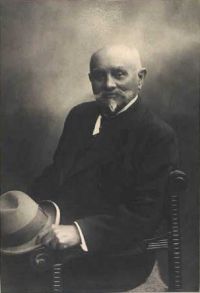 Peter Lauridsen,
Vitus Bering: the Discoverer of Bering Strait
Peter Lauridsen,
Vitus Bering: the Discoverer of Bering Strait
“ But in the greatness of the tasks undertaken, in the perseverance of their leaders, in difficulties, dangers, and tragic fates, Russian explorations stand worthily at their side. The geographical position of the Russians, their dispersion throughout the coldest regions of the earth, their frugal habits, remarkable power of foresight, and their adventurous spirit, make them especially fitted for Arctic explorations. ”
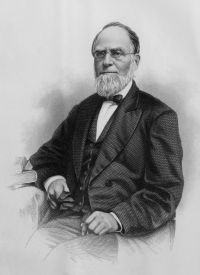 John S. C. Abbott,
The Empire of Russia: From the Remotest Periods to the Present Time
John S. C. Abbott,
The Empire of Russia: From the Remotest Periods to the Present Time
“ It is estimated that the territory of Russia now comprises one seventh of the habitable globe, extending from the Baltic Sea across the whole breadth of Europe and of Asia to Behring's Straits, and from the eternal ices of the north pole, almost down to the sunny shores of the Mediterranean. As the previous narrative has shown, for many ages this gigantic power has been steadily advancing towards Constantinople. The Russian flag now girdles the Euxine Sea, and notwithstanding the recent check at Sevastopol, Russia is pressing on with resistless strides towards the possession of the Hellespont. ”
 William Eleroy Curtis,
Around the Black Sea
William Eleroy Curtis,
Around the Black Sea
“ These caravans meet and receive and discharge their cargoes at a large open square, surrounded by khans, the Oriental substitute for hotels, and such places are always fascinating to people from other parts of the world. Most of the goods that are carried into the interior come from Moscow, for the Russian government always protects its manufacturers and promotes their trade where it can be done without interfering with military affairs. ”
Ward Moore, Greener Than You Think
“ Often the obvious course is the surprising one; since the Russians couldnt go over or under the grass they decided to march on top of it. They had heard of our prewar snowshoe excursions on its surface and so they equipped a vast army with this clumsy footgear and set it in motion with supplytrains on wide skis pulled by the men themselves. Russian ingenuity, boasted the Kremlin, would succeed in conquering the grass where the decadent imperialists had failed. ”
Ellen Churchill Semple,
Influences of Geographic Environment
“ The world-wide maritime expansion of the English-speaking people had its starting point in the lowlands of the Elbe. The makers of empire in northern China were cradled in the small highland valley of the Wei River. The little principality of Moscow was the nucleus of the Russian Empire.Penetration into a people's remote past comes always upon some limited spot which has nurtured the young nation, and reveals the fact that territorial expansion is the incontestible feature of their history. ”
John S. C. Abbott,
The Empire of Russia: From the Remotest Periods to the Present Time
“ The Russians took possession of the city, prosecuted the war vigorously through the summer, and the tzar, on the 20th of October, which was his birthday, received the gratifying intelligence that every foe was quelled, and that the Russian government was firmly established on the shores of the Caspian. Well might Russia now be proud of its territorial greatness. The opening of these new realms encouraged commerce, promoted wealth, and developed to an extraordinary degree the resources of the empire. ”
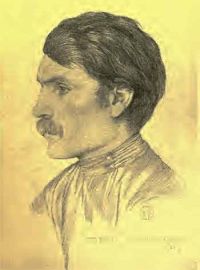 Stephen Graham,
Through Russian Central Asia
(1916)
Stephen Graham,
Through Russian Central Asia
(1916)
“ Nothing stands in Russia’s way, and she is always quietly colonising the empty East.An interesting yearly chart might be issued by the Russian Government showing the waves of colonisation: the new spots in forests and deserts that have been given names, the new farms, the thickening of the population in the nearer-in districts, the efflorescence of Russian enterprise at the farthest-out points whither they have gone. Several hundred Russian families are settled in Northern Persia, several hundred also in Mongolia and China. ”
Stephen Graham,
Through Russian Central Asia
(1916)
“ The movement goes on, and it is not primarily due to the density of population in European Russia. All Russia, excepting the few industrial regions, is under rather than over-populated. There is plenty of room. Why, then, should Russia increase? or why not? Russia has access to the empty heart of Asia. The old world is hollow at the core, and Russia has access to that great, wide hollowness, stands at the door of it and stares into the great emptiness. Then her people are wanderers; they have the wandering spirit. ”
Peter Berngardovich Struve, Russian Realities and Problems… (1917)
“ Russia is building up her culture not in a confined space already occupied and settled, but in a free colonial area which is continually expanding, and at the same time is constantly connected territorially with the centre from which it expands. When the Russian State was being formed, the Moscow region was such a centre. ”
Victoria C. Woodhull, The Origin, Tendencies and Principles of Government (1871)
“ Like no other country, Russia has vast possessions in the unyielding frigid zone, which gives way but slowly before the gradually equalizing temperature of the globe, and of the character of which Russian Government naturally partakes. ”
Marr Murray, The Russian Advance
“ Apart from the initial handicap of having to fight on the defensive because of the comparative slowness of her mobilisation, Russia is the most advantageously situated of all European Powers for war on the grand scale. Britain is dependent on her command of the sea for her food and trade; the existence of both France and Germany more or less depend on supplies from the outer world. But Russia is self-contained. Her vast “lump” of empire can supply all her needs, from food and trade to an unlimited store of first-class fighting material. ”
Joseph Markus Goldstein, The Russian Review (1916)
“ The question of Russia's becoming an economic colony of some other power, so often urged by Russian ultra-protectionists, is scarcely worth discussing, for the question that will stand before- Russia after this War is over, will not be that of becoming anybody's colony, but of gradually becoming a part of the world's stream of trade, of developing her own productive forces, and thus assuming on the world market a position befitting a first-class power. ”
Manjiro Inagaki, Japan and the Pacific, and a Japanese View of the Eastern Question
“ Russia is divided into fifteen military districts, which comprise also Finland, Siberia, the Caucasus, the Trans-Caspian region, and Turkestan. The entire Russian effective force, including officers, artillery, engineers, train, &c., consists of— By adding to these figures, the effective troops not levied in time of peace, say 100,000 men, we reach an effective of 2,000,000 for the war footing. ”
Queen of Great Britain Victoria, The Letters of Queen Victoria…
“ Greater and more brilliant successes by land and sea might probably have been accomplished by the Allies if the war had continued, but any great and important additional security against future aggressions by Russia could only have been obtained by severing from Russia large portions of her frontier territory, such as Finland, Poland, and Georgia ”
Various, Eclectic Magazine of Foreign Literature…
“ Russia might recoil from contact with us, or we might mutually retire to a convenient distance from each other, or in our respective positions at Merv and Herat—Russia being able to draw on her European resources through the Oxus and the Caspian, while a railway through Candahar connected our advanced garrison with the Indus—we might lay the foundation of that limitary relationship along the whole line of frontier, which, although unsuited to the present state of affairs in Central Asia, must inevitably be the ultimate condition of our joint dominion in the East. ”
 Frederick Jackson Turner
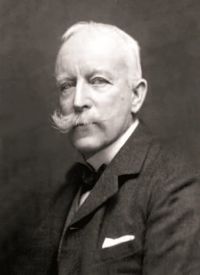 Thomas HoldichStephen GrahamSir E. Denison Ross
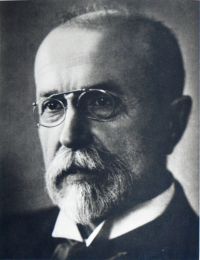 Tomáš Garrigue MasarykBernard ParesPeter Berngardovich StruveCharles Sarolea
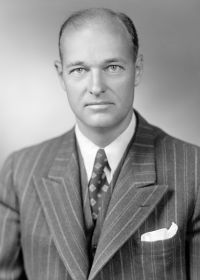 George F. Kennan
 Adèle Hommaire de HellUniversity of Oxford. Faculty of Modern HistoryLeo Tolstoy
 Emile Joseph DillonJoseph Markus GoldsteinManjiro Inagakicomte de Philippe-Paul SégurEllen Churchill Semple
 Ivan TurgenevThomas Wallace KnoxPeter Lauridsen