“ Yet when I was at last brought within the influence of one who not only believed all that my first opponent did, but who also knew that the more light was thrown upon it the more clearly would its truth be made apparent—a man who talked with me as though he was anxious that I should convince him if he were in error, not as though bent on making me believe whatever habit and circumstances had imposed as a formula upon himself—my heart softened at once, and the dry places of my soul were watered. ”
Quotes about “Samuel Butler”
 Edmund Gosse,
Aspects and Impressions
Edmund Gosse,
Aspects and Impressions
“ Henry Festing Jones's Life of Samuel Butler tells the history of a very remarkable man with a vividness which leaves nothing to be desired. This is not a vain compliment; it is a tribute which common justice demands on an unusual occasion. There were ninety-nine chances in a hundred that Butler's life would never be adequately, or even intelligently, recorded. ”
Samuel Butler, The Way of All Flesh
“ It was a fine sight to see him tucking his napkin under his rosy old gills, and letting it fall over his capacious waistcoat while the high light from the chandelier danced about the bump of benevolence on his bald old head like a star of Bethlehem.The soup was real turtle; the old gentleman was evidently well pleased and he was beginning to come out. Gelstrap stood behind his master’s chair. I sat next Mrs Theobald on her left hand, and was thus just opposite her father-in-law, whom I had every opportunity of observing. ”
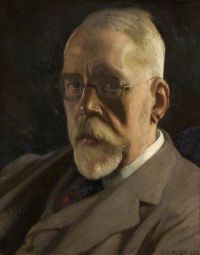 Henry Festing Jones,
Samuel Butler: A Sketch
Henry Festing Jones,
Samuel Butler: A Sketch
“ Anyone who wants to know what kind of an artist F. S. Cary was can see his picture of Charles and Mary Lamb in the National Portrait Gallery.In 1865 Butler sent from London to New Zealand an article entitled “Lucubratio Ebria,” which was published in the Press of 29th July, 1865. It treated machines from a point of view different from that adopted in “Darwin among the Machines,” and was one of the steps that led to Erewhon and ultimately to Life and Habit. The article is reproduced in The Note-Books of Samuel Butler (1912) . ”
Edmund Gosse,
Aspects and Impressions
“ Butler lives twice over, or rather has never ceased to live, in the mind and humour of Mr. Henry Festing Jones.We move in an age which prides itself more and more on being able to see the mote in the eye of its immediate predecessor. But Samuel Butler was the precursor of this rebellion, and is historically notable as the earliest anti-Victorian. He was born at a moment which was to prove less rich than almost any other of the remarkable nineteenth century, in producing men who were to be eminent for intellectual talent. ”
A. T. Bartholomew, The Samuel Butler Collection at Saint John's College…
“ Pencil drawing: Samuel Butler, 1854.Reproduced in the Memoir, ch. iii. On the back of this drawing is the beginning of a water-colour sketch. It was in a book with others mentioned in the Memoir as having been given to Shrewsbury School (I. 44) . I have no doubt that the sketch on the back is by Butler, and represents part of the Rectory house at Langar.The Rev. D. Y. Blakiston was born in 1832. He studied art at the Royal Academy Schools especially under W. Dobson, R.A. From about 1850 to 1865 he painted in London and at St. Leonard’s, and exhibited at the Royal Academy. ”
William Andrews, Curious Epitaphs, Collected from the Graveyards of Great Britain and Ireland
“ In St. Mary’s Church, Beverley, a tablet is placed in remembrance of a notable Yorkshire actor:—In Memory of Samuel Butler, A poor player that struts and frets his hour upon the stage, and then is heard no more. Obt. June 15th 1812, Æt. 62.Butler’s gifted son, Samuel William, was buried in Ardwick cemetery, Manchester. A gravestone placed to his memory bears the following eloquent inscription by Charles Swain:— [Pg 99] Here rest the mortal remains of Samuel William Butler, Tragedian. ”
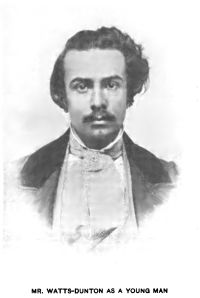 Walter Theodore Watts-Dunton,
1911 Encyclopædia Britannica
(1911)
Walter Theodore Watts-Dunton,
1911 Encyclopædia Britannica
(1911)
“ That effort of Wycherley's to bring to Buckingham's notice the case of Samuel Butler (so shamefully neglected by the court Butler had served) shows that the writer of even such heartless plays as The Country Wife may be familiar with generous impulses, while his uncompromising lines in defence of Buckingham, when the duke in his turn fell into trouble, show that the inventor of so shameless a fraud as that which forms the pivot of The Plain Dealer may in actual life possess that passion for fairplay which is believed to be a specially English quality. ”
Samuel Butler, Hudibras (1859)
“ This little monument was erected in the year 1780, by some of the parishioners of Covent Garden, in memory of the celebrated Samuel Butler, who was buried in this church, a. d. 1680. A few plain men, to pomp and state unknown, O'er a poor bard have rais'd this humble stone, Whose wants alone his genius could surpass, Victim of zeal! the matchless Hudibras! ”
 A. P. Herbert,
The House by the River
A. P. Herbert,
The House by the River
“ He spoke of the eternal contradictions of human personality, of the amazing mixtures which make up men; how true was the saying of Samuel Butler that everything a man does is in a measure a picture of himself, yet how true it was that one could not confidently judge what a man was like from what he wrote. ”
Samuel Butler, Hudibras (1859)
“ The life of a retired scholar can furnish but little matter to the biographer: such was the character of Mr Samuel Butler, author of Hudibras. His father, whose name was likewise Samuel, had an estate of his own of about ten pounds yearly, which still goes by the name of Butler's tenement; he likewise rented lands at three hundred pounds a year under Sir William Eussel, lord of the manor of Strensham, in Worcestershire. ”
Samuel Butler, The Way of All Flesh (1903)
“ He does not like this branch of his profession—indeed he hates it—but will not admit it to himself. The habit of not admitting things to himself has become a confirmed one with him. Nevertheless there haunts him an ill defined sense that life would be pleasanter if there were no sick sinners, or if they would at any rate face an eternity of torture with more indifference. He does not feel that he is in his element. The farmers look as if they were in their element. They are full-bodied, healthy and contented ”
A. T. Bartholomew, The Samuel Butler Collection at Saint John's College…
“ Vol. XXXVIII., no. 171 (December) . “A ‘Few Earnest Words’ on Samuel Butler.” (Review of J. F. Harris’s “Samuel Butler: the man and his work” (1916) , by W. E. Heitland.) A FIRST YEAR IN CANTERBURY SETTLEMENT1863. Original cloth, purchased.1914. New edition with other early Essays. Presentation copy from R. A. Streatfeild, with two letters inserted.THE EVIDENCE FOR THE RESURRECTION1865. One complete copy containing pencil marks made by Butler. Cloth, original wrappers bound in.1865. Two mutilated copies used by Butler in making the MS. of The Fair Haven. These were given to St. ”
Samuel Butler, The Way of All Flesh (1903)
“ The change was so great that it was not till Ernest actually spoke to him that the coachman knew him. "How are my father and mother?" he asked hurriedly, as he got into the carriage. "The Master's well, sir," was the answer, "but the Missis is very sadly." The horse knew that he was going home and pulled hard at the reins. The weather was cold and raw—the very ideal of a November day; in one part of the road the floods were out, and near here they had to pass through a number of horsemen and dogs, for the hounds had met that morning at a place near Battersby. ”
Samuel Butler, Hudibras (1859)
“ In 1854, when the church-yard was closed against further burials, the tablet, then in a dilapidated condition, was carted away with other debris. ↑ Translation.—Sacred to the memory of Samuel Butler, who was born at Strensham, in Worcestershire, in 1612, and died in London, in 1680,—a man of great learning, acuteness, and integrity; happy in the productions of his intellect, not so in the remuneration of them ”
Edmund Gosse,
Aspects and Impressions
“ They are unreadable. His religious polemic was even more disagreeable than his scientific, and the lumbering sarcasm of the attack on Christianity, called The Fair Haven, is an epitome of all that is most unpleasing in the attitude of Butler. Unctuous sarcasm so sustained as to deceive the very elect, and "affectation of the tone of indignant orthodoxy," have a tendency to grow rancid in the passage of years, and to become exceedingly unappetizing. Samuel Butler, whose rashness was astounding, had the courage to call his homonym of the Analogy a "poor creature"! ”
Samuel Butler, The Way of All Flesh (1903)
“ I had already long since come to that conclusion myself. "Well," he continued, "there are a lot of things that want saying which no one dares to say, a lot of shams which want attacking, and yet no one attacks them. It seems to me that I can say things which not another man in England except myself will venture to say, and yet which are crying to be said." I said: "But who will listen? If you say things which nobody else would dare to say is not this much the same as saying what everyone except yourself knows to be better left unsaid just now?" ”
A. T. Bartholomew, The Samuel Butler Collection at Saint John's College…
“ Inscribed “Samuel Butler, from his affectionate Godmother and Aunt Anna Worsley, September 13th, 1836.” So that he was not christened till he was more than nine months old, and he used to say that this delay was a risky business, because during all those months the devil had the run of him. He imitated the inscription in this Bible for the inscription in the christening Bible which Ernest spurns from him when he is about to undertake the conversion of Miss Maitland in chapter lx. of The Way of All Flesh. ”
Samuel Butler, Hudibras (1859)
“ The three small volumes, entitled Posthumous Works, in prose and verse, by Mr Samuel Butler, author of Hudibras, printed 1715, 1716, 1717, are all spurious, except the Pindaric Ode on Duval the highwayman, and one or two of the prose pieces. Mr Nash says, "As to the MSS. which after Mr Butler's death came into the hands of Mr Longueville, and from which Mr Thyer published his Genuine Remains in the year 1759; what remain unpublished are either in the hands of the ingenious Doctor Farmer of Cambridge, or myself. ”
Samuel Butler, Unconscious Memory
“ Such learned writings as Semon’s or Hering’s could never produce such an effect: they do not penetrate to the heart of man; they cannot carry conviction to the intellect already filled full with rival theories, and with the unreasoned faith that to-morrow or next day a new discovery will obliterate all distinction between Man and his makings. The mind must needs be open for the reception of truth, for the rejection of prejudice; and the violence of a Samuel Butler may in the future as in the past be needed to shatter the coat of mail forged by too exclusively professional a training. ”
Samuel Butler, The Way of All Flesh (1903)
“ Pryer had done well to warn Ernest against promiscuous house to house visitation. He had not gone outside Mrs Jupp’s street door, and yet what had been the result?Mr Holt had put him in bodily fear; Mr and Mrs Baxter had nearly made a Methodist of him; Mr Shaw had undermined his faith in the Resurrection; Miss Snow’s charms had ruined—or would have done so but for an accident—his moral character. As for Miss Maitland, he had done his best to ruin hers, and had damaged himself gravely and irretrievably in consequence. ”
1911 Encyclopædia Britannica, Volume 4… (1911)
“ We are nowhere informed in what capacity Butler served Sir Samuel Luke, or how he came to reside in the house of a noted Puritan and Parliament man. In the family of this “valiant Mamaluke,” who, whether he was or was not the original of Hudibras, was certainly a rigid Presbyterian, “a colonel in the army of the Parliament, scoutmaster-general for Bedfordshire and governor of Newport Pagnell,” Butler must have had the most abundant opportunities of studying from the life those who were to be the victims of his satire ”
“ It is a great pity that Samuel Butler did not live longer and write more novels. But in regretting him, we shall do well to remember that though publication was delayed until some time after the author's death, the bulk of The Way of All Flesh was written in the '70's. The Way of All Flesh is not sympathetic to the contemporary mood ”
Samuel Butler, The Way of All Flesh (1903)
“ The last time I had a long gossip with her was about two years ago when she came to me instead of to Ernest. She said she had seen a cab drive up just as she was going to enter the staircase, and had seen Mr Pontifex’s pa put his Beelzebub old head out of the window, so she had come on to me, for she hadn’t greased her sides for no curtsey, not for the likes of him. She professed to be very much down on her luck. Her lodgers did use her so dreadful, going away without paying and leaving not so much as a stick behind, but to-day she was as pleased as a penny carrot. ”
 George Bernard Shaw,
Major Barbara
(1905)
George Bernard Shaw,
Major Barbara
(1905)
“ Well, it cannot be denied that the English are only too anxious to recognize a man of genius if somebody will kindly point him out to them. Having pointed myself out in this manner with some success, I now point out Samuel Butler, and trust that in consequence I shall hear a little less in future of the novelty and foreign origin of the ideas which are now making their way into the English theatre through plays written by Socialists. There are living men whose originality and power are as obvious as Butler's ”
Samuel Butler, The Way of All Flesh (1903)
“ But they seldom have fair play; as a general rule they meet with foul play, and foul play from those who live by selling them stones made into a great variety of shapes and sizes so as to form a tolerable imitation of bread. Some are lucky enough to meet with few obstacles, some are plucky enough to over-ride them, but in the greater number of cases, if people are saved at all they are saved so as by fire. While Ernest was with me Ellen was looking out for a shop on the south side of the Thames near the "Elephant and Castle," which was then almost a new and a very rising neighbourhood. ”
Samuel Butler, The Way of All Flesh (1903)
“ It still seemed to him that the best thing both for him and them would be that he should sever himself from them completely, take whatever money he could recover from Pryer, and go to some place in the uttermost parts of the earth, where he should never meet anyone who had known him at school or college, and start afresh. Or perhaps he might go to the gold fields in California or Australia, of which such wonderful accounts were then heard; there he might even make his fortune, and return as an old man many years hence, unknown to everyone, and if so, he would live at Cambridge. ”
Samuel Butler, The Way of All Flesh
“ Mrs Jupp at first tried to dissuade him, but seeing him resolute, suggested that she should herself see Miss Snow first, so as to prepare her and prevent her from being alarmed by his visit. She was not at home now, but in the course of the next day, it should be arranged. In the meantime he had better try Mr Shaw, the tinker, in the front kitchen. Mrs Baxter had told Ernest that Mr Shaw was from the North Country, and an avowed freethinker; he would probably, she said, rather like a visit, but she did not think Ernest would stand much chance of making a convert of him. ”
A. T. Bartholomew, The Samuel Butler Collection at Saint John's College…
“ My first attempt at a drawing in pencil and ink of Butler’s Homestead, Mesopotamia, New Zealand.I did it in 1910 or thereabouts from a faded photograph taken about 1863 and lent to Butler by J. D. Enys. Also Emery Walker’s reproduction of my first attempt which was not used in the Memoir.4. My second attempt, which was reproduced in the Memoir.SAMUEL BUTLER5. Water-colour: A view in Cambridge.Probably done when Butler was an undergraduate, and given to St. John’s some years ago. I found it in the book wherein I found Blakiston’s drawing (no. 2) .6. Oil Painting: Family Prayers. ”
Samuel Butler, The Way of All Flesh (1903)
“ For society indeed of all sorts, except of course that of a few intimate friends, he had an unconquerable aversion. “I always did hate those people,” he said, “and they always have hated and always will hate me. I am an Ishmael by instinct as much as by accident of circumstances, but if I keep out of society I shall be less vulnerable than Ishmaels generally are. The moment a man goes into society, he becomes vulnerable all round.” ”
