“ If you want to form some idea of the South London folk, go stand inside Cannon Street Station and watch the trains come in, each with its freight of those who earn their daily bread within the City. See them pass out—by the hundred—by the thousand—by the fifty thousand. The brain reels at the mere contemplation of this mighty multitude which comes in every morning and goes out every afternoon. As they hurry past you observe on each the same expression, the same set eagerness, with which the day's work is approached. Employer or employé, principal or clerk, it matters nothing. ”
South London
Definition and stakes
The theme of “South London” has been addressed by authors such as . It is often associated with terms like Southwark, city, river, population and street.
Quotes about “South London”
“ Or, taking the whole area of South London, that part which is covered by the electoral districts, there is now a population of very nearly two millions; in other words the population, in less than a hundred years, has been multiplied by ten. That of London itself, in the same time, the London including the City, Clerkenwell, Whitechapel, Bloomsbury, and Westminster, has been multiplied during the same time by five. What has caused this enormous increase in South London? Well, people must live somewhere ”
“ In the centuries which include the twelfth to the fifteenth, however, South London, so far as it was populated at all, was{49} the residence of great lords and the place of sojourn for merchants from the country. As yet the reputation of Southwark was spotless and its dignity enviable. London itself had no such collection of palaces gathered together so closely. As for the land, that lay low, but was protected by the Embankment from the river. Many rivulets flowed slowly across the misty meadows; many ponds lay about the flats ”
“ Those who call attention to this miracle always point to the filling up of the huge area between Highgate and Hampstead and Clerkenwell in the North, or the extension of the town to Hammersmith on the West. Perhaps a little consideration of the South may show a still more remarkable growth. I have before me a map of the year 1834, only sixty-four years ago, showing South London as it was. I see a small town or collection of small towns, occupying the{302} district called the Borough Proper, Lambeth, Newington, Walworth, and Bermondsey. ”
“ The clerks lived nearer London, mostly on the north of the river. Lastly came the railway, when London made another step outward, so as to take in the places lying south of Clapham and Brixton. Then the builder began; he saw that a new class of residents would be attracted by small houses and low rents. The houses sprang up as if in a single night; streets in a month, churches and chapels in a quarter. The population of South London no longer consists of rich merchants, principals, and partners. Clerks, assistants, and employés of all kinds now crowd the morning and evening trains. ”
“ Almshouses which are perfectly beautiful are only vouchsafed to man for a limited period, lest other buildings become intolerable. Their time expired, they are then carried off Heavenward.Or turn your eyes further south. London in this direction now covers—for the most part completely, in some parts leaving spaces and fields here and there—Greenwich, Blackheath, Brockley, Peckham, Forest Hill, Dulwich,{307} Brixton, Stockwell, Camberwell, Clapham, Balham, Wandsworth, Vauxhall, and Penge, and many others. ”
“ South London is more frequently favored with their achievements than the quarter with which we are here concerned; they are difficult to deal with because they meet, fight, and disperse with such rapidity that it is next to impossible to get hold of them. ”
J. Arthur Gibbs, A Cotswold Village; Or, Country Life and Pursuits in Gloucestershire
“ London is becoming miserably hot and dusty; everybody who can get away is rushing off, north, south, east, and west, some to the seaside, others to pleasant country houses. Who will fly with me westwards to the land of golden sunshine and silvery trout streams, the land of breezy uplands and valleys nestling under limestone hills, where the scream of the railway whistle is seldom heard and the smoke of the factory darkens not the long summer days? Away, in the smooth "Flying Dutchman"; past Windsor's glorious towers and Eton's playing-fields ”
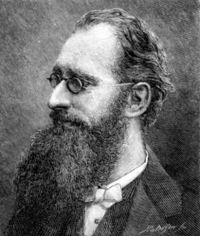 Mandell Creighton,
Historical Lectures and Addresses
(1903)
Mandell Creighton,
Historical Lectures and Addresses
(1903)
“ Westminster was merely the purlieus of the Royal Palace of Whitehall, the Abbey and the Palace of Westminster, which was the seat of Parliament and of the Law Courts. South London was represented by the little borough of Southwark, which was incorporated with the city of London in the reign of Edward VI. Its western promenade was open to the river, and was called Bankside. It was a natural centre of amusement to the citizens of London, and the Globe Theatre on the Bankside is famous through its connexion with Shakespeare. ”
“ Great is the work, and worthy to be held in the highest honour, of those who trace out the irresistible march of national freedom: I cannot join their company; I must be contented with the lowlier, yet somewhat useful, task of showing how the people, my forefathers, lived, and{2} what they thought, and how they sang and feasted and made love and grew old and died.My South London extends from Battersea in the west to Greenwich in the east, and from the river on the north to the first rising ground on the south. ”
“ Here they live by the hundred thousand—by the million: there are more than a million working men in South London. For their use are{321} the shops of the Borough, chiefly provision shops, and the public houses. The third layer is found on a slip of ground, of which Newington and Kennington may be taken as representative: it consists principally of lodging-houses for clerks. The fourth layer is that of the suburban villa, from the little semi-detached cottage to the stately mansion. The 'High Street,' filled with shops, is for the villas. ”
“ At Putney, but for the villas, I should look for Pitt. Oh! there are a thousand people once living, and walking, and playing their parts in their villages, whose wraiths and spectres would willingly haunt them still, but cannot for the{315} bricks and the walls, the chimneys and the smoke, the roads and the trams.We have destroyed the beauty of South London: we have also made its historical associations impossible. RED CROSS GARDENS, Southwark The first settlers or colonisers of this region, apart from its rural folk, came from London about the time when roads began to be tolerable ”
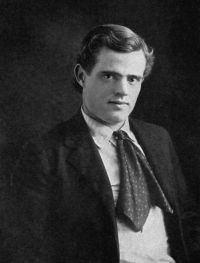 Jack London,
The Cry for Justice: An Anthology of the Literature of Social Protest
Jack London,
The Cry for Justice: An Anthology of the Literature of Social Protest
“ There are derelict churches in the Strand, and dingy, blatant taverns, and strident signs and hoardings; and there are slums hard by.There are thieves in the Strand, and prowling vagrants, and gaunt hawkers, and touts, and gamblers, and loitering failures, with tragic eyes and wilted garments; and prostitutes plying for hire.And east and west, and north and south of the Strand, there is London. Is there a man amongst all London’s millions brave enough to tell the naked truth about the vice and crime, the misery and meanness, the hypocrisies and shames of the great, rich, heathen city? ”
 H. G. Wells,
Tono-Bungay
(1909)
H. G. Wells,
Tono-Bungay
(1909)
“ And south of this central London, south-east, south-west, far west, north-west, all round the northern hills, are similar disproportionate growths, endless streets of undistinguished houses, undistinguished industries, shabby families, second-rate shops, inexplicable people who in a once fashionable phrase do not "exist." ”
Dorothy M. Richardson, Backwater: Pilgrimage, Volume 2
“ North London would always be North London, hard, strong, sneering, money-making, noisy and trammy. Perhaps the difference between the north and the south and her own south-west of London was like the difference between the north and the south of England.... Green’s “History of the English People” ... spinning-jennys began in the Danish north, hard and cold, with later sunsets. In the south was Somersetshire lace. North London meant twenty pounds a year and the need for resignation and determination every day. Eve had thirty-five pounds and a huge garden and new books and music ... ”
“ When, for instance, the Danes held London for twelve years, leaving it a wreck and a ruin, can we believe that any people remained in Southwark? In times of peace the fishermen lived here for greater convenience of their work; London by this time was impossible for them, because it was walled all along the river side. If peace was prolonged, inns were set up for the merchants: people built houses along the causeway. When war began again, and the enemy once more appeared, Southwark was again abandoned. ”
“ I have set down what royal processions Southwark was permitted to see, but I do not suppose that among the four hundred citizens who went out in one livery to meet King Richard there was one man from Southwark, nor do I suppose that when nine hundred and sixty citizens, each man carrying a silver cup, rode through London with the Coronation procession, there was a single man from the quarter south of London Bridge. ”
W. Roberts, The Book-Hunter in London
“ Up to nearly the end of the last century, these localities were for the most part, and for close on 350 years, confined to within a narrow area. With the rapid expansion of London north, east, south, and west, the 'trade' has not only expanded, but its representatives have sprung up in every district, whilst many of the older ones have forsaken the limits of the City, and pitched their tents in Greater London. For centuries bookselling and publishing flourished side by side in St. Paul's Churchyard, Fleet Street, and their immediate neighbourhoods. ”
Henry B. Wheatley, The Story of London
“ We learn from Fitz-Stephen that ‘London formerly had walls and towers in like manner in the south, but that most excellent river the Thames, which abounds with fish, and in which the tide ebbs and flows, runs on that side, and has in a long space of time washed down, undermined and subverted the walls in that part.’ Whether there were gates or not along the river front of London, there can be little doubt that there were not structures at all the places named gates, many of these were doubtless merely ways. ”
M. F. Mansfield, Dickens' London
“ If the latter, there seems no reason why London might not well be thought to include pretty much all of Kent and Surrey,—the home counties lying immediately south of the Thames,—though in reality one very soon gets into green fields in this direction, and but for the ominous signs of the builder and the enigmatic references of the native to the "city" or "town," the stranger, at least, might think himself actually far from the madding throng. ”
 Hilaire Belloc,
The River of London
(1912)
Hilaire Belloc,
The River of London
(1912)
“ When we consider something more than distance and think of London as the “centre [Pg 97] of gravity” of the Midlands, the east and the south, we find it still more central for the centuries immediately preceding our own. Their staple export was wool. The pasturage of the chalk ranges runs right round London in the Chilterns and their extension into East Anglia, in the north and south Downs and the Uplands of Wiltshire, Hampshire, and Dorset. London is the obvious centre of all that triangle of chalk. ”
“ In this respect, one or two of the East London suburbs are richer than those of the west or the south because they are older. Hackney and Stoke Newington, Stepney and Tottenham, were villages inhabited by wealthy people or noble people when the suburbs of the south were mere rural villages, with farms and meadows among their hanging woods. ”
 Walter Besant,
The History of London
Walter Besant,
The History of London
“ Chelsea, Bermondsey: in all such words ea or ey is an old word for island. In this way are formed Winchelsea, Battersea, &c.; Thorney (where Westminster is now) is the Island of Thorns; and Jersey, Cæsar's Island.Southwark: a district of London opposite the City, on the south side of the Thames. It was the South work, or fort, and is spoken of as a village as late as 1327, the accession of Edward III.{236} 2. THE FOUNDATION OF LONDON. PART II.Malarious: causing the air to be bad, and so giving rise to fevers; unhealthy. (Latin malus, bad; aer, air.) ”
Osbert John Radcliffe Howarth, Thomas Allan Ingram, and Henry Benjamin Wheatley, 1911 Encyclopædia Britannica, Volume 16… (1911)
“ London south of the Thames has none of the grander characteristics of the wealthy districts to the north. Poor quarters lie adjacent to the river over the whole distance from Battersea to Greenwich, merging southward into residential districts of better class. ”
Henry B. Wheatley, The Story of London
“ Much of the life was frivolous, and some of it worse than that, but among the respectable classes the opportunities for social intercourse were greater than now, when large numbers of the workers live out of London, some in the north, and some in the south, and it takes as long to get from Hampstead to Croydon as to travel a hundred miles into the country. ”
“ Raoul passed his length of rope around the base of an adjacent tree and stood looking on. The wind was frightful. He had never dreamed it could blow so hard. A sea breached across the atoll, wetting him to the knees ere it subsided into the lagoon. The sun had disappeared, and a lead-colored twilight settled down. A few drops of rain, driving horizontally, struck him. The impact was like that of leaden pellets. A splash of salt spray struck his face. It was like the slap of a man's hand. His cheeks stung, and involuntary tears of pain were in his smarting eyes. ”
Henry Jephson, The Sanitary Evolution of London
“ The southern group, with a population roughly of about 700,000, consisted of the whole of that portion of the metropolis which was situate on the south side of the river. Beginning on the west, there was Wandsworth (which included Battersea) , then Lambeth, Camberwell, Lewisham, with Woolwich and Plumstead on the extreme east, then Greenwich, Rotherhithe, Bermondsey, St. ”
Jack London,
South Sea Tales
(1911)
“ He became the slave of old Fanfoa, head chief over a score of scattered bush-villages on the range-lips of Malaita, the smoke of which, on calm mornings, is about the only evidence the seafaring white men have of the teeming interior population. For the whites do not penetrate Malaita. They tried it once, in the days when the search was on for gold, but they always left their heads behind to grin from the smoky rafters of the bushmen's huts.When Mauki was a young man of seventeen, Fanfoa got out of tobacco. He got dreadfully out of tobacco. ”
“ Other blacks there were on board, from unheard-of far places, and when the white man spoke to them, they tore the long feather from Mauki's hair, cut that same hair short, and wrapped about his waist a lava-lava of bright yellow calico. After many days on the schooner, and after beholding more land and islands than he had ever dreamed of, he was landed on New Georgia, and put to work in the field clearing jungle and cutting cane grass. For the first time he knew what work was. Even as a slave to Fanfoa he had not worked like this. And he did not like work. ”
“ There was old Johnny Simons—twenty-six years on the raw edges of Melanesia, swore he knew the niggers like a book and that they'd never do for him, and he passed out at Marovo Lagoon, New Georgia, had his head sawed off by a black Mary (woman) and an old nigger with only one leg, having left the other leg in the mouth of a shark while diving for dynamited fish. There was Billy Watts, horrible reputation as a nigger killer, a man to scare the devil. I remember lying at Cape Little, New Ireland you know, when the niggers stole half a case of trade-tobacco—cost him about three dollars and a half. ”
Jack London,
South Sea Tales
(1911)
“ Every slow movement was a protest and a threat. The atmosphere was moist and sticky like mucilage, and in the absence of wind all hands seemed to pant and gasp for air. The sweat stood out on faces and bare arms, and Captain Davenport for one, his face more gaunt and care-worn than ever, and his eyes troubled and staring, was oppressed by a feeling of impending calamity."It's off to the westward," McCoy said encouragingly. "At worst, we'll be only on the edge of it." ”
