“ Stoke Newington, though it could boast so many distinguished natives and residents, consisted of one long street, mostly with houses on one side only, and a church. The place is now entirely built upon; a few of the old houses remain, but not many, and the old atmosphere only survives in places which I have indicated, such as Sutton Place, High Street, Homerton, and Church Street, Stoke Newington. And I fear that to the visitor, to whom these associations are not familiar, there is no dignity about these streets other than is conferred by the few surviving mansions. ”
Stoke Newington
Definition and stakes
Quotes about “Stoke Newington”
Leslie Stephen,
Dictionary of National Biography…
(1898)
“ Stoke Newington, the site of his wife's property, was Sutton's ordinary residence for many years, though he occasionally resided in London, at Littlebury, and at Ashdon, Essex, and at Balsham, Cambridgeshire. At a somewhat later period he had a residence at Hackney and also lodgings at a draper's near the nether end of St. Dunstan's Church in Fleet Street. One Sutton of Newington, esq., appears in a return of 28 Nov. 1595 of the names of gentlemen of account, not being citizens of London, in the ward of Farringdon Within. Sutton has been inaccurately represented as a merchant in London. ”
Leopold Wagner, Names: and Their Meaning; A Book for the Curious
“ This was a quiet suburban village situated in a valley during the days when the northern districts of the Metropolis were more or less wooded—as witness Stoke Newington, or the new town in the meadow by the wood. The word Stoke comes from the Anglo-Saxon stoc, a wood or stockade; ton is the Old English for town, and ing the Anglo-Saxon for a meadow, also a family settlement. ”
Edwin Paxton Hood,
Isaac Watts; his life and writings…
(1875)
“ Watts’ biographers have hitherto not nicely discriminated the periods of his residence; reading Southey, it might be supposed he had passed all his life at Stoke Newington; reading Milner, it might be supposed he not only passed the greater part of his life, but closed his days at Theobalds. The truth is, that Thomas Gunston, the brother of Lady Abney, purchased a house and twenty-five acres of land with the Manor of Stoke Newington. ”
John Ashton, Dictionary of National Biography… (1886)
“ On the death of his wife, he went as assistant to Mr. Samuel Reynolds, a surgeon at Stoke Newington, whose sister he married, and with whom he entered into a partnership which lasted fourteen years. He continued to practise at Stoke Newington until his death, on 3 Feb. ”
Edwin Paxton Hood,
Isaac Watts; his life and writings…
(1875)
“ It has been said that Samuel Rogers, in his “Human Life,” portrays the Twickenham side of existence. The Stoke Newington side was very much like it, certainly wholly unlike the stir and heat of the vivid passions, the painful introspections, and diseased musings, which have forced their way into modern poetry. If Watts described or dealt with these it was not in his verse, although many of his prose writings seem to reveal that he was not ignorant of them; such is his often quoted piece:True Riches. ”
William Arthur Shaw, Dictionary of National Biography… (1895)
“ This property Patten assigned about 1571 to John Dudley (see William Robinson, Stoke Newington, p. 28; and Ellis, Campagna of London, p. 109) . While lord of the manor of Stoke Newington Patten repaired the parish church, which was in a ruinous state (1563) (ib. p. 199) . Patten subsequently became one of the tellers of the receipt of the queen’s exchequer at Westminster, receiver-general of her revenues in the county of York custumer of London outward, and a justice of peace for Middlesex (State Papers, Dom. Eliz. xi. 101, 3 Jun 1563) . ”
Henry Seton Merriman, Tomaso's Fortune and Other Stories
“ The world still exonerates him because he was drowned. “He sits and dreams all day,” is the report that Mary always gives to Stoke when she meets him in the town square, where the Penzance omnibus, the only link with the outer world, deposits its rare passengers. “And you?” Stoke once asked her in a moment of unusual expansion, his deep voice half muffled with suppressed suspense. She glanced at him with that waiting look which he knows to be there, but never meets. For he is a hard man—hard to her, harder to himself. ”
Thompson Cooper, Dictionary of National Biography… (1885)
“ There is also a document in the form of an advertisement printed on a half-sheet quarto, to be issued to his patrons. In this he describes himself as of Stoke-next-Nayland in Suffolk, and asserts that he had practised in survey for more than forty years. He states that he had a perfect knowledge of customary tenures and titles of all kinds, that he was a good penman and well acquainted with old records. ”
“ The main road from London to Ailesworth does not pass through Stoke, but from the highway you can see the ascent of the bridge over the railway, down the vista of a straight mile of side road; and, beyond, a glimpse of scattered cottages. That is all, and as a matter of fact, no one who is not keeping a sharp look-out would ever notice the village, for the eye is drawn to admire the bluff of Deane Hill, the highest point of the Hampdens, which lowers over the little hamlet of Stoke and gives it a second name; and to the church tower of Chilborough Beacon, away to the right, another landmark. ”
Various, Notes and Queries, Vol. V, Number 122…
“ The quotation from Bosworth is doubtless correct. Blomfield, in his History of Norfolk, when describing Stoke-ferry, says:"This town stands on the river Wissey, and in the Book of Domesday it is wrote 'Stoches;' not taking its name from stoch, (i.e.) some wood, but from stow, a dwelling or habitation, and ches, or kes, by the water."There are two villages of the name of Stoke in Norfolk, and both are situate on small streams. J. F. F. West Newton. A Baron's Hearse (Vol. v., p. 128.) . ”
Baroness Emmuska Orczy Orczy, The Heart of a Woman
“ Doctor Newington shrugged his shoulders good-humouredly."Your uncle has had something in the nature of a stroke," he said bluntly, and he fixed keen light-coloured eyes on those of Luke, watching the effect which the news—baldly and crudely put—would have on the young man's nerves. He was a man with what is known as a fashionable practice. He lived in Hertford Street and his rounds were encircled by the same boundaries as those of the rest of Mayfair. He had had plenty of opportunity of studying those men and women who compose the upper grades of English society. ”
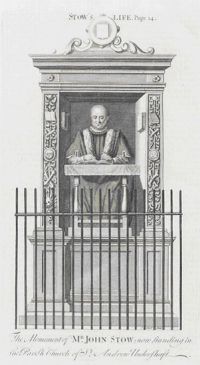
John Stow,
The Survey of London
“ Thomas Sackeford, esquire, one of the masters of requests, gave to the poor of that parish forty shillings the year for ever, out of his alms-house at Woodbridge in Suffolk, where he is buried. Henry Stoke, gardener, buried there, gave twenty shillings the year for ever, towards reparation of that church. This priory was valued to dispend two hundred and sixty-two pounds nine shillings by the year, and was surrendered the 31st of Henry VIII. Many fair houses are now built about the priory, namely, by the highway towards Iseldon. ”
“ HIS DEPARTURE FROM STOKE-UNDERHILL I The village of Stoke was no whit intimidated by the news that Mrs. Reade sowed abroad. The women exclaimed and chattered, the men gaped and shook their heads, the children hung about the ruinous gate that shut them out from the twenty-yard strip of garden which led up to Stott's cottage. Curiosity was the dominant emotion. Any excuse was good enough to make friendly overtures, but the baby remained invisible to all save Mrs. Reade; and the village community kept open ears while the lust of its eyes remained, perforce, unsatisfied. ”
Lytton Strachey,
Eminent Victorians
“ Pious youths in Oxford were carried away by them, and began to flock around the standard of Newman. Newman himself became a party chief—encouraging, organising, persuading. His long black figure, swiftly passing through the streets, was pointed at with awe; crowds flocked to his sermons; his words were repeated from mouth to mouth; 'Credo in Newmannum' became a common catchword. Jokes were made about the Church of England, and practices, unknown for centuries, began to be revived. Young men fasted and did penance, recited the hours of the Roman Breviary, and confessed their sins to Dr. Pusey. ”
Lucas Malet,
The Gateless Barrier
“ You are very distinctly mistaken. I have never been more ready that you should see Stoke Rivers than within the last hour—that is, when Stoke Rivers is fit to be seen. The poor, old house seems to have been in jeopardy of final disappearance about a week ago. There's where my bad news comes in. They write me word of a nasty fire there. Nobody's fault—an electric light wire heated, and not being properly cased charred some of the panelling which finally caught alight. The house has been kept at such a high temperature for years, that the woodwork is like so much tinder. ”
Alan St. Aubyn, The master of St. Benedict's, Vol…
“ The hopes of Newnham were set on Pamela Gwatkin, who was expected to do such great things, to win such honour for the women's college. A dark rumour had reached St. John's and Trinity—who like to divide the honours between them—that they were likely to be left behind in the race—far behind. They were uneasy and anxious, though they wouldn't have owned it for the world, for— 'At times the high gods, who o'er papers preside, Send a lady from Newnham to chasten their pride.'The rumour caused a great deal of midnight oil to be burnt in Cambridge during the first week in June. ”
Cynthia Stockley, Poppy: The Story of a South African Girl
“ He told himself then, that they were the eyes of a girl who had come to a bad bit of the road, and though she had wonderfully changed in a few days, his professional eye, blurred though it was, saw still on her the traces of stress and storm. Now, Maurice Newnham knew all about bad bits of the road. He had stumbled through muddy and broken places himself, and seen others do the same; some dying in the holes they had made, some lying down by the wayside with no heart to start afresh. His keen instinct for a fellow-stumbler was the only instinct he had not deliberately blunted. ”
Murray Gilchrist, The Peak District
“ Perhaps it was at Stoke that the lady set to music Campbell’s song of the brave Roland who expired at Ronceval, a romance beloved by the contraltos of our grandsires’ days.After Stoke, the Derwent, crossing a great weir, runs over a stony bed to Calver, then through green [Pg 47] meadows to Baslow, from whose steep bridge there is a view almost as beautiful as that at Bakewell. Close by stands the little church, disfigured with a grotesque “Jubilee” clock dial. In the vestry may be seen a dog-whip, with which in less civilized times the verger drove out the offending animals. ”
J. D. Beresford, The Hampdenshire Wonder
“ Fifteen years of Stoke had brought about a reaction. Nature had made him a feeble fanatic, and he was now as ardent an opponent of science as he had once been a defender. In his little mind he believed that his early reading had enabled him to understand all the weaknesses of the scientific position. His name was Percy Crashaw.Mrs. Stott could not deny her rector the right of entry, and he insisted on seeing the infant, who was [88] not yet baptised—a shameful neglect, according to Crashaw, for the child was nearly six weeks old. Nor had Mrs. Stott been “churched.” ”
Sir Leslie Ward,
Forty years of 'Spy'
“ One of the nicest men among the many hundreds who have been willing subjects is Lord Newlands. I was struck with his considerate and charming manner to all he came in contact with, even to an old charwoman. It was interesting to hear him talk of his old friend, Dr. Jowett, Master of Balliol College, whose memory he regarded with the deepest respect. My early caricature of him seemed to have pleased him so much that he not only gave a good sum for it at the sale of Vanity Fair cartoons [328] at Christie's, but also commissioned me to make a copy of it. ”
Bram Stoker,
The Man (Stoker) — Chapter VIII: The T-cart
(1905)
“ Squire Norman was ready, and, after a kiss from Stephen, climbed into the high cart. The men raised their hats and waved good-bye. A word from Rowly; with a bound the horses were off. Stephen stood looking at them delighted; all was so sunny, so bright, so happy. The world was so full of life and happiness to-day that it seemed as if it would never end; that nothing except good could befall.Harold, later on that morning, was to go into Norcester also; so Stephen with a lonely day before her set herself to take up loose- ends of all sorts of little personal matters. ”
Henry James, The American (1907)
“ Newman rejoined. "A visit to London in the Season is certainly a sign of prosperity." M. Nioche, in answer to this superior dig, lifted the puppy up to his face again, peering at his critic from his small blank eye-holes. There was something inane in the movement, and Newman hardly knew if he were taking refuge in an affected failure of reason or whether he had in fact paid for his base accommodation by the loss of his wits. In the latter case, just now, he felt little more tenderly to the foolish old man than in the former. ”
Bram Stoker,
The Lair of the White Worm — Chapter 21…
(1925)
“ The windows of the study were barred and locked, and heavy dark curtains closed them in. When this was done not a gleam of light from the tower could be seen from outside. When they were alone, Sir Nathaniel explained that he had taken his old friend, Mr. Salton, into full confidence, and that in future all would work together. "It is important for you to be extremely careful. In spite of the fact that our marriage was kept secret, as also your temporary absence, both are known." ”
William Harrison Ainsworth,
Cruikshank's Water Colours
“ If Neilson’s imprudent visits to Lord Edward before the arrest subjected him to a charge of treachery afterwards, his conduct on the night he reconnoitred Newgate proves him to have been quite unfitted for command. That a man known to every turnkey should have personally examined a building in which he had been so long confined appeared, from its extreme rashness, almost to indicate indifference to the consequences of discovery. ”
“ With that logical mind of his, and with his experience of law and the passions that lead to law-invoking, he knew that the realization of Athlyne’s name and position was a troublesome matter which might have been attended with disastrous consequences. To a man of Colonel Ogilvie’s courage and strong passion the presence of an antagonist worthy of his powers is rather an incentive to quarrel than a palliative. As to poor Judy she was in no position to think at all. She was to all practical intents, except for the noise she was occasionally making—her transport was subsiding—as one who is not. ”
Bram Stoker,
The Man (Stoker) — Chapter VIII: The T-cart
(1905)
“ From that hour Miss Rowly stayed at Normanstand. Stephen wanted her; and she wanted to be with Stephen.After the funeral Harold, with an instinctive delicacy of feeling, had gone to live in his own house; but he came to Normanstand every day. Stephen had so long been accustomed to consulting him about everything that there was no perceptible change in their relations. Even necessary business to be done did not come as a new thing. ”
Christina Blackie, Geographical etymology: a dictionary of place-names giving their derivations (1887)
“ Leinster, Irish Laighen or Layn; Munster, Irish Mumha (named after a king) .STOC, STOW (Teut.) ,literally a stake or the trunk of a tree, applied at first to a place protected by a stockade, or surrounded by stocks or piles; and in German topography sometimes applied to hills, as in Hochstock (high hill) ; Stockheim (the home on the hill) ; sometimes to places built upon stakes, as in Stockholm. In Great Britain, standing alone, it means simply the place, as Stock, in Essex; Stow, a parish in Mid Lothian; Stoke-upon-Trent; Stow-in-the-Wold or waste land ”
Bram Stoker,
The Lair of the White Worm — Chapter 23…
(1925)
“ Sir Nathaniel's voice was calm and self-possessed. When he was engaged in any struggle of wits he was all diplomatist. "She asks Mimi and me to tea this afternoon at Diana's Grove, and hopes that you also will favour her." Sir Nathaniel smiled. "Please ask Mrs. Salton to accept for us all." "She means some deadly mischief. Surely--surely it would be wiser not." "It is an old trick that we learn early in diplomacy, Adam--to fight on ground of your own choice. It is true that she suggested the place on this occasion; but by accepting it we make it ours. ”