Swedish Academy

Definition and stakes

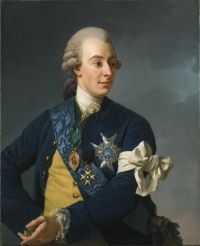
Portrait of Gustav III of Sweden Gustav III of Sweden,  Select orations, and other important papers… (1792)

“ If on a future day we should be happy enough to establish, on a solid basis, the orthography of our language, the certain principles and rules of composition, and to procure to the Swedes what they are still in want of, a compleat dictionary—shall we then have acquitted ourselves of all that the public have a right to expect from the Swedish academy? No, gentlemen, the honour which our society has of being distinguished by the national name, imposes upon us duties of a permanent nature. ”
Source: Wikisource

Edmund William Gosse,  Encyclopædia Britannica, Ninth Edition (1887)

“ In 1786 Gustavus created the Swedish Academy, on the lines of the French Academy, but with eighteen members instead of forty. The first list of immortals, which included the survivors of a previous age and such young celebrities as Kellgren and Leopold, embraced all that was most brilliant in the best society of Stockholm; the king himself presided, and won the first prize for an oration. The principal writers of the reign of Gustavus III. bear the name of the Academical school. But we must first consider a writer of genius who had nothing academical in his composition. ”
Source: Wikisource

Edmund William Gosse,  Encyclopædia Britannica, Ninth Edition (1887)

“ Journalism began to develop; the Swedish Academy was founded; the drama first learned to flourish in Stockholm; and literature began to take a characteristically national shape. This fruitful period naturally divides itself into two divisions, equivalent to the reigns of the two kings. The royal personages of Sweden have commonly been protectors of literature; they have strangely often been able men of letters themselves. Gustavus III. (1746-1792) , the founder of the Swedish Academy and of the Swedish theatre, was himself a playwright of no mean ability. ”
Source: Wikisource

Get perspective with Kwize: daily news enlightened by great literature