“ Another whirly-gust of sand and other debris assailed the flying-machine, and while sight was thus rendered almost useless for the time being, the aerostat began to sway and reel from side to side, shivering as though caught by an irresistible power, yet against which it battled as though instinct with life and brain-power. ”
Aerostat
Definition and stakes
The theme of “aerostat” has been addressed by authors such as Jules Verne, Jos. E. Badger, Archibald Williams and Various. It is often associated with terms like airplane, wind, airship, aircraft and flight.
Quotes about “aerostat”
Archibald Williams, The Romance of Modern Invention
“ Even supposing that our aerostat can lift itself successfully, we encounter the difficulties connected with steering in a medium traversed by ever-shifting currents of air, which demands of the helmsman a caution and capacity seldom required on land or water. Add to these the difficulties of leaving the ground and alighting safely upon it; and, what is more serious than all, the fact that though success can be attained only by experiment, experiment is in this case extremely expensive and risky, any failure often resulting in total ruin of the machine, and sometimes in loss of life. ”
 Jules Verne,
Robur the Conqueror
Jules Verne,
Robur the Conqueror
“ If the aerostat finds support in the air it belongs to the medium in which it moves; under such conditions, how can its mass, which offers so much resistance to the currents of the atmosphere, make its way against the wind? In this struggle of the inventors after a light and powerful motor, the Americans had most nearly attained what they sought. A dynamo-electric apparatus, in which a new pile was employed the composition of which was still a mystery, had been bought from its inventor, a Boston chemist up to then unknown. ”
Jules Verne,
Robur the Conqueror
(1886)
“ Since eleven o'clock the enormous aerostat had been floating a few feet from the ground ready to rise in mid-air. It was splendid weather and seemed to have been made specially for the experiment, although if the breeze had been stronger the results might have been more conclusive. There had never been any doubt that a balloon could he guided in a calm atmosphere; but to guide it when the atmosphere is in motion is quite another thing; and it is under such circumstances that the experiment should be tried. ”
Jules Verne,
Robur the Conqueror
“ Screws opposing a slanting plane to the bed of air will produce an ascensional movement, and the models experimented on have shown that the disposable weight, that is to say the weight it is possible to deal with as distinct from that of the apparatus, increases with the square of the speed. Herein the aeroplane has the advantage over the aerostat even when the aerostat is furnished with the means of locomotion. ”
Various, British Quarterly Review, American Edition…
“ Having now reached the highest point to which our aerostat will mount so long as its weight continues unchanged, we surrender ourselves to the guidance of the current in which we are involved. In rising to a moderate elevation, a balloon will sometimes shoot through more than one of these aerial streams. Mr. Foster detected the existence of four distinct currents in one experiment, namely, from the E.N.E., N., S.W., and S.S.E., and on the following day found there were three, namely, from the E.N.E., S.E., and S.S.W. Sometimes an upper and an under current may move in opposite directions. ”
Jules Verne,
Robur the Conqueror
“ That is how I solved the problem of aviation. That is what a balloon will never do, nor will any machine that is lighter than air.” Silence, absolute, on the part of the colleagues, which did not for a moment disconcert the engineer. He contented himself with a half-smile, and continued in his interrogative style, “Perhaps you ask if to this power of the “Albatross” to move horizontally there is added an equal power of vertical movement—in a word, if, when, we visit the higher zones of the atmosphere, we can compete with an aerostat? ”
 John M. Bacon,
The Dominion of the Air: The Story of Aerial Navigation
John M. Bacon,
The Dominion of the Air: The Story of Aerial Navigation
“ The future development of aerostation is necessarily difficult to forecast. Having reviewed its history from its inception we have to allow that the balloon in itself, as an instrument of aerial locomotion, remains practically only where it was 120 years ago. Nor, in the nature of the case, is this to be wondered at. The wind, which alone guides the balloon, is beyond man's control, while, as a source of lifting power, a lighter and therefore more suitable gas than hydrogen is not to be found in nature. ”
Fulgence Marion, Wonderful Balloon Ascents; Or, The Conquest of the Skies (1870)
“ No means have yet been found of directly steering balloons, but by allowing the gas to escape the aeronaut can descend at will, and by lightening his car of part of the ballast he carries he can ascend as readily. It must also be remembered that the currents of air vary in their directions, according to their elevation, and were the aeronaut perfectly acquainted with aerial currents, he might, by raising or lowering himself, find a wind blowing in the direction in which he wished to proceed, and the last problem of aerostation would be solved. ”
Jules Verne,
Robur the Conqueror
“ During the seven months, however, they had said nothing of their adventures; and even Frycollin had not uttered a whisper of Robur and his wonderful clipper. Probably Uncle Prudent and his friend desired that no question should arise as to the merits of the aeronef, or any other flying machine. Although the “Go-Ahead” might not claim the first place among aerial locomotives, they would have nothing to say about the inventions of other aviators. They believed, and would always believe, that the true atmospheric vehicle was the aerostat, and that to it alone belonged the future. ”
Eric Stuart Bruce, Aircraft in war (1914)
“ In practice it is never possible, even by working the motor against the wind, to avoid a certain amount of bumping, since the aërostatical equilibrium is not easily judged and allowed for, especially in strong winds. ”
Chelsea Curtis Fraser, Around the World in Ten Days
“ Mountains, hills, houses, lakes, valleys, rivers, forests, all cause bumps or holes in the air up above them. At one thousand feet they are pretty bad. At ten thousand feet they are scarcely noticeable. That's why most pilots prefer to fly high whenever they can.""What causes the air to act in this way over such configurations?" propounded the publisher.John looked helpless, and smiled. "You've got me there," he admitted. "I haven't had the opportunity to study aerostatics the same as Paul here. He can probably tell us." ”
Roy J. Snell, Jet Plane Mystery
“ The jet plane carries no oxygen for its engine: its jet propulsion engine uses oxygen from the air. This engine has fewer parts and is of simpler construction than the traditional engine. It operates a mechanism which compresses the air. This air is mixed with atomized fuels such as gasoline, kerosene, alcohol, or some other fuels of the hydrocarbon family, rich in hydrogen. From that point forward the operation is the same as in the rocket engine; that is to say, the gas is released and ignited, the resulting expansion and emission through the jet providing the power.... ”
Portal:Civil Aeronautics Board, Aviation Accident Report: Pennsylvania Central Airlines Flight 19 (1940)
“ Methods should be developed for collecting and correlating the experiences that airplane pilots may have with exceptional turbulence, or other unusual atmospheric conditions. It happens from time to time that a pilot, military, airline, or private, observes some exceptional atmospheric condition, or some exceptional effect upon the flight of the aircraft. The ability of pilots to benefit from one another's experiences in such matters is quite largely limited to the results of informal report. ”
George Whale, British Airships, Past, Present…
“ It must be mentioned that the air and hydrogen are not subject in the same way to changes of temperature. Important variations in lift may occur when the temperature of the gas inside the envelope becomes higher, owing to the action of the sun, than the air which surrounds it. A difference of some 20 degrees Fahrenheit may result between the gas and the air temperatures; this renders it highly necessary that the pilot should by able to tell at any moment the relative temperatures of gas and air, as otherwise a false impression will be gained of the lifting capacity of the airship. ”
James R. Driscoll, The Brighton Boys in Transatlantic Flight
“ But the moment the plane is either augmented or retarded by favorable or unfavorable winds, the air-speed indicator becomes a very unreliable instrument for showing distances traveled: it practically only records the speed of the air pushed past the plane. It is like running at ten miles an hour with a pin-wheel in the hand on a perfectly calm day, and getting a certain velocity of revolutions of the wheel per minute. On another day one might stand still with the pin-wheel and permit the rush of a high velocity of wind to twirl it round with the same speed. ”
 Octave Chanute,
Flying Machines: Construction and Operation
Octave Chanute,
Flying Machines: Construction and Operation
“ Air pressure is a big factor in the matter of aeroplane horsepower. Allowing that a dead calm exists, a body moving in the atmosphere creates more or less resistance. The faster it moves, the greater is this resistance. Moving at the rate of 60 miles an hour the resistance, or wind pressure, is approximately 50 pounds to the square foot of surface presented. If the moving object is advancing at a right angle to the wind the following table will give the horsepower effect of the resistance per square foot of surface at various speeds. ”
Charles Fitzhugh Talman, Meteorology: The Science of the Atmosphere
“ Before we leave the subject of wind it will be well to emphasize once more the fact, which the average layman has difficulty in grasping, that the only movements of the air that affect the safety and comfort of flight are the movements relative to the machine, and not those relative to the ground. To the aviator, when he is once clear of the ground, a steady wind of any speed is merely a mass of calm air. Hence an aviator will sometimes have perfectly smooth flying when the wind, as measured on the earth, is blowing 40 or 50 miles an hour ”
Charles Fitzhugh Talman, Meteorology: The Science of the Atmosphere
“ Of the meteorological elements that affect aeronautics, other than those we have mentioned, the most important is the density of the atmosphere—generally expressed in terms of barometric pressure. The air diminishes in density upward, and the rarefied atmosphere of high levels has several effects on aircraft. Its decreased buoyancy imposes a limit upon the ascent of balloons; its decreased resistance makes it necessary for an aeroplane to fly at greater speed in order to get the same lift ”
 Thomson Burtis,
Direct methods
(1922)
Thomson Burtis,
Direct methods
(1922)
“ Two tachometers, two air-pressure gages, two for temperature, air-speed meter, two sets of switches, starting buttons, double spark, double throttle, and on the sides of the cockpit shutter levers, gas levers, landing lights and parachute flare releases—it was a staggering maze to the uninitiated, but the two airmen read them automatically. From time to time they turned to watch more instruments set on the sides of the motors; oil-pressure gages, and additional air-pressure and temperature instruments, to say nothing of gages to tell how much gas and oil they had. ”
Portal:Civil Aeronautics Board, Aviation Accident Report: Pennsylvania Central Airlines Flight 19 (1940)
“ Here again, as in the case of lightning, direct research is difficult, but a substantial amount has already been accomplished. We believe it important that the existing store of knowledge of the nature of atmospheric turbulence, of its structure when its severity is at a maximum, and of its effect on the flight performance and the control of the aircraft should be extended as rapidly as possible. ”
William D. Ennis, Flying Machines Today
“ This feature of aeronautics is particularly important, because any device which will give automatic stability when turning corners will go far toward making aviation a safe amusement. Inequalities of velocity exist not only on curves, but also when the wind is blowing at anything but uniform velocity across the whole front of the machine. [Pg 42] The slightest “flaw” in the wind means an at least temporary variation in lifting force of the two arms. Here is a pregnant source of danger, and one which cannot be left for the aviator to meet by conscious thought and action. ”
Frederick William Lanchester, Aerodynamics, constituting the first volume of a complete work on aerial flight… (1906)
“ As a maximum estimate of the range of flight conceivably possible without some fundamental discovery in fuel and prime movers we may take the following supposititious case. Using liquid hydrogen as fuel, and carrying 25 per cent, of the total mean weight, and assuming a yet-unheard-of thermal efficiency of 50 per cent., a total mechanical efficiency of 90 per cent., and a propeller efficiency of 70 per cent., with the minimum angle of given in the Table (= 6°) , the exhaustion of fuel will be complete after a flight of 6,800 miles distance. ”
by NASA, NASA Facts — Making the Skies Safe from Windshear
“ If the pilots are unaware that this speed increase is caused by windshear, they are likely to react by reducing engine power. However, as the plane passes through the shear, the wind quickly becomes a downdraft and then a tailwind. This reduces the speed of air over the wings, and the extra lift and speed vanish. Because the plane is now flying on reduced power, it is vulnerable to sudden loss of airspeed and altitude. The pilots may be able to escape the microburst by adding power to the engines. But if the shear is strong enough, they may be forced to crash. ”
William D. Ennis, Flying Machines Today
“ Our vertical field of control may then be represented by a series of oscillations of gradually decreasing magnitude until finally all power to ascend is gone. And even this situation, serious as it is, is made worse by the gradual but steady leakage of gas through the envelope fabric. Here, in a word, is the whole problem of altitude regulation. Air has no surface [Pg 65] of equilibrium like water. Some device supplementary to ballast and the safety valve is absolutely necessary for practicable flight in any balloon not staked to the ground. ”
Frederick Arthur Ambrose Talbot, Aeroplanes and Dirigibles of War
“ Success is influenced very materially by the accuracy of the airman's judgment. A slight miscalculation of the velocity and direction of the wind, or failure to detect any variations in the climatic conditions, is sufficient to prove his undoing. German airmen who essayed journeys of discovery in this manner, often failed to regain their lines because they ventured too far, misjudged the speed of the wind which was following them on the outward run, and ultimately were forced to earth owing to the exhaustion of the fuel supply during the homeward trip ”
De Lysle F. Cass, The Airship Boys in the Great War…
“ As may be surmised, the duties of the pilot were not merely to steer and keep a lookout ahead, but also to watch the machine and counteract the influence of unexpected air currents and those atmospheric obstructions like “pockets,” indistinguishable puffs of air, and the like, which are always very dangerous and will jolt an airship exactly as a rock or piece of wood will bounce an automobile into the air and maybe completely overturn it. Among experienced aeronauts, these air-ruts are recognized as being one of the chief perils in aviation. ”
Charles Fitzhugh Talman, Meteorology: The Science of the Atmosphere
“ Recalling, now, what has been said above about the way in which the lift of an aeroplane varies with the angle at which the wings meet the air and also with the speed of the machine relative to the air, it will be easy to understand some of the difficulties experienced in maintaining one’s equilibrium when flying in a turbulent atmosphere. Waves, eddies, vertical currents and other features of wind structure cause abrupt changes in the attitude and the speed of the machine with respect to the air stream. ”
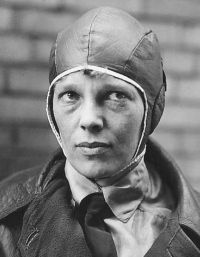 Amelia Earhart,
20 hrs. 40 min. our flight in the Friendship
(1928)
Amelia Earhart,
20 hrs. 40 min. our flight in the Friendship
(1928)
“ The nautical boys have an advantage over the avigators. Constant things like the gulf stream can be labeled and put on charts and shoals marked. But one can’t fasten buoys in the atmosphere. Flyers can only plot topography. Air, like water, gives different effects under different conditions. The pilot must learn that when the wind blows over a hill from one direction, the result is not the same as that when it blows from another. Water behaves similarly. The shoals of the air seem a little more elusive, however, because their eddies are invisible. ”
