“ It is best not to let go the anchor until the vessel has begun to gather stern way; then give her chain gradually until she has taken out enough—that is, under ordinary circumstances, about three times as much length of chain as the depth of the water. If the chain is allowed to run out all at once it will fall on the top of the anchor, a coil will get round one of the flukes, dislodge the other fluke from the ground, and the vessel will drag.The end of the chain, especially if no windlass is used, should be secured to a bolt in the chain locker or otherwise ”
Anchor chain
Definition and stakes
The theme of “anchor chain” has been addressed by authors such as Thomas Morley, W. H. Smyth, Thomas Riley Blanckley, Douglas Frazar and Thomas Fleming Day. It is often associated with terms like ship, cable, windlass, rope and propeller.
Quotes about “anchor chain”
Inquiry into the shipwreck of 'Geffrard' (1875)
“ One of the chains is generally smaller than the other in most ships I believe that ships ride with one anchor better than with two I have seen ships lay with 2 anchors and both parted and another with a single anchor ride safely. We had not time enough to heave in on the first chain I let the second anchor go. ”
 French Ensor Chadwick,
Ocean Steamships
“ The wheel is shifted, the capstan reels noisily, and link by link the chain comes home. At last, after a vicious tug or two on the cable, the ground is broken, and, smothered and sputtering with cleansing water from the hose, the anchor, ring and stock, appears above the foam-streams rippling at the bow. ”
 Perceval Gibbon,
McClure's Magazine, Volume 31, Number 5…
(1908)
“ That day, they set to work at cutting through the great chain that was fast to the anchor ring. Their equipment for such a purpose was poor; there was nothing for it but to flog a cold chisel through the wrought iron; and though the rust flaked from it if one but scratched with a fingernail, the metal below was sound and tough yet, a heartbreaking thing to assault with mere strength of arm. ”
Thomas Morley, Encyclopædia Britannica, Ninth Edition…
“ The anchor is held by a chain attached to the shackle, and the strain is applied to each arm separately at 1/3d of its length from the point. The proof of the anchor is that it must show no sign of fracture, and that if any deflection is caused by the strain, it must return very nearly to its original shape. A good anchor, after being deflected half an inch, will return to its former shape, leaving no permanent set. ”
Sir William Edward Parry, Three Voyages for the Discovery of a Northwest Passage from the Atlantic to the Pacific…
“ All hands were sent upon the floe to cut it up ahead, and the whole operation was a novel, and, at times, a fearful one; for the ice, being weakened by the cutting, would suddenly gather fresh way astern, carrying men and tools with it, while the chain cable continued to plough through it in a manner which gave one the idea of something alive, and continually renewing its attacks. The anchor held surprisingly; and after this tremendous strain had been put upon it for above an hour, we had fairly cut the floe in two, and the ship was riding in clear water about half a mile from the shore. ”
 Richard Henry Dana,
The Seaman's Friend
“ In moderate weather, and where you are not in a strong tide-way, it will generally be sufficient to let go one anchor, since, if you have out a good scope of chain, you will ride by the bight of it, and it will require a very heavy blow to bring a strain upon the anchor. ”
Inquiry into the shipwreck of 'Geffrard' (1875)
“ I found on the piece of chain recovered an opening in the weld in one of the links sufficiently large to admit the blade of a small pen knife I saw no other defect I do not consider the weather was bad enough for a second anchor to be down thinking the first chain fit to hold the ship It is a matter of opinion as to a second anchor being down, it would have helped had there been 2 anchors down & 90 fathoms on each in each case there would have been danger in fouling and also difficulty in recovering. ”
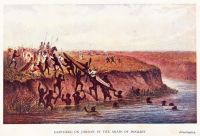 John MacGregor,
The Voyage Alone in the Yawl "Rob Roy"
“ The gentle motion of riding with a chain-cable is quite in contrast to that when anchored by a rope; for this latter will jerk and pull, while the heavier chain, laid in a drooping curve, acts as a constant spring that eases and cushions every rude blow.I intended to start again with any freshening breeze, and to get into Littlehampton for the night; therefore the small anchor and the hemp cable were used so as to be more ready for instant departure, and well it was thus. ”
 W. H. Smyth,
The Sailor's Word-Book
“ BITTER-END. That part of the cable which is abaft the bitts, and therefore within board when the ship rides at anchor. They say, "Bend to the bitter-end" when they would have that end bent to the anchor, and when a chain or rope is paid out to the bitter-end, no more remains to be let go. The bitter-end is the clinching end—sometimes that end is bent to the anchor, because it has never been used, and is more trustworthy. The first 40 fathoms of a cable of 115 fathoms is generally worn out when the inner end is comparatively new. ”
W. S. Lindsay, History of merchant shipping and ancient commerce… (1876)
“ If a manufacturer can produce an article which, by some means or other, is able to pass inspection, it is a matter, now, of far less consequence than formerly to make it of the best description, as, in the case of accident, he screens himself behind the official certificate of its merit. Besides, the test Government, originally, adopted too often destroyed in a great measure the elasticity of chain cables [258] —a quality of the utmost importance to a ship riding at anchor in a heavy sea-way. I quite admit that many vessels and too many lives have been lost through inferior anchors and cables ”
John MacGregor,
The Voyage Alone in the Yawl "Rob Roy"
“ After considering the matter of anchors a long time, and poising too the various opinions of numerous advisers, the Rob Roy was fitted with a 50-lb. galvanized Trotman anchor and 30 fathoms of chain, and also with a 20-lb. Trotman and a hemp cable.The operation of anchoring in a new place and that of weighing anchor are certainly among the most testing and risky in a voyage like this, where the circumstances are quite new on each occasion, and where all has to be done by one man. ”
Thomas W. Corbin, The Romance of War Inventions
“ The anchor is often fitted with wheels so that it forms a truck upon which the mine and the weight are placed, the whole running upon rails laid on the deck of the mine-layer. As this ship steams ahead the men push the mines along the rails, dropping them over the stern at regular intervals.When the thing reaches the water, the weight sinks the most rapidly, thereby tugging at the chain whereby it is connected to the anchor. The latter, being less compact, sinks more slowly so that the pull upon the rope is maintained until at last the weight rests upon the bottom. ”
Douglas Frazar, Practical Boat-Sailing: A Concise and Simple Treatise
“ They are useful when the yacht is likely to lie at anchor in a sea-way for a long time, for then they would not chafe; whilst a manila cable might become seriously injured. Some use a few fathoms of iron chain, and then manila above that, so as to keep the end near the anchor from fraying on rocky bottoms. It is to be remembered, then, in a long piece of chain cable, that the one imperfect link, or one that is weak in any way, determines the utmost strength of the cable. In other words, the strain necessary to part the weakest link makes the stronger ones useless. ”
“ The slack of the chain, as it comes in, drops perpendicularly through the hawse-pipe to the chain-locker below, and requires no attention or handling. The machinery for getting the anchor possesses great power, and, even when the anchor has a tight hold of the bottom, the wheel in the cockpit can be turned almost with one finger. The wheel is made to ship and unship, and when not in use is hung up to the side of the cabin. ”
 Robert S. Ball,
Experimental Mechanics
“ One chain of the model is attached to a spring balance at a; by reference to the scale we see the tension indicated to be 90 lbs.: a sufficiently close approximation to the calculated tension of 87 lbs.479. A large suspension bridge has its chains strained by an enormous force. It is therefore necessary that the ends of these chains be very firmly secured. A good attachment is obtained by anchoring the chain to a large iron anchor imbedded in solid rock. ”
William Caius Crutchley, My Life at Sea
“ I picked up an anchor and chain, claimed as belonging to one of the Castle line, another anchor and chain, and also heavy moorings laid down for the company’s ships some years146 before. On the last day I was engaged in this operation, Garrett took Merritt on shore to the races, leaving me with a pious adjuration to be sure not to kill any one. It’s rather a mercy we had no accident, for we were dealing with heavy weights with makeshift gear. However, it was done, though when we got home the skipper was asked his reason for picking up the company’s moorings. ”
by John Marshall, Royal Naval Biography — Jervoise… (1823)
“ Through the opposite port, led one of our hempen cables, shackled to the small-bower chain, the anchor of which was nearly astern; on this was clapped a runner and yard-tackle; – the stream-anchor which had been of necessity dropped among the rocks on the starboard quarter, the day before, was now turned to good account by leading its chain through the same port, and therewith guying the ship into the deepest water. Through the stern port on deck was the shroud hawser ”
W. H. Smyth,
The Sailor's Word-Book
“ SHORT-HANDED. A deficient complement of men, or short-handed by many being on the sick-list.SHORT-LINKED CHAIN. A cable without studs, and therefore with shorter links than those of stud-chains; such are slings and chains generally used in rigging bobstays, anchor-work, &c. Cables only have studs.SHORT-SEA. A confused cross sea where the waves assume a jerking rippling action, and set home to the bows or sides; especially tiresome to boats, hampering the oars, and tumbling in-board. Also, a race.SHORT-SERVICE. Chafing geer put on a hemp cable for a short range. ”
Richard Henry Dana,
The Seaman's Friend
“ If it is just abaft the windlass, it will be convenient in case you wish to slip your cable. A Flying Moor—sometimes called a RUNNING MOOR.—Have both anchors ready for letting go, with double the scope of chain you intend to ride by ranged for the weather anchor, and the riding scope of the lee chain. There are two ways of making a flying moor. One is to clew up everything and let go the first anchor while she has sufficient headway to run out the whole double range. When it is all out, or just before, luff sharp up, brace aback to stop her way, and let go the other anchor. ”
Elisha Noyce, The Boy's Book of Industrial Information
“ In “weighing” anchor, that is in pulling it up from the bottom to bring it on board again, the cable is slowly wound up by the capstan, and as the cable is shortened the ship is drawn along to a point nearly over where the anchor rests, when—the pull at the cable continuing—the shank is raised into an upright position, and the fluke and arm, instead of dragging up a great piece of earth, remove but a small portion, as may be seen by the dotted lines in figs. 4 and 5, which show the earth to be removed before the anchor can be drawn from its hold. ”
Frederic J. Haskin, The Panama Canal
“ The first thing a ship encounters when it approaches the locks is the giant chain stretched across its path. That chain is made of links of 3 inches in diameter. When in normal position it is stretched across the locks, and the vessel which does not stop as soon as it should will ram its nose into the chain. There is a hydraulic paying-out arrangement at both ends of the chain, and when the pressure against it reaches a hundred gross tons the chain will begin to pay out and gradually bring the offending vessel to a stop. ”
 Jacob Abbott,
Rollo on the Atlantic
“ The anchor may have caught at a place where the cable passes over the edge of a sharp rock, which soon cuts [Pg 202] it off, in consequence of the motion. Then the ship must go on shore."At other times," continued the captain, "the ground for the anchor is too soft, instead of being too hard; and the flukes, therefore, do not take a firm hold of it. Then the anchor will drag. Every sea that strikes the ship drives her a little in toward the shore, and she is, of course, in great danger." ”
 Oliver Optic,
Little By Little; or, The Cruise of the Flyaway
“ If the vessel rides at anchor with a short cable, her motion, as she rises and falls with the sea, raises up the shaft of the anchor, which has a tendency to detach the flukes, or points from the bottom. But Paul had been careful the night before to give the Fawn all the cable he could spare; and it was evident, therefore, that the anchor was not heavy enough, or that there was no holding-ground at the bottom."There is only one thing we can do, John," said Paul, desperately, after he had fully examined the situation of the boat. ”
 Joseph Conrad,
The Mirror of the Sea
“ From first to last the seaman’s thoughts are very much concerned with his anchors. It is not so much that the anchor is a symbol of hope as that it is the heaviest object that he has to handle on board his ship at sea in the usual routine of his duties. The beginning and the end of every passage are marked distinctly by work about the ship’s anchors. A vessel in the Channel has her anchors always ready, her cables shackled on, and the land almost always in sight. The anchor and the land are indissolubly connected in a sailor’s thoughts. ”
 William Falconer,
An Universal Dictionary of the Marine
“ Anchor-ground, fond de bonne tenue, is a bottom which is neither too deep, too shallow, nor rocky; as in the first the cable bears too nearly perpendicular, and is thereby apt to jerk the anchor out of the ground: in the second, the ship’s bottom is apt to strike at low water, or when the sea runs high, by which she is exposed to the danger of sinking: and in the third, the anchor is liable to hook the broken and pointed ends of rocks, and tear away its flukes; whilst the cable, from the same cause, is constantly in danger of being cut through as it rubs on their edges. ”
Various, Chambers's Journal of Popular Literature…
“ The anchor has been got up; the paying-out gear is all in working order; the men are all at their appointed places. The cable is being held fast at the ship's stern, and the running out by its own weight is prevented. But directly all are aboard again, the word is given, the screw revolves, the cable is let go at the stern, and the real work of paying out begins.The cable passes from the tank to the stern of the ship, and from thence to the bottom of the sea. The weight of that part which hangs in the water between the ship and the bottom pulls it out of the ship as the latter moves along. ”
W. S. Lindsay, History of Merchant Shipping and Ancient Commerce… (1874)
“ There are ten anchors on board which, with their stocks, weigh 55 tons, and 800 fathoms of chain cable weighing 98 tons, the capstan and warps weighing 100 tons, so that there are 253 tons weight of appliances on board devoted exclusively to the [Pg 513] purpose of anchoring or mooring the great ship. Through the centre of her stem there are two hawse-holes each 18 inches in diameter, so that the large cable runs straight out from the stem; and, besides these, there are additional hawse-holes on each side of the cutwater. ”
Nathan Clifford, Cammeyer v. Newton — Opinion of the Court
“ As there employed, the term 'self anchors' means anchors capable of self-adjustment, by having at all times free play, because not attached to their sockets nor moving with the bottom section to which the sockets are attached, which sufficiently explains the difference between the word 'anchor,' as commonly used, and the term 'self anchors,' as used in the description of the patented apparatus. ”
Joseph Conrad,
The Mirror of the Sea
(1924 (first published in 1906))
“ An anchor is forged and fashioned for faithfulness; give it ground that it can bite, and it will hold till the cable parts, and then, whatever may afterwards befall its ship, that anchor is "lost." The honest, rough piece of iron, so simple in appearance, has more parts than the human body has limbs: the ring, the stock, the crown, the flukes, the palms, the shank. All this, according to the journalist, is "cast" when a ship arriving at an anchorage is brought up. ”
Thomas Morley, Encyclopædia Britannica, Ninth Edition…
“ A result which will accord with sound practice may be obtained by calculating the resistance of a given ship at a speed or twelve knots, and taking this tor the working load of the anchor. The working load should be half the testing strain, and consequently 1/6th of the breaking strength. A large ironclad carries 8 anchors,—2 bower, 2 sheet, 1 stream, 1 stern, end 2 kedge. The bower anchors (fig. 7) are stowed at the bow, and are for ordinary use in a roadstead; if there is any difference in weight, the heavier is stowed on the starboard side, and is termed the best bower. ”