
Bhuta

Definition and stakes

Portrait of H. P. Blavatsky H. P. Blavatsky,  From the Caves and Jungles of Hindostan

“ That is why the Hindu fears above all things to remain bodiless after his death.
"It is better for one to enter the body of a tiger, of a dog, even of a yellow-legged falcon, after death, than to become a bhuta!" an old Hindu said to me on one occasion. "Every animal possesses a body of his own and a right to make an honest use of it. Whereas the bhutas are doomed dakoits, brigands and thieves, they are ever watching for an opportunity to use what does not belong to them.
”
Source: Gutenberg

A. C. Burnell,  Hobson-Jobson

“ A bhūta, or as in Tamil more usually, pēy, is a malignant being which is conceived to arise from the person of anyone who has come to a violent death. This superstition, in one form or another, seems to have formed the religion of the Dravidian tribes of S. India before the introduction of Brahmanism, and is still the real religion of nearly all the low castes in that region, whilst it is often patronized also by the higher castes. ”
Source: Gutenberg

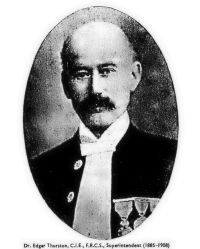
Portrait of Edgar Thurston Edgar Thurston,  Castes and Tribes of Southern India (1909)

“ If the ceremony is not performed on one of the recognised days, the permission of some Bants or Billavas must be obtained before it can be carried out.
All castes in South Canara have great faith in Bhūtas, and, when any calamity or misfortune overtakes a family, the Bhūtas must be propitiated. The worship of Bhūtas is a mixture of ancestor and devil propitiation. In the Bhūta cult, the most important personage is Brahmeru, to whom the other Bhūtas are subordinate.
”
Source: Wikisource

Get perspective with Kwize: daily news enlightened by great literature