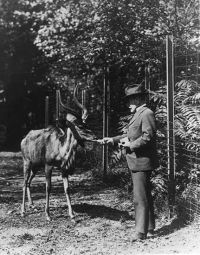
“ Deer give beautiful animation to the forests, harmonizing finely in their color and movements with the gray and brown shafts of the trees and the swaying of the branches as they stand in groups at rest, or move gracefully and noiselessly over the mossy ground about the edges of beaver meadows and flowery glades, daintily culling the leaves and tips of the mints and aromatic bushes on which they feed. There are three species, the black-tailed, white-tailed, and mule deer; the last being restricted in its range to the open woods and plains to the eastward of the Cascades. ”
Black-tailed deer
Definition and stakes
Quotes about “black-tailed deer”
Mayne Reid,
The Hunters' Feast: Conversations Around the Camp Fire
“ They receive it on account of the colour of the hair upon the upper side of their tail-tips, which is of a jetty blackness, and is very full and conspicuous.The two species have been often confounded with each other, though in many respects they are totally unlike. The black-tails are larger, their legs shorter and their bodies more “chunky,” and altogether of stouter build. In running, they bound with all their feet raised at once; while those of the long-tailed species run more like the common fallow deer—by trotting a few steps, then giving a bound, and trotting as before. ”
Various, St. Nicholas Vol. XIII, September…
“ The white-tailed deer is small and much like the antelope in color, but has a far more sleek and handsome coat. The black-tailed or mule deer is twice as large as its white-tailed cousin, and wears a quaker-colored coat, which in summer is tinged with brown. Sometimes, on horseback, I have met the deer in the mountains without giving them any alarm, and we have stood and gazed at one another at our leisure, just to satisfy curiosity. But they know that a man on foot or carrying a rifle is a dangerous creature, and they never stop long to look at him. ”
William Clark, History of the Expedition Under the Command of Captains Lewis and Clark…
“ The black-tailed deer never runs at full speed, but bounds with every foot from the ground, at the same time, like the mule deer. He sometimes inhabits the woodlands, but more [167] often the prairies and open grounds. It may be generally said, that he is of a size larger than the common deer, and less than the mule deer. The flesh is seldom fat, and in flavour is far inferior to any other of the species.3. The mule deer inhabit both the seacoast and the plains of the Missouri, and likewise the borders of the Kooskooskee river, in the neighbourhood of the Rocky mountains. ”
William Clark, History of the Expedition Under the Command of Captains Lewis and Clark…
“ The black-tailed fallow deer are peculiar to this coast, and are a distinct species, partaking equally of the qualities of the mule and the common deer. Their ears are longer, and their winter coat darker than those of the common deer. The receptacle of the eye more conspicuous, their legs shorter, their bodies thicker and larger. The tail is of the same length with that of the common deer, the hair on the under side white, and on its sides and top of a deep jetty black: the hams resemble in form and colour those of the mule, which it likewise resembles in its gait. ”
Mayne Reid,
The Hunters' Feast: Conversations Around the Camp Fire
“ Their form, however, as well as their size, colour, and markings, leave no doubt of their being specifically distinct not only from the latter, but from each other. Indeed, there are two varieties of the black-tails, differing in some respects, although both have the dark hair upon the tail, and the long ears, which so much distinguish them from other deer. The great length of their ears gives to their heads something of a “mulish” look—hence they are often known among the trappers by the name of “mule deer.” ”
Great Smoky Mountains National Park (1954)
“ No hunting or trapping is permitted. Since establishment of the park, the black bear population has increased considerably, and such animals as the white-tailed deer, red and gray foxes, raccoon, bobcat, wild turkey, ruffed grouse, and others find sanctuary in these mountains. ”
Various, Popular Science Monthly (1886)
“ The black-tail deer, more important animals in some respects, in their unsophisticated state are very easy to approach, but a short experience of danger on their part changes their character, and when hunters are often afoot, they become "as wild and wary as may be." They would be extremely difficult to hunt except for their inordinate curiosity, which gives them the habit of turning round every once in a while, stopping, and looking at their pursuer. ”
Algernon Blackwood,
The Valley of the Beasts
[
“ They gambolled, sometimes they rose and stood half upright, they were comely in their mass and power, they rolled past him so close that he could touch them. And the black bear and the brown went with them, bears beyond counting, monsters and little ones, a splendid multitude. Beyond them, yet only a little further back, where the park-like spaces made free movement easier, rose a sea of horns and antlers like a miniature forest in the silvery moonlight. The immense tribe of deer gathered in vast throngs beneath the starlit sky. ”
William T. Hornaday,
Our Vanishing Wild Life: Its Extermination and Preservation
“ Five hundred years hence, when the greed and rapacity of "civilized" man has completed the loot and ruin of the continent of North America, the white-tailed deer will be the last species of our big game to be exterminated. Its mental traits, its size, its color and its habits all combine to render it the most persistent of our large animals, and the best fitted to survive. It neither bawls nor bugles to attract its enemies, it can not be called to a sportsman, like the moose, and it sticks to its timber with rare and commendable closeness. ”
Narratives of New Netherland, 1609-1664
“ The savages say that the white deer are of very great consequence in the estimation of the other deer, and are exceedingly beloved, regarded and honored by the others, but that the reverse is true of the black deer. There are various other large animals in the interior, but they are unknown to the Christians. There are also wolves, dangerous only to small cattle, beavers, otters, weasels, wild cats, foxes, raccoons, minks, hares, musk-rats, about as large as cats, pole-cats and squirrels, some of which can fly. ”
Noah Brooks,
First Across the Continent
“ This morning the hunters brought in some fat deer of the long-tailed red kind, which are quite as large as those of the United States, and are, indeed, the only kind we have found at this place. There are numbers of the sand-hill cranes feeding in the meadows: we caught a young one of the same color as the red deer, which, though it had nearly attained its full growth, could not fly; it is very fierce, and strikes a severe blow with its beak. ”
Mayne Reid,
The Hunters' Feast: Conversations Around the Camp Fire
“ Like the fallow deer, it produces spotted fawns, which are brought forth in the spring, and change their colour to that of the deer itself in the first winter. About the month of November they gather into herds, and remain together until April, when they separate, the females secreting themselves to bring forth their young.“The long-tailed deer is often found in wooded countries; though its favourite haunts are not amid the heavy timber of the great forests, but in the park-like openings that occur in many parts of the Rocky Mountain valleys. ”
George Ethelbert Walsh, White Tail the Deer's Adventures
“ Young Black Buck’s Challenge Young Black Buck had, of course, been in training all this time, for it is the law of the deer that none shall aspire for the leadership of a herd until he has learned all the ways of the woods, and can out-pace and out-jump his father and mother. All the laws of the deer are very strict, for the safety of all depends upon the leader. ”
Edward William Nelson, Wild Animals of North America
“ The black-tails have one of the most restricted ranges among our deer. They are limited to the humid heavily forested belt along the Pacific coast from Juneau, Alaska, southward to the Coast range in central California. This coastal belt is characterized by superb growths of cedars, spruces, and firs in the north and by redwoods and firs in the south, uniting to make one of the most magnificent forest areas in the world. Here the deer live in the midst of rank undergrowths of gigantic ferns and other vegetation, as luxuriant in many places as that of the humid tropics. ”
The Living Animals of the World…
“ The large ears, from which the American species takes its name, are noticeable even in the young. The American Deer.Excepting always the elk, wapiti, and reindeer, which have been already described, the deer of North and South America stand quite apart from those of the Old World, and are placed in a genus of their own. Usually the tail is long, and the brow-tine is always wanting. The most familiar species is the common American Deer, of which the Virginian or White-tailed Deer is the type. ”
Emerson Hough,
The Young Alaskans on the Missouri
“ But Gass in his book also says something I want you to remember, for it may help explain the ‘fallow’ deer which Clark mentions, and which I don’t understand at all. Gass says: ‘There is another species of deer in this country, with small horns and long tails. The tail of one we killed was 18 inches long.’ Now that precisely coincides with the ‘fantail’ deer which some old-time hunters of my acquaintance say [Pg 94] they have killed in the Black Hills country, though scientists say there never was any fantail deer. Our men were now right east of the Black Hills. ”
J. Frank Dobie,
Guide to Life and Literature of the Southwest…
“ White-tailed deer are far more common and more widely dispersed. Men, women also, by the tens of thousands go out with rifles every fall in efforts to get near them; but the night-piercing howl and the cunning ways of the coyote, the panther's track and the rumor of his scream have inspired more folk tales than all the deer. ”
George Bird Grinnell,
Musk-Ox, Bison, Sheep and Goat
“ White-tail deer are greatly attached to particular localities, and when undisturbed, confine their wanderings within very narrow limits. Even if thoroughly frightened, and driven to a considerable distance, they soon return. If an old white-tail buck is run [Pg 142] with dogs, he may make a long chase, and cover a wide stretch of country, but to-morrow he will probably be found in his old home. In the same way, mule deer, mountain sheep, white goats, and antelope show their attachment for localities, and unless persistently disturbed, wander but little. ”
William T. Hornaday,
The Minds and Manners of Wild Animals…
“ The White-Tailed, or Virginia Deer is the wisest member of the Deer Family in North America, and it will be our last big-game species to become extinct. It has reduced self-preservation to an exact science.In areas of absolute protection it becomes very bold, and breeds rapidly. Around our bungalow in the wilds of Putman County, New York, the deer come and stamp under our windows, tramp through our garden, feed in broad daylight with our neighbor's cattle, and jauntily jump across the roads almost anywhere. ”
Laurence B. White, Life in the Shifting Dunes
“ Tail held upright when alarmed White patch on throat under chin Ear lined with whiteThe White-tailed Deer is certainly the most obvious mammal on the Neck and is readily seen if one will take a short stroll in the wooded area behind the main beach or farther out on the Neck. There are probably close to one hundred deer here, a number approaching overpopulation. They feed mostly on grasses and the more succulent plants. ”
Theodore Wood, The Animal World, A Book of Natural History
“ The well-known Virginia deer found in Eastern North America, and believed to range as far south as Louisiana, stands a trifle over three feet in height, and weighs, clean, about one hundred and seventy-five pounds. The coloration is chestnut in summer, bluish gray in winter. The antlers are of good size, and usually measure from twenty to twenty-four inches in length. As a sporting animal the white-tailed deer is not popular. It has been described as "an exasperating little beast," possessing every quality which a deer ought not to, from the sportsman's point of view. ”
American Big Game in Its Haunts…
“ In many places the hills are covered with an almost impenetrable chaparral of scrub oak, buckthorn, greasewood, manzanita, and deer-brush, in which the wary deer have taken refuge. In and through these, guided sometimes by the tracks of the deer, or encouraged by the presence of such tracks even if he cannot follow them, up steep mountains, exposed to the heat of the sun, in dust, over rocks, and without water, toils the hunter, who accounts himself lucky if, by tramping scores of miles through this sort of impediment, he succeeds, after days of toil, in killing his deer. ”
Mayne Reid,
The Hunters' Feast: Conversations Around the Camp Fire
“ The fawns of this species are beautiful little creatures; they are fawn-coloured, and showered all over with white spots which disappear towards the end of their first summer, when they gradually get into the winter grey.The American deer is a valuable animal. Much of the buckskin of commerce is the product of its hides, and the horns are put to many uses. Its flesh, besides supplying the tables of the wealthy, has been for centuries almost the whole sustenance of whole nations of Indians. Its skins have furnished them with tents, beds, and clothing ”
R. D. Blackmore,
Lorna Doone: A Romance of Exmoor
“ Through that season of bitter frost the red deer of the forest, having nothing to feed upon, and no shelter to rest in, had grown accustomed to our ricks of corn, and hay, and clover. There we might see a hundred of them almost any morning, come for warmth, and food, and comfort, and scarce willing to move away. And many of them were so tame, that they quietly presented themselves at our back door, and stood there with their coats quite stiff, and their flanks drawn in and panting, and icicles sometimes on their chins, and their great eyes fastened wistfully upon any merciful person ”
Various, The Nursery, April 1878, Vol. XXIII. No…
“ With this purpose, the deer will often make enormous leaps, or run around in a circle so as to confuse and puzzle his pursuers. He will mount a stone wall, and run along it for some distance, well aware that the dog cannot scent him so well on the rock as on the grass. If he can find a pond or stream of water, the deer will plunge in and swim a long distance, so that the dogs may lose his trail.It is a joyful sound to the poor hunted deer when the dogs send up that sad, dismal howl, which they give utterance to when they have lost all scent of the deer, and despair of finding it. ”
Writers' Program of the Work Progress Administration, Washington, A Guide to the Evergreen State (1941)
“ The size of individual catches determines the prize winner. The hunter seeking big game will find bear, cougar, and deer in the mountainous country. In deer season, which seldom lasts more than 15 days, the bag is limited to one buck; the law also forbids slaying a doe and the use of dogs. The mule deer, averaging 140 pounds dressed, is found on nearly all the islands of Puget Sound; the larger whitetail, dressing from 250 to 300 pounds, roams the Cascades. ”
Edward William Nelson, Wild Animals of North America
“ They have little of the protective caution so characteristic of the white-tails, and when a shot is fired at a band they often begin a series of extraordinary “buck jumps,” bounding high in the air, facing this way and that, sometimes not taking fight until after several additional shots have been fired. These high, bounding leaps are characteristic of mule deer and are commonly made when the animals are suddenly alarmed and often when they are in full flight through brushy thickets. ”
Various, Blackwood's Edinburgh Magazine…
“ Are there any deer on these hills, Ian? But seldom. Occasionally a straggler may come over from one of the upper forests, but there are too many sheep about; and the deer, though they will herd sometimes with black cattle, have a rooted antipathy to the others. No sight is finer than that of a stag surrounded by his hinds; but it is late in the year that the spectacle becomes most imposing, and we would have given something to have been present with Mr St John on the following occasion:—"The red deer had just commenced what is called by the Highlanders roaring, i. ”
Mayne Reid,
The Hunters' Feast: Conversations Around the Camp Fire
“ Many pairs of horns have been found in the forest thus locked together, and there is not a museum in America without this singular souvenir of mutual destruction!The hair of the American deer is thickly set and smooth on the surface. In winter it grows longer and is of a greyish hue; the deer is then, according to hunter phraseology, “in the grey.” In the summer a new coat is obtained, which is reddish, or calf-coloured. ”